
CGTMSE vs MCGS-MSME: Which Credit Guarantee Scheme Fits Your Business?
- by kapil
- Updated August 25, 2026
- 21 mins read
An MSME seeking finance may hear that both CGTMSE and MCGS-MSME can reduce a lender’s dependence on collateral. That similarity often causes businesses to treat the two schemes as substitutes. They are not. CGTMSE vs MCGS-MSME is mainly a comparison of business size, funding purpose, facility type, project scale and guarantee structure.
CGTMSE is the broader route for eligible micro and small enterprises that need term finance, working capital or certain non-fund-based facilities. MCGS-MSME is designed principally for larger equipment or machinery-led projects and can include eligible medium enterprises. Its current framework also contains special provisions for qualifying exporters.
This guide compares the current rules, including the March 2026 MCGS-MSME modifications, and explains how to select and prepare for the more suitable route.
What Is CGTMSE?
The Credit Guarantee Fund Trust for Micro and Small Enterprises was set up by the Ministry of MSME and SIDBI. The SIDBI institutional overview explains its role in improving the flow of institutional credit. Through its Credit Guarantee Scheme, it provides guarantee support to registered Member Lending Institutions that extend eligible credit to micro and small enterprises.
The current CGTMSE credit-facility parameters cover eligible fund-based and non-fund-based facilities up to ₹10 crore per borrower, subject to the scheme. A term loan, working capital facility, letter of credit or bank guarantee may qualify. The standard structure is based on project viability without collateral security or a third-party guarantee; the hybrid-security product can cover the eligible unsecured portion, with collateral supporting another portion.
CGTMSE does not itself sanction a “CGTMSE loan”. A bank, eligible NBFC or other registered MLI sanctions its own facility and registers eligible cover.
Read more: Businesses that need a more detailed starting point can review the collateral-free CGTMSE loan guide.
What is MCGS-MSME?
The Mutual Credit Guarantee Scheme for MSMEs is administered through the National Credit Guarantee Trustee Company. It provides guarantee support to registered lending institutions for eligible credit used to purchase plant, machinery or equipment.
The standard route can support an eligible loan of up to ₹100 crore, although a project may cost more. The scheme provides 60% guarantee coverage on the eligible amount in default under the standard framework. The official NCGTC MCGS-MSME page should be checked for the latest operational guidelines and registered MLIs.
The original 2025 MCGS-MSME approval established the scheme, which was modified in 2026. Eligible service-sector MSMEs were included, machinery or equipment cost was reduced from 75% to at least 60% of project cost, the standard 5% upfront contribution became refundable in yearly stages from the fourth year subject to satisfactory account performance, and guarantee tenure was limited to 10 years.
The MCGS-MSME scheme therefore serves a defined capex purpose. It should not be treated as a general ₹100 crore working-capital window. A business planning a large asset purchase should first develop a defensible cost and funding schedule through a bank-focused project report.
CGTMSE vs MCGS-MSME Comparison at a Glance
Below is the table of comparison for CGTMSE vs MCGS-MSME:
| Comparison point | CGTMSE | MCGS-MSME |
| Main objective | Improve credit access for eligible micro and small enterprises | Support eligible MSME projects involving machinery or equipment purchase |
| Eligible enterprise size | Micro and small enterprises | Micro, small and medium enterprises |
| Typical purpose | Business term loan, working capital and eligible non-fund facilities | Machinery or equipment-led term finance |
| Maximum eligible facility or loan under standard route | Guarantee framework covers eligible facilities up to ₹10 crore | Eligible guaranteed loan up to ₹100 crore; project cost may be higher |
| Standard guarantee percentage | Generally 75%; higher cover may apply to specified categories under current rules | 60% of eligible amount in default |
| Special exporter provision | Separate CGTMSE export-credit provisions may apply under their own rules | Eligible exporters may receive 75% cover for a guaranteed loan up to ₹20 crore under the special 2026 provision |
| Working capital alone | Can qualify | Not the principal purpose of the standard scheme |
| Non-fund facilities | Eligible letters of credit and bank guarantees can qualify | Not the core standard use described for machinery or equipment term assistance |
| Medium enterprise | Not eligible under standard MSE scheme | Eligible if scheme and lender conditions are met |
| Udyam Registration | Mandatory for a new guarantee application | Valid Udyam Registration required at sanction |
| Equipment share of project cost | No universal machinery-share test for every facility | At least 60% under the modified framework |
| Upfront contribution to guarantee trust | Annual guarantee fee structure applies; no equivalent standard 5% mutual contribution | 5% standard upfront contribution, refundable in stages subject to conditions |
| Guarantee tenure | Linked to facility and scheme rules; standalone working-capital cover follows prescribed blocks | Guarantee expires after 10 years under the modified standard framework |
| Application route | Borrower approaches a CGTMSE MLI | Borrower approaches an NCGTC-registered MLI |
| Approval | Lender decision; guarantee eligibility does not assure sanction | Lender decision; guarantee eligibility does not assure sanction |
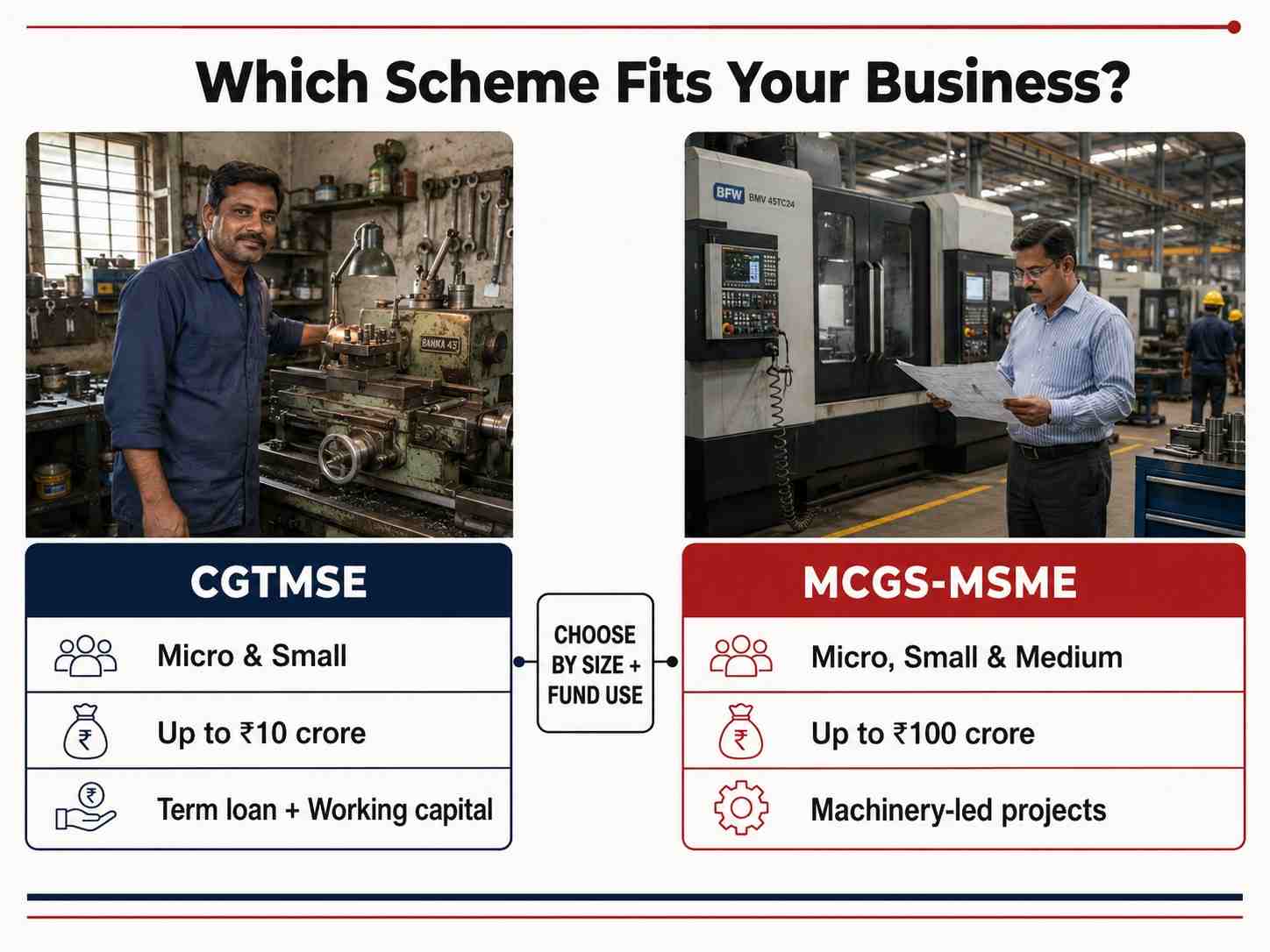
The CGTMSE vs MCGS-MSME loan limit is one of the most visible differences, but it is not the only decision point. The CGTMSE loan limit for covered eligible facilities is ₹10 crore, while the standard MCGS-MSME loan limit is ₹100 crore. A ₹4 crore machinery proposal by a small enterprise might potentially fit either framework. The correct choice depends on the complete funding mix, eligible purpose, required working capital, available security, guarantee cost and the lender’s product.
Who is Eligible Under Each Scheme?
The eligibility under each scheme is as follows:
Official CGTMSE loan eligibility
The CGTMSE eligible-borrower guidance covers new and existing micro and small enterprises engaged in eligible manufacturing or service activity, subject to exclusions and current scheme provisions. Retail and wholesale trade have also been aligned under current credit-facility rules. Agriculture, SHGs and JLGs are among the exclusions identified in the published borrower guidance.
A valid Udyam Registration Number is mandatory for new applications and should be created only through the official Udyam portal. The enterprise must remain within the applicable MSE classification for the relevant scheme treatment. From 1 April 2025, the official revised MSME classification uses both investment and turnover:
| Category | Investment ceiling | Turnover ceiling |
| Micro | ₹2.5 crore | ₹10 crore |
| Small | ₹25 crore | ₹100 crore |
| Medium | ₹125 crore | ₹500 crore |
Both limits apply to classification. An enterprise exceeding either applicable ceiling moves to the next category, subject to the official rules. Before applying, verify that PAN, activity and classification details are consistent through the Udyam Registration process.
Official MCGS-MSME eligibility
MCGS-MSME can cover an eligible micro, small or medium enterprise with a valid Udyam Registration Number. The facility must support a qualifying project in which machinery or equipment represents at least 60% of project cost under the modified framework. The account must meet the scheme’s performance and status conditions; an existing NPA cannot be converted into an eligible fresh guaranteed facility merely by naming the scheme.
The 2026 revision brought eligible service-sector MSMEs into the framework. This matters for businesses investing heavily in equipment, such as diagnostic, logistics, technical, hospitality or other service operations, provided their project and activity satisfy the operational guidelines. Service-sector inclusion does not turn ordinary operating expenses into eligible machinery cost.
Special exporter treatment is narrower. The official modification describes profitable units that exported at least 25% of sales turnover in each of the previous three financial years and meet export-realisation conditions. These units may receive 75% guarantee cover for an eligible guaranteed loan up to ₹20 crore, with a 2% upfront contribution capped at ₹40 lakh, nil guarantee fee in year one and 0.50% annually on outstanding thereafter.
Lender-specific appraisal applies to both
Official eligibility only allows the lender to consider guarantee cover. It does not prescribe one universal minimum credit score, turnover, vintage, debt-service ratio or promoter margin for every borrower.
Lenders commonly assess:
- promoter experience, ownership and integrity;
- business and promoter credit history;
- existing loans, guarantees and contingent liabilities;
- audited and current financial performance;
- bank-account conduct and tax-return consistency;
- project feasibility, supplier credibility and implementation risk;
- promoter contribution and its verified source;
- cash flow available for instalments;
- licences, approvals and environmental or sector compliance; and
- primary and collateral security where relevant.
A business can strengthen this part of the file by maintaining consistent small-business accounts and resolving unexplained differences between financial statements, bank credits, GST returns and ITRs.
What Can Each Scheme Finance?
CGTMSE is functionally broader. It may support a standalone term loan, a standalone working-capital facility, a composite structure or eligible non-fund facilities. This makes it relevant when a small unit needs machinery plus inventory, receivables finance or a contractual bank guarantee within the eligible ceiling.
Use should still be supported by evidence. A fixed asset should normally be matched with a suitable business term-loan structure, while inventory and receivables should be assessed through a working-capital requirement calculation. Combining both without calculating the operating cycle can leave a new machine installed but unused because no funds remain for stock and wages.
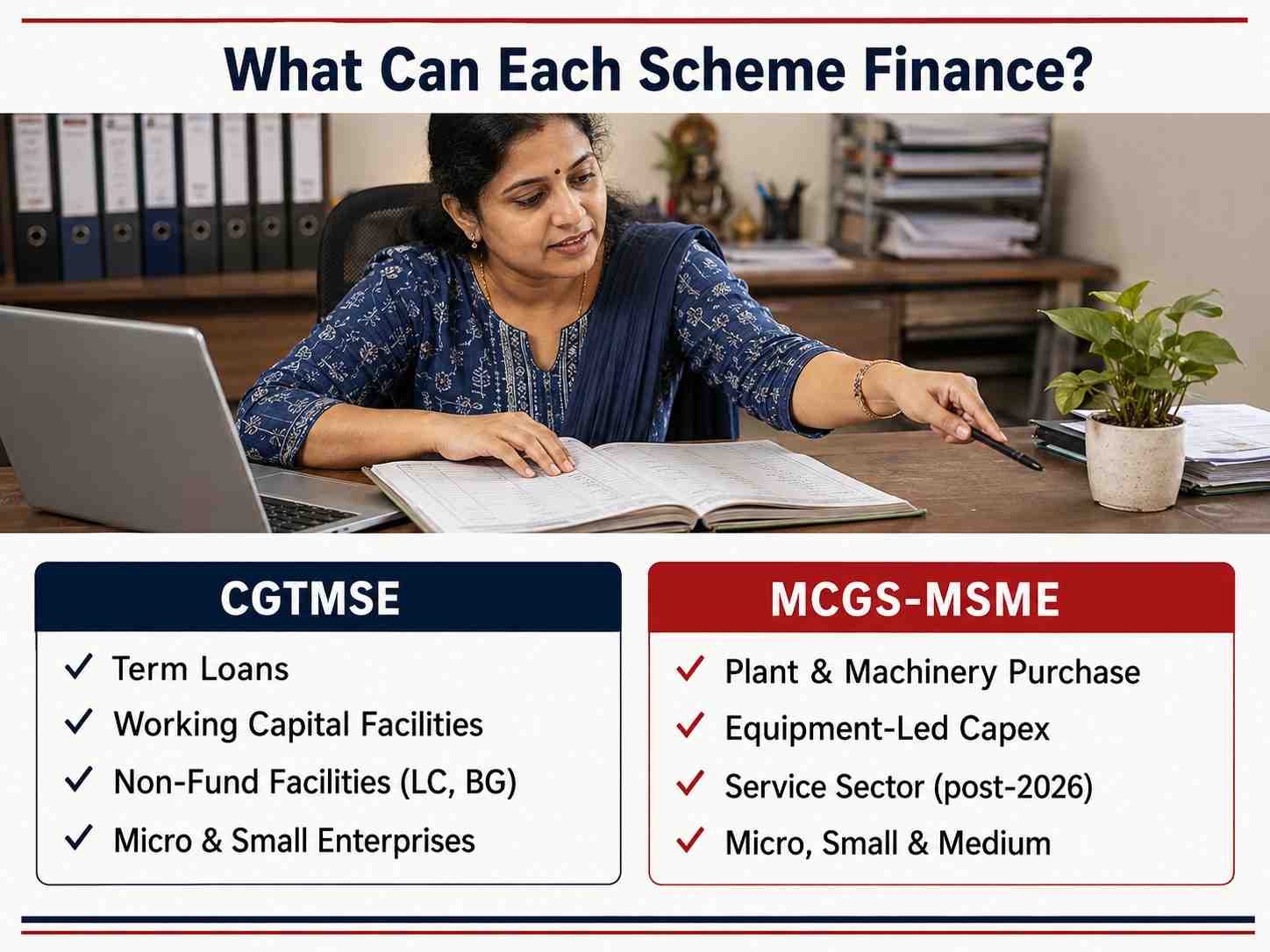
MCGS-MSME is capex-led. Typical qualifying expenditure can include plant, production lines, processing equipment, specialised service equipment, machinery modernisation or additional capacity.
An MCGS-MSME machinery purchase loan must satisfy the 60% project-cost threshold, and the lender will examine supplier quotations, technical suitability, installation, capacity, demand and repayment. In practical terms, any machinery loan for MSME use must still be supported by viable cash flow and verifiable end use.
The remaining part of project cost may include eligible supporting expenditure under the operational guidelines, but businesses should not assume that land, old debt, general overheads or every civil cost will be accepted. Obtain the MLI’s written cost eligibility before finalising the funding plan.
How do Guarantee Cover and Costs Compare?
CGTMSE guarantee cover
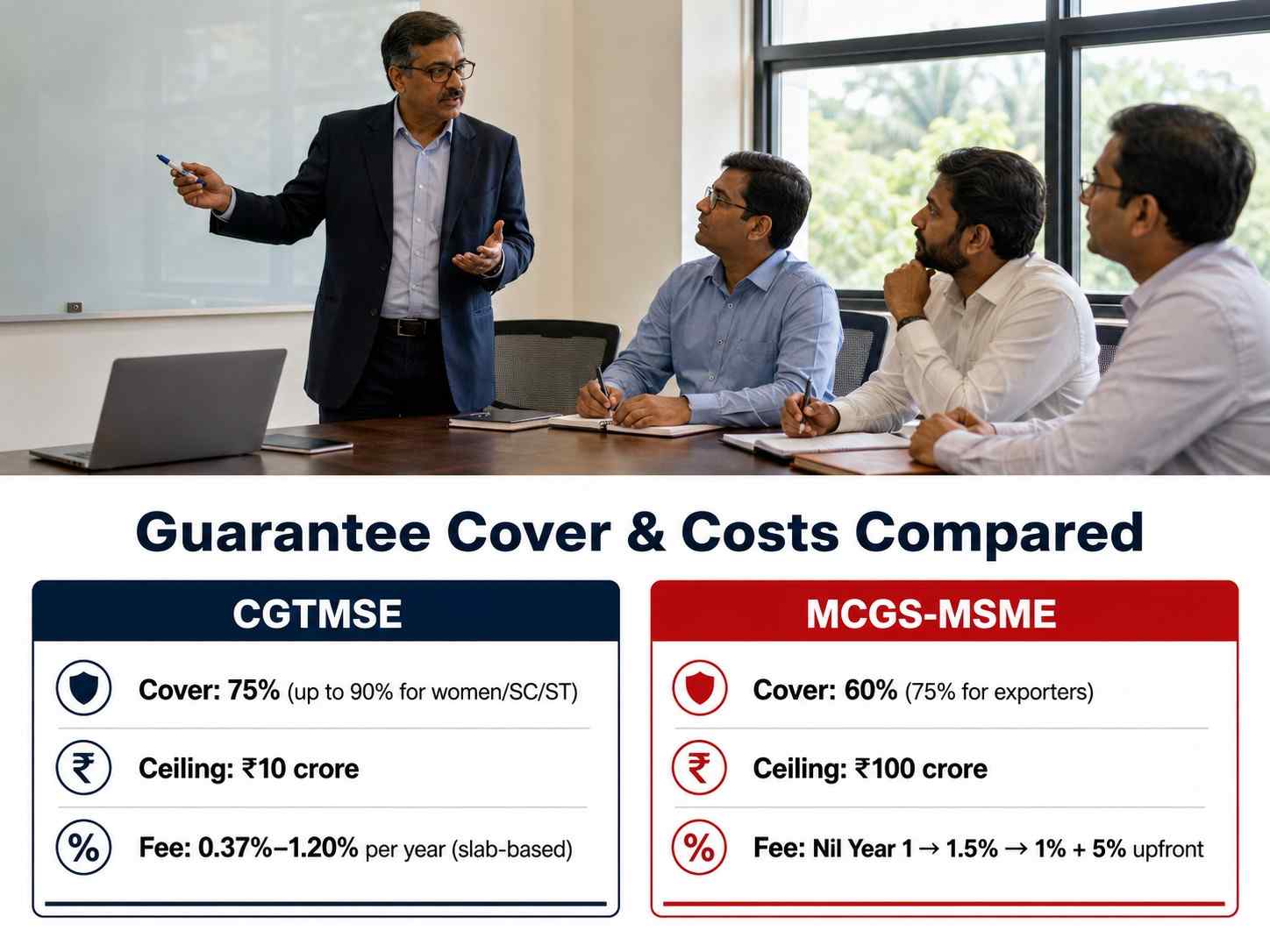
Standard CGTMSE credit guarantee cover is generally 75% of the eligible amount in default. The updated CGS-I scheme document provides higher coverage for specified categories. Women-led enterprises can receive up to 90% under the official enhancement circular; micro enterprises for facilities up to ₹5 lakh can receive 85%; and certain SC/ST, PwD, Agniveer-promoted, aspirational-district and ZED-certified enterprises may receive up to 85%, subject to the current category conditions.
These percentages are not a discount on the borrower’s debt. If a business defaults, the lender must follow the scheme’s claim and recovery process. Even after a claim is paid, the lender continues recovery and the borrower remains responsible for the full outstanding debt under the loan documents.
The CGTMSE fee structure effective for guarantees approved or renewed on or after 1 April 2025 sets standard annual rates by slab:
| Eligible credit slab | Standard annual guarantee fee |
| Up to ₹10 lakh | 0.37% |
| Above ₹10 lakh to ₹50 lakh | 0.55% |
| Above ₹50 lakh to ₹1 crore | 0.60% |
| Above ₹1 crore to ₹2 crore | 0.85% |
| Above ₹2 crore to ₹5 crore | 1.00% |
| Above ₹5 crore to ₹8 crore | 1.10% |
| Above ₹8 crore to ₹10 crore | 1.20% |
The CGTMSE guarantee fee framework permits MLI-level risk pricing and category concessions. The MLI decides whether to bear the fee or pass it to the borrower, so applicants should ask for the actual rupee cost in the sanction terms rather than applying the standard table mechanically.
MCGS-MSME guarantee cover and contribution
The standard MCGS-MSME guarantee coverage is 60% of the eligible amount in default. A 5% upfront contribution applies to the standard route, subject to the scheme’s calculation rules and cap. Following the 2026 modification, this amount is refundable at 1% each year from the fourth year onwards, subject to satisfactory performance of the loan account.
The upfront contribution is not automatically the same as promoter contribution or margin. The lender may separately require the promoter to fund part of the project cost. Current MLI implementation disclosures should be reviewed for annual fee treatment after the first year, calculation on outstanding and treatment of collateral.
Compare total cost, not one fee
For either scheme, calculate:
- interest under the stated benchmark and spread;
- processing, documentation and legal expenses;
- guarantee fee or upfront contribution;
- valuation, insurance and security-creation costs;
- promoter margin and working-capital contribution;
- tax on applicable charges;
- prepayment and penal-charge provisions; and
- cash cost during any principal moratorium.
A moratorium usually delays principal; it does not necessarily stop interest. A larger guarantee percentage can reduce lender loss exposure but does not necessarily produce a lower interest rate or smaller EMI.
Is Collateral Required?
The label “collateral-free MSME loan” does not mean unsecured in every legal or operational sense. The lender may still hold primary security over assets financed, require contractual covenants and, where a scheme permits, structure partial or hybrid security.
Three terms must be separated:
- Primary security: assets created from the loan or directly connected with the financed business, such as the machinery purchased.
- Collateral security: additional property or assets offered beyond the primary financed assets.
- Personal or third-party guarantee: a contractual promise by a promoter or another person, distinct from an asset charge.
Standard CGTMSE is designed for eligible credit without collateral security or a third-party guarantee. Under hybrid security, the lender may take collateral for one part and obtain CGTMSE cover for the eligible unsecured part, up to the applicable ceiling. Primary security can still be created.

MCGS-MSME also focuses on reducing dependence on collateral for eligible machinery finance. However, where collateral is obtained, current scheme implementation applies guarantee treatment to the eligible amount after accounting for collateral value. The machinery created from finance remains primary security, and charge creation can be necessary.
For a company, a charge over financed assets can trigger ROC filing duties. Review the registration of charges process before disbursement conditions expire. If a proposal instead relies on existing immovable property, compare the commercial and enforcement implications of a loan against property rather than assuming a guarantee route is always cheaper.
What Documents Are Required?
Below is the list of documents required:
Common documents for both routes
| Document group | Common records |
| Promoter and authorised signatory | PAN, permitted identity and address proof, photographs, bureau-consent forms |
| Entity constitution | Incorporation certificate, partnership deed, LLP agreement, memorandum and articles, registrations |
| Authority to borrow | Board or partner resolution, authorised-signatory proof and borrowing powers |
| MSME status | Current Udyam Registration certificate and classification details |
| Tax compliance | ITRs, computations, GST returns and reconciliations, where applicable |
| Financial records | Audited statements, schedules, cash flows and current provisional results |
| Banking and debt | Bank statements, sanction letters, repayment schedules, outstanding certificates and contingent liabilities |
| Proposal | Application, purpose note, project report, projected statements and repayment calculation |
| Compliance | Sector licences, environmental approvals, land or lease records and insurance information |
Keep GST turnover, ITR income, audited sales and bank credits reconcilable. Where registration is required, organise the GST registration and records and income-tax filing documents before the application reaches credit appraisal. Validate return status through the official GST portal and Income Tax e-Filing portal rather than relying on an unofficial screenshot.
Documents required for CGTMSE loan appraisal
- working-capital assessment, stock and receivable statements where a cash-credit facility is requested;
- order book or contracts supporting business demand;
- term-loan quotations and asset details;
- category evidence for any enhanced cover or fee concession;
- statement of collateral, if hybrid security is proposed; and
- declarations required by the MLI for guarantee registration.
Documents required for MCGS-MSME appraisal
- itemised project cost and means of finance;
- machinery or equipment quotations from verifiable suppliers;
- calculation proving the minimum 60% equipment share;
- technical specifications, capacity and installation schedule;
- site ownership or lease evidence and implementation approvals;
- promoter contribution and source-of-funds proof;
- projected profitability, cash flow and debt-service analysis;
- exporter turnover and realisation evidence where the special exporter provision is claimed; and
- account-status and existing-lender declarations required under the guidelines.
Large equipment projects may require independent technical or financial review. A structured financial due-diligence exercise can identify hidden debt, unresolved tax matters or unsupported assumptions before submission.
A lender may also commission its own asset valuation, even if the applicant already has a professional valuation report.
How to Apply for MSME Credit Guarantee Scheme Support
Below is the step-by-step process for how to apply for MSME Guarantee Scheme Support:
Step 1: Define the exact funding purpose
Separate machinery, installation, building, other fixed assets and working capital. If machinery or equipment is below 60% of project cost, the standard MCGS-MSME route may not fit, even if the total requirement is large.
Step 2: Confirm MSME classification
Check investment and turnover under current classification and ensure Udyam details match PAN and activity. A medium enterprise should not prepare a standard CGTMSE application because the principal CGTMSE scheme is for micro and small enterprises.
Step 3: Prepare realistic project financials
Build project cost from quotations, show promoter funds, identify the proposed facility and estimate working capital separately. Forecast commissioning, utilisation, sales, margins, taxes and instalments under conservative assumptions. For a complex proposal, virtual CFO funding-readiness support can help organise cash-flow assumptions and financial records.
Step 4: Approach a registered MLI
Use the official CGTMSE or NCGTC list, then confirm that the selected branch or lending team handles the required scheme and facility size. A borrower does not submit a guarantee request directly to the trust. RBI’s MSME lending guidance should be read separately from scheme rules because regulatory directions and a lender’s guarantee registration perform different functions.
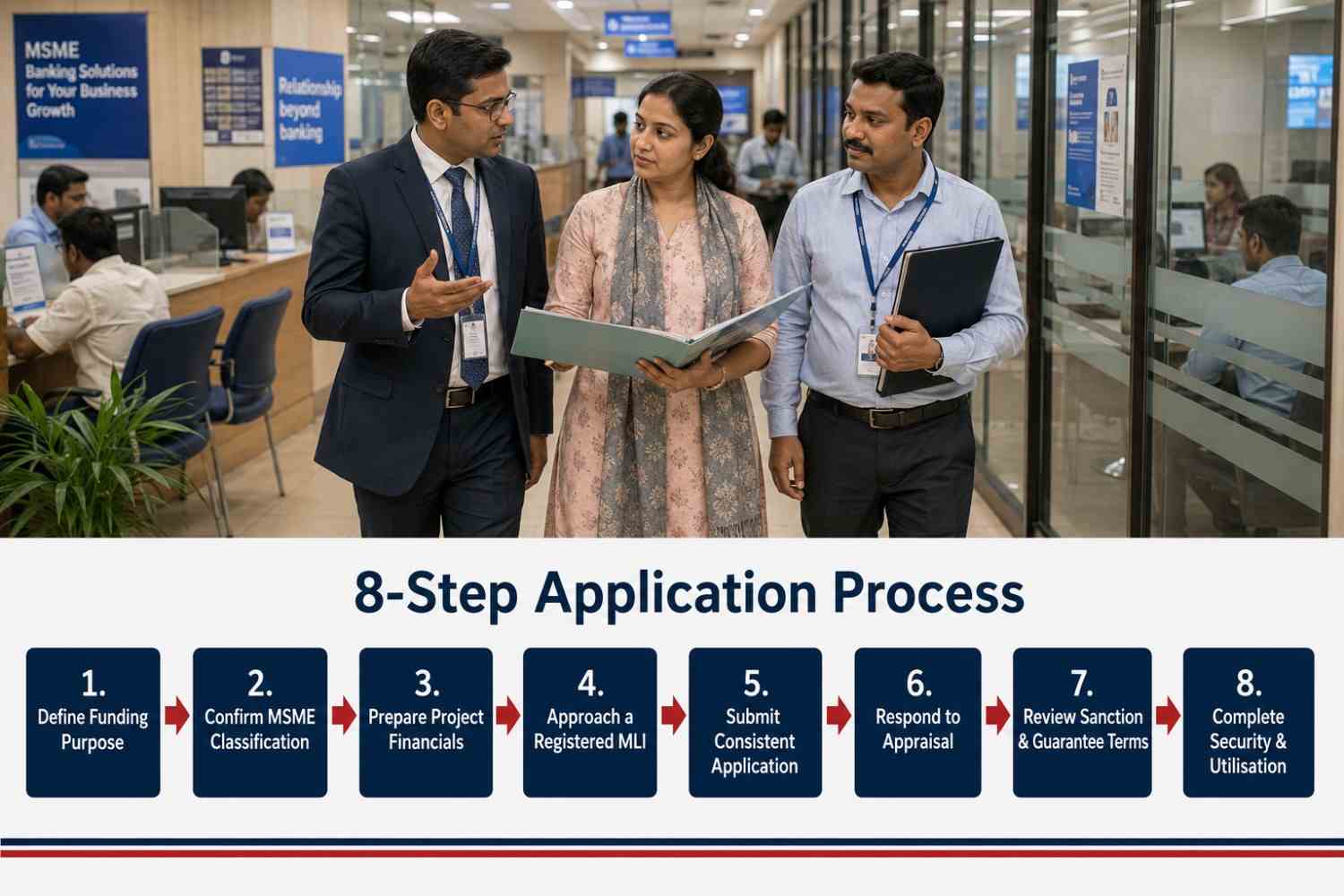
Step 5: Submit a consistent application
Provide the application, KYC, entity records, Udyam certificate, tax returns, financials, bank statements, debt schedule, project report, quotations and scheme-specific evidence. Retain an acknowledgement and list of submitted documents.
Step 6: Respond to appraisal
The lender may conduct site visits, supplier checks, bureau enquiries, legal review, technical appraisal and stress testing. Explain one-off losses, related-party entries, unusual bank deposits and changes in turnover with evidence.
Step 7: Review sanction and guarantee terms
Check the amount, end use, interest benchmark, margin, repayment, moratorium, guarantee fee, contribution, security, covenants, insurance, prepayment and conditions precedent. A sanction letter is not disbursement; every pre-disbursement requirement must still be completed.
Step 8: Complete security and utilisation requirements
Bring the promoter contribution, execute documents, create the required charge and submit invoices. Machinery payments may go directly to suppliers or be released in stages. Preserve utilisation evidence and asset insurance throughout the required period.
Which Scheme Should Your Business Choose?
Below are the business situation and their supporting scheme:
| Business situation | More relevant starting route | Reason |
| Micro unit needs ₹35 lakh for inventory and receivables | CGTMSE | Standalone eligible working-capital finance can be covered |
| Small manufacturer needs ₹4 crore for machinery plus working capital | Compare both | CGTMSE is broader; MCGS-MSME may fit if equipment is at least 60% of project cost |
| Medium manufacturer needs ₹45 crore for a new production line | MCGS-MSME | Medium enterprises are included and the purpose is machinery-led capex |
| Service MSME needs ₹12 crore for specialised equipment | MCGS-MSME may fit | Eligible services were included in 2026; verify the 60% equipment test |
| Small contractor needs a bank guarantee and cash-credit line | CGTMSE may fit | Eligible non-fund and working-capital facilities can be considered |
| Business needs funds mainly for land and general construction | Neither automatically | MCGS equipment test may fail; CGTMSE and lender end-use rules still apply |
| Profitable exporter meeting three-year export tests needs ₹18 crore machinery finance | MCGS-MSME exporter provision | Special up-to-₹20-crore route provides 75% cover subject to export conditions |
| Small business can provide property and wants flexible end use | Compare secured alternatives | A secured business facility may offer a different cost or purpose structure |
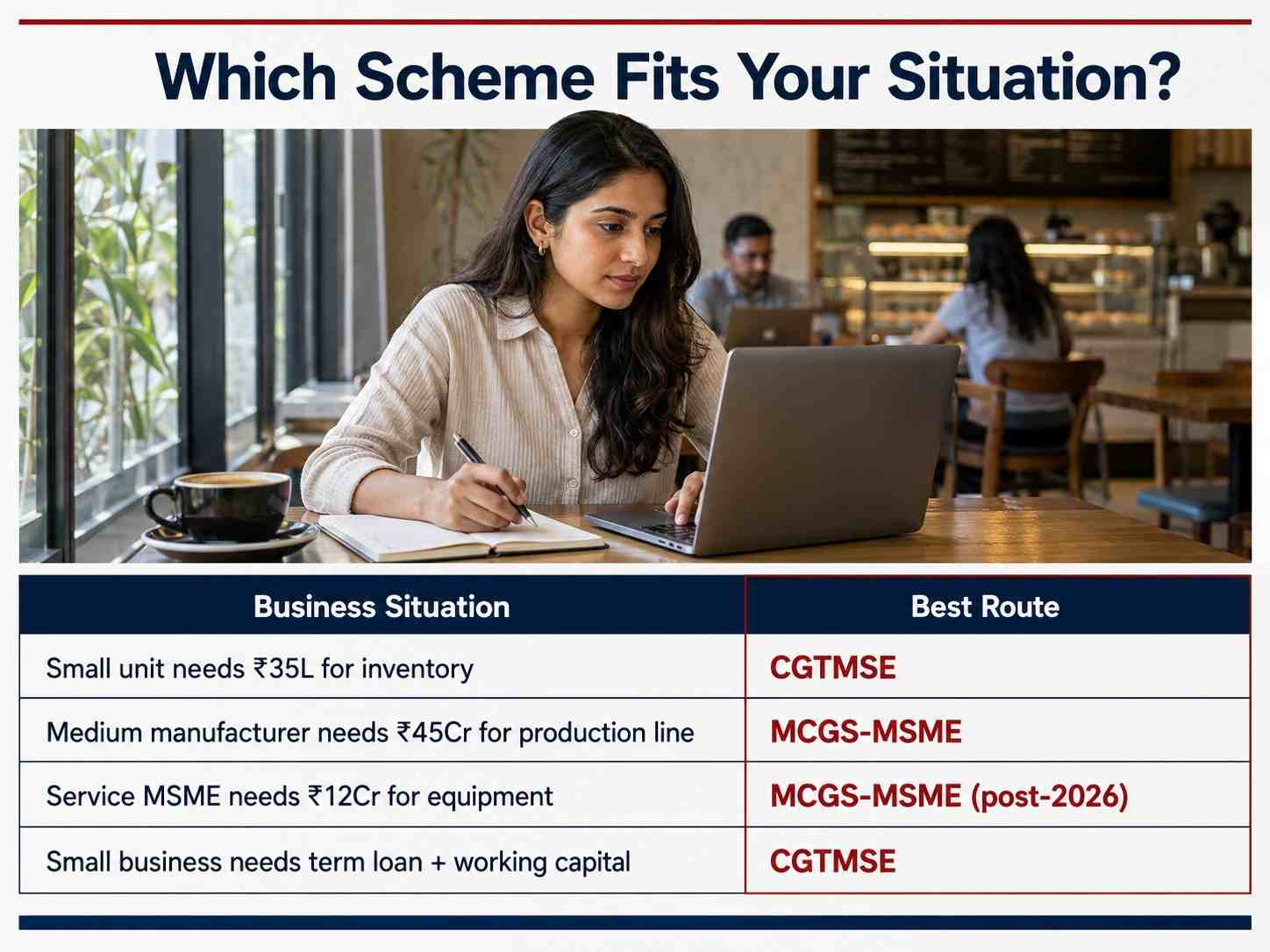
The best choice is the facility that finances the real need with affordable repayment, not the scheme with the largest headline limit. A government credit guarantee scheme reduces part of the lender’s eligible risk; it does not make unsuitable debt affordable. Use a general business-loan preparation guide to compare the complete sanction terms, and review bank-guarantee requirements separately if the proposal includes contractual non-fund exposure.
What Mistakes Should Applicants Avoid?
- Treating guarantee cover as a subsidy: the guarantee primarily protects the lender and does not reduce the principal owed.
- Using the wrong enterprise category: a medium enterprise cannot use standard CGTMSE simply because it was small in an older financial year.
- Ignoring the 60% equipment test: MCGS-MSME is not a general-purpose ₹100 crore loan.
- Confusing the 5% contribution with lender margin: both can affect cash required, and they are not automatically interchangeable.
- Submitting inconsistent records: differences among GST, ITR, accounts and bank credits generate appraisal queries.
- Underfunding working capital: machinery may be eligible, but the project can still fail without raw material, salaries and receivable funding.
- Assuming “collateral-free” means no security documents: primary-security and charge-creation requirements can remain.
- Relying on old scheme limits: many pages still describe a ₹5 crore CGTMSE ceiling or the pre-modification 75% MCGS project-cost test.
- Overstating projected sales: lender stress tests can expose unrealistic utilisation, margin or collection assumptions.
- Applying through an unverified intermediary: use the MLI’s branch or official digital channel and never pay for a promised guaranteed sanction.
What Happens After Sanction?
The lender completes guarantee registration and payment formalities; the borrower usually does not operate the CGTMSE or NCGTC portal. The business must satisfy margin, documentation, insurance, supplier-payment and security conditions before disbursement.
After disbursement, funds must be used for the sanctioned purpose. Maintain invoices, asset records, installation evidence, stock statements and financial reporting required by the lender. Any material change in project cost, ownership, activity or implementation should be disclosed before it affects scheme eligibility or covenants.
Guarantee cover does not prevent an account from being classified as NPA. On default, the lender may enforce security, invoke guarantees and pursue recovery under the loan documents and applicable law. CGTMSE’s published claim guidance confirms that lender recovery duties continue even after a guarantee claim is settled.
Conclusion
The practical answer to CGTMSE vs MCGS-MSME depends on four questions: is the enterprise micro, small or medium; is the need working capital or capex; does machinery or equipment form at least 60% of project cost; and can the business service the full debt after fees and promoter funding?
CGTMSE generally suits eligible micro and small enterprises needing a wider range of facilities up to the scheme ceiling. MCGS-MSME is the stronger starting point for eligible machinery-heavy projects, especially larger requirements and medium enterprises. The 2026 service-sector and exporter provisions widen its relevance, but they do not remove lender appraisal.
Before choosing between the CGTMSE and Mutual Credit Guarantee Scheme, verify the latest operational guidelines, approach a registered MLI and compare the complete sanction—not only the guarantee percentage. A consistent project report, reconciled records and realistic cash flow cannot assure approval, but they allow the lender and the business to evaluate the proposal on evidence.
FAQs About CGTMSE vs MCGS-MSME
What is the main difference between CGTMSE and MCGS-MSME?
The main difference between CGTMSE and MCGS-MSME is their scope. CGTMSE supports a wider range of eligible credit for micro and small enterprises, while MCGS-MSME focuses on machinery or equipment-led projects for micro, small and medium enterprises. The appropriate route depends on enterprise classification, end use, facility amount and project composition.
Which scheme has the higher loan limit?
MCGS-MSME supports eligible guaranteed loans up to ₹100 crore under the standard framework, while CGTMSE covers eligible credit facilities up to ₹10 crore per borrower. These are guarantee-scheme ceilings, not promised sanctions. A lender may approve less, reject the proposal or require a different structure after appraisal.
Can medium enterprises apply for CGTMSE?
The standard CGTMSE scheme discussed here is for eligible micro and small enterprises, not medium enterprises. An eligible medium enterprise can consider MCGS-MSME for a qualifying machinery or equipment project. It must still hold valid Udyam Registration and satisfy the scheme and lender’s credit conditions.
Is MCGS-MSME available to service businesses?
Yes, the March 2026 modification included eligible service-sector MSMEs. The project must still meet the machinery or equipment requirement, including the minimum 60% share of project cost under the modified rules. Ordinary salary, marketing or general operating needs do not become eligible equipment expenditure merely because the borrower is a service business.
Does either scheme guarantee loan approval?
No. CGTMSE and NCGTC provide risk cover to registered lenders; they do not replace the lender’s appraisal or direct the lender to sanction a particular amount. The borrower must demonstrate eligibility, viability, satisfactory credit conduct, promoter funding and repayment capacity.
Is a loan under either scheme completely collateral-free?
Standard CGTMSE is structured around eligible credit without collateral or a third-party guarantee, although hybrid security can cover an unsecured portion. MCGS-MSME is also intended to reduce dependence on collateral, but primary security over financed machinery remains relevant and any collateral taken can affect the eligible guaranteed amount. Always read the sanction letter’s definitions of primary security, collateral and guarantees.
What is the 5% upfront contribution under MCGS-MSME?
It is a scheme contribution associated with standard MCGS-MSME guarantee cover, subject to the operational calculation rules and cap. Following the 2026 change, it is refundable at 1% each year from the fourth year onwards if the loan account performs satisfactorily and other conditions are met. It should not be confused with the separate promoter margin that a lender may require for the project.
Can CGTMSE cover working capital while MCGS-MSME covers machinery?
CGTMSE can cover an eligible standalone working-capital facility, term loan or combination within its rules. MCGS-MSME is designed principally for qualifying machinery or equipment-led term assistance. A project needing both may require one integrated lender structure, parallel facilities or selection of the route that best fits the total proposal.
Can a borrower apply directly to CGTMSE or NCGTC?
No, the borrower approaches a registered Member Lending Institution. The lender appraises and sanctions the credit, then applies for eligible guarantee cover through the relevant system. Businesses should verify the MLI list on the official scheme website before relying on an intermediary’s claim.
Which MSME credit guarantee scheme is better for a small machinery project?
There is no universal winner in CGTMSE vs MCGS-MSME. A small enterprise with a machinery-heavy project may potentially fit both, but CGTMSE may offer a broader facility mix while MCGS-MSME applies a specific equipment-led structure and contribution model. Compare total cost, working-capital need, guarantee terms, collateral treatment, tenure and the lender’s sanction conditions.
You may also like


Can PAIMA Membership Expand Your Global Moving Network?
PAIMA membership can help an established Indian moving company build relationsh