Copyright Objection in India: What It Means and How to Reply
A copyright objection is a notice from the Copyright Office raising a concern about your application, either from a third party who disputes your claim within the mandatory 30-day window, or from the examiner over an incomplete application. You get 30 days to reply. Miss it, and your application gets rejected.
What Is a Copyright Objection?
A copyright objection is a formal notice telling you that your copyright application will not sail through to registration without some pushback first. It shows up after you file, while your application sits in the Copyright Office's queue, and it needs a proper written response before the Registrar of Copyrights will move your file forward.
Copyright registration itself runs under Chapter X of the Copyright Act, 1957 and the Copyright Rules, 2013, administered from a single Copyright Office based in Delhi rather than the regional structure you might be used to from other IP filings. This guide sits inside LegalBabu's Intellectual Property services, alongside copyright registration itself, and it picks up right where a completed application meets its first real checkpoint.
Why Do Copyright Objections Actually Come in Two Different Forms?
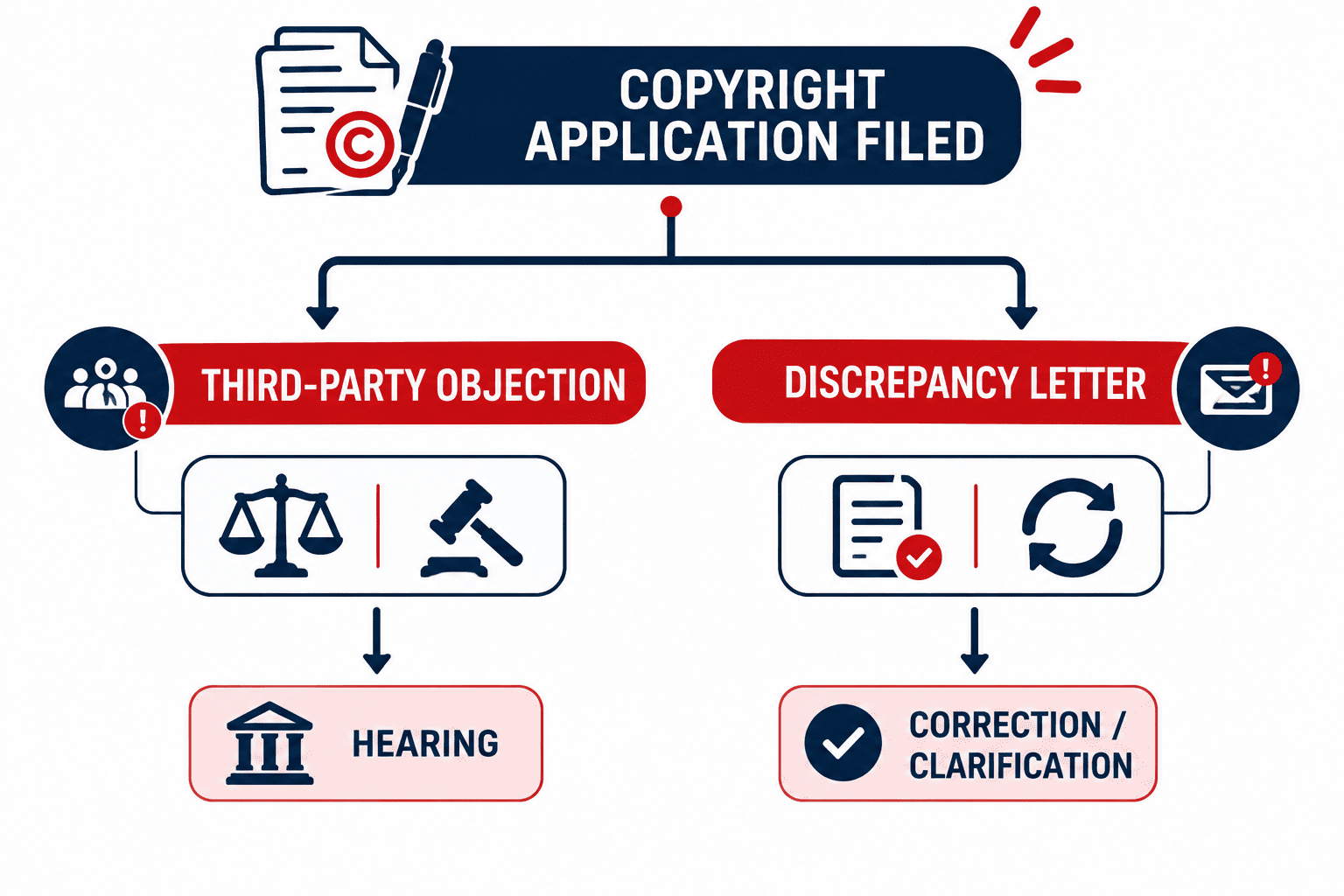
This is the part most guides on this topic get muddled, and it genuinely changes how you should respond. A copyright objection is not one single thing. It is either a third-party objection or a discrepancy letter, and the two run on completely different logic.
A third-party objection comes from someone else entirely, a person who claims rights over your work or disputes that you are the rightful applicant. A discrepancy letter comes from the Copyright Office's own examiner, flagging something incomplete or incorrect in your paperwork rather than a rival claim. Treating both the same way, which is an easy mistake to make since both arrive as a letter demanding a response, means missing that one of them is adversarial and the other is administrative.
|
Point |
Third-Party Objection |
Discrepancy Letter |
|
Raised by |
Another person disputing your claim |
The Copyright Office's own examiner |
|
Trigger |
Filed within the 30-day window after your application is received |
Found during the examiner's review of your paperwork |
|
Governed by |
Rule 70(9) to 70(12), Copyright Rules, 2013 |
Rule 70(10), Copyright Rules, 2013 |
|
How it resolves |
A hearing where both sides present their case |
You correct or clarify the application yourself |
|
Who you're arguing against |
The objector |
The Registrar's own examiner |
Why Would Someone File a Third-Party Objection Against Your Copyright Application?
Anyone who claims an interest in your work, or disputes that you actually own it, can file an objection within 30 days of your application being received. A former collaborator claiming joint authorship, a previous employer arguing the work was created during employment, or a rights holder claiming your work copies theirs, all fit this category.
There is a detail here that catches applicants off guard. Rule 70(9) actually places an obligation on you, the applicant, to notify anyone who might reasonably claim an interest in the work before you file. Skipping that notice does not just risk an objection later; it has genuinely led to registrations being challenged in court after the fact, specifically because the rightful notice was never sent in the first place. If you co-created a work, or if there is any question about who commissioned it, sorting that out honestly before you file saves a far messier fight afterward.
What Counts as a Discrepancy in a Copyright Application?
Discrepancies are the Copyright Office's own quality check, and they show up more often than genuine third-party disputes.
-
Missing or incomplete Statement of Particulars, the core details describing your work
-
No NOC from a co-author or previous rights holder, when the applicant and the original creator are not the same person
-
Missing trademark clearance, specifically for artistic works meant for use in trade, such as logos and labels, which is its own requirement covered in detail below
-
Missing design affidavit, if the work could arguably be registered as an industrial design instead, confirming it has not been applied to more than 50 articles
-
Originality concerns, where the examiner questions whether the work reflects genuine skill and judgment rather than simply copying or minimal effort
That last point traces back to a well-known Supreme Court standard. In Eastern Book Company v D.B. Modak (2008), the Court held that copyright originality requires real skill and judgment on the creator's part, not just labour or effort alone. An examiner leaning on that standard is not being difficult; they are applying settled law.
How Long Do You Have to Respond?
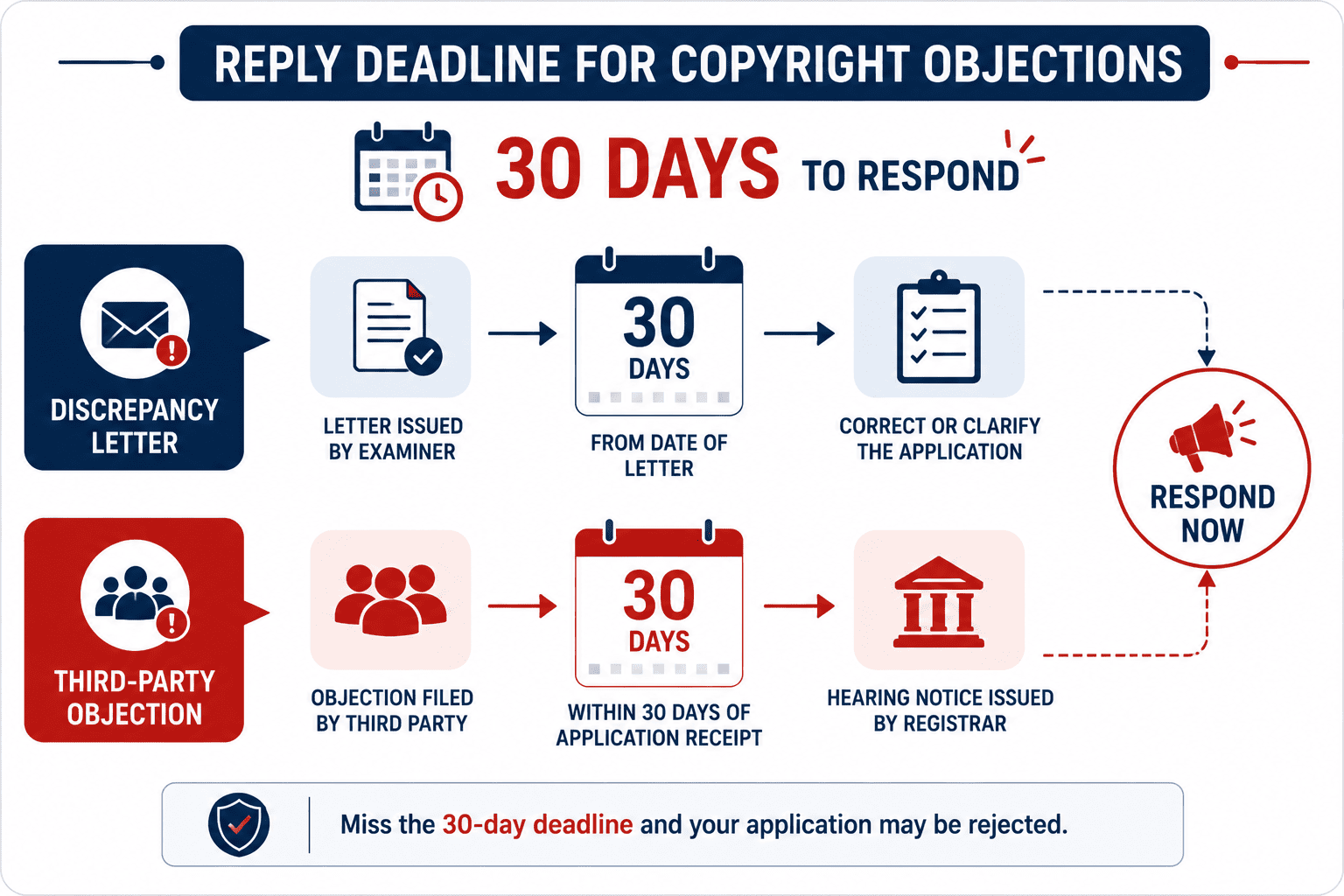
Thirty days, in both tracks, though the clock starts from a slightly different point depending on which one you are dealing with. For a discrepancy letter, you generally have 30 days from the date the Office issues it. For a third-party objection, the Registrar sets a hearing date and notifies both sides directly, so your window is fixed by that notice rather than a blanket 30-day rule from the original filing.
Missing either deadline puts your application at real risk. An unanswered discrepancy commonly results in the application being marked rejected outright, and an unanswered objection lets the Registrar proceed to a decision without your side of the story ever being heard.
What Happens If a Hearing Gets Scheduled?
Third-party objections get a hearing, not just an exchange of letters. Under Rule 70(11) and 70(12) of the Copyright Rules, 2013, the Registrar notifies both you and the objector, and each side gets a genuine opportunity to make their case before any decision is made. The Registrar cannot simply reject your application without giving you that chance to be heard first.
Since the Copyright Office operates as a single, centralised office in Delhi rather than through regional branches, these hearings, and any later court appeal, tend to concentrate there too. This is worth knowing if you are used to how trademark matters work, where hearings happen at one of five regional Registry offices depending on your location. Copyright does not follow that same regional structure.
After the hearing, the Registrar has three options: register the work exactly as applied for, register it with modified particulars, or reject the application outright. A modified registration, similar to a conditional acceptance in trademark matters, is often a perfectly workable outcome rather than something to fight against on principle.
What Documents Do You Need to Reply to a Copyright Objection?
-
Copy of your original application and Diary Number
-
Copy of the objection or discrepancy letter itself
-
Evidence of originality and ownership, such as drafts, source files, or dated records showing your creative process
-
NOC from any co-author or previous rights holder, if applicable
-
Assignment deed, if ownership passed to you from someone else
-
Power of attorney, if an agent or lawyer is filing on your behalf
-
Trademark clearance certificate, specifically if the work is a logo or label intended for trade use
Not every reply needs every item here. A discrepancy over a missing signature needs a fraction of what a genuine ownership dispute with a former business partner requires, so match your evidence to the actual concern raised rather than sending everything at once.
How Do You Draft and File Your Reply?
-
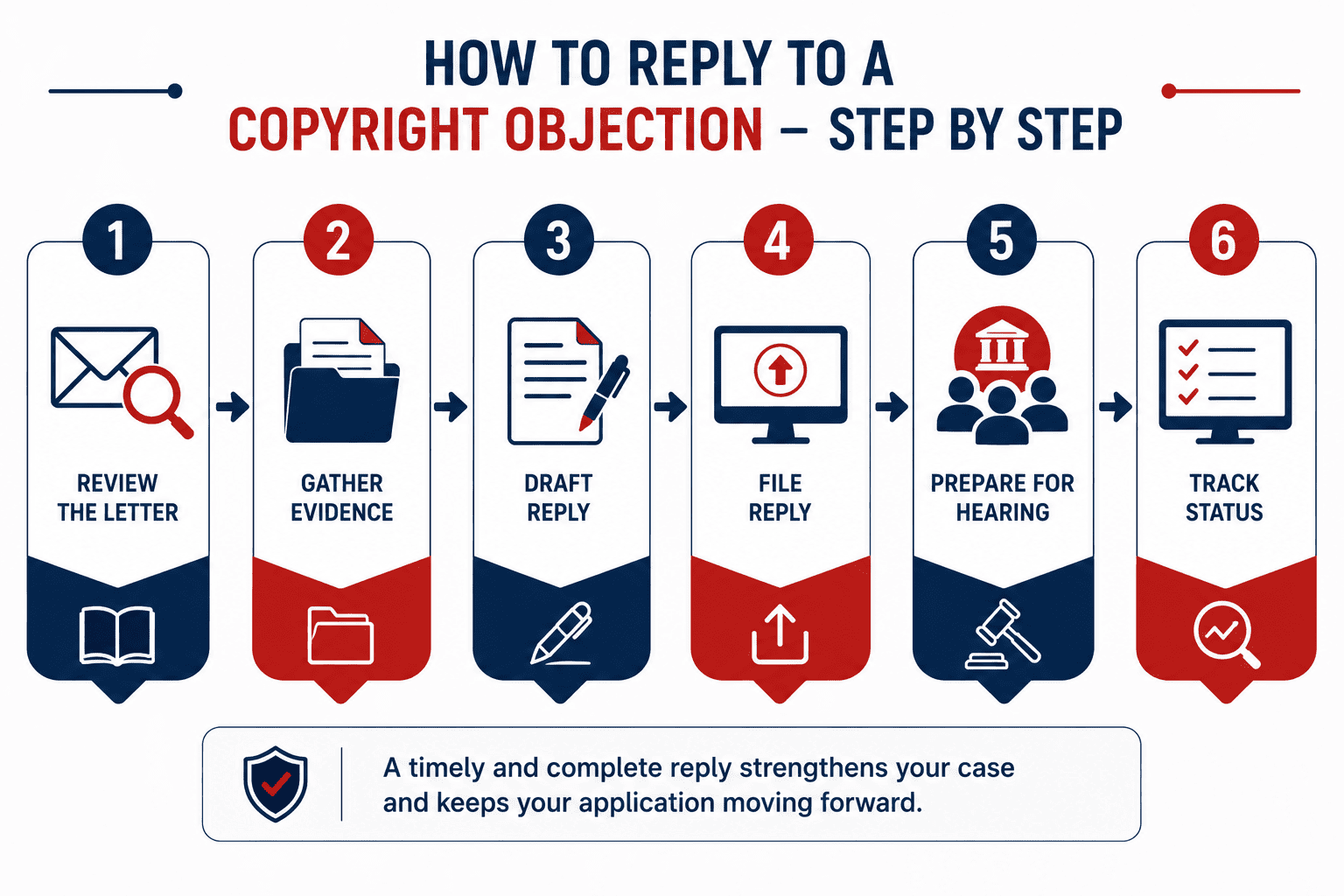
Read the letter carefully. Work out whether you are dealing with a third-party objection or a discrepancy letter, since your entire approach depends on that distinction.
-
Gather your evidence. Pull together proof of originality, ownership records, and any NOCs before you start writing, so your reply reads as a complete argument.
-
Draft a point-by-point response. Address each specific concern the letter raises, referencing the relevant rule or section where it helps your case.
-
File through the Copyright Office. Submit your reply via the Copyright Office portal against your existing Diary Number, within the deadline set for your specific letter.
-
Prepare for a hearing if one is scheduled. This applies mainly to third-party objections; have your documents organised and ready to present in person or through a representative.
-
Track your application status. Keep an eye on your Diary Number until the Registrar confirms whether your particulars have been entered in the Register of Copyrights.
What If Your Work Is a Logo or Label Meant for Business Use?
This is a requirement a lot of first-time applicants never see coming. Under the proviso to Section 45(1) of the Copyright Act, artistic works meant for use in trade, think logos, product labels, and packaging design, need a certificate from the Registrar of Trade Marks confirming that no identical or deceptively similar mark already exists in someone else's name before the copyright application can proceed.
In practice, this means your logo often needs to clear a trademark check even if you never intended to register it as a trademark at all. If you are filing for both, it is worth handling your trademark registration search early, since a properly documented trademark clearance can prevent this exact discrepancy from holding up your copyright application later. Getting an Expert Trademark Review done on your logo before you file either application tends to save a second round of paperwork on both fronts.
What Happens If the Registrar Rejects Your Application After the Hearing?
You can appeal, and this is another area where a lot of information floating around online, including on some government pages themselves, has not caught up with a real change. Section 72 of the Copyright Act gives you three months from the date of the Registrar's order to appeal.
For years, that appeal went to the Intellectual Property Appellate Board. The IPAB was abolished in 2021 under the Tribunals Reforms Act, and its powers moved to the Commercial Courts, a division of the High Courts. Since the Copyright Office itself sits only in Delhi, appeals against its decisions generally end up before the Delhi High Court, which has set up a dedicated Intellectual Property Division specifically to handle matters like this one. If you come across a source, government or otherwise, still pointing you toward the IPAB, treat that as outdated rather than current guidance.
What Common Mistakes Weaken a Copyright Objection Reply?
-
Treating a discrepancy letter like an adversarial fight, when the examiner is often just asking for a missing document or a clarification, not disputing your ownership at all
-
Skipping the required notice to co-owners or prior claimants before filing, which can trigger the exact objection you were hoping to avoid
-
Sending evidence with no dates attached, since proving you created something first depends heavily on being able to show when
-
Missing the trademark clearance requirement entirely for logos and labels, only to discover it as a discrepancy months into the process
-
Waiting until close to the deadline to start drafting, leaving no time to track down an NOC or a missing affidavit
FAQS
FAQ’s on Copyright Objection
-
What is a copyright objection?
It is a formal notice from the Copyright Office raising a concern about your application, coming either from a third party disputing your claim or from the examiner over an incomplete application.
- What's the difference between a copyright objection and a discrepancy letter?
- Who can file an objection against my copyright application?
- How many days do I have to reply to a copyright objection?
- Will I get a hearing if someone objects to my copyright application?
- What happens if I don't reply to a copyright objection in time?
- Do I need a trademark clearance certificate to copyright my logo?
- Can I appeal if the Registrar rejects my copyright application?
- Can I file a copyright objection reply myself, or do I need a lawyer?
- Is a copyright objection the same as a trademark objection?


