IP Reimbursement Schemes: Benefits, Eligibility & How to Apply
- by kapil
- Updated September 27, 2026
- 18 mins read

IP reimbursement schemes in India pay back part of the cost of filing a patent, trademark, design or GI. The two main routes are the SIPP scheme (facilitator fees for startups) and the MSME Innovative Scheme’s IPR component (up to ₹1 lakh for a domestic patent, ₹5 lakh for a foreign one). Several states run parallel schemes too.
Most founders find out about these schemes only after they get an attorney’s quote and feel the sting. A patent application with drafting, filing and prosecution support can easily cross ₹50,000, and a foreign filing multiplies that several times over. IP reimbursement schemes exist precisely to soften that blow for startups, MSMEs and individual inventors who would otherwise delay protecting their work.
This guide walks through every active central and state scheme, what each one actually pays for, who qualifies, and how the claim process works in practice, including the parts that trip people up.
What Are IP Reimbursement Schemes in India?
An IP reimbursement scheme pays back money you have already spent on registering intellectual property, or in one specific case, pays your facilitator directly so you never spend it in the first place. These are not the same as fee discounts. A discount lowers the government’s own filing fee at the counter. A reimbursement gives you money back after you have paid, usually once a milestone like grant or registration is reached.
In India, three layers of support work alongside each other:
- Central government schemes run by DPIIT and the Ministry of MSME, covering patents, trademarks, designs and geographical indications (GIs).
- State government schemes that top up central support for units registered within that state.
- Statutory fee concessions built into the Patents Rules and Trade Marks Rules, which are not reimbursements but are commonly confused with them.
If you are still deciding which type of IP to file in the first place, our guide to the types of intellectual property is a useful starting point before you look at which scheme fits.
Why Do IP Reimbursement Schemes Matter for Startups and MSMEs?
Filing an IP application in India has two cost layers: the statutory government fee and the professional fee charged by a patent agent, trademark agent or attorney for drafting, responding to examination reports and attending hearings. The government fee is often the smaller number. For a patent, professional fees alone can range from roughly ₹30,000 to ₹80,000 or more, depending on the technology and how many examination rounds the application goes through.
We have seen this pattern often: a founder has a genuinely patentable idea, gets a quote from a patent attorney, and quietly shelves the filing because the number feels disconnected from a pre-revenue budget. Reimbursement schemes exist to close exactly that gap, either by paying the facilitator directly or by returning the cost once the IP is secured.
The catch is that reimbursement is not automatic. You still need to file correctly, meet deadlines and prove the expense. Getting the underlying patent application or trademark registration right matters just as much as picking the correct scheme.
Which Government Schemes Offer IP Cost Reimbursement in India?
Here is the full landscape at a glance before we go deeper into each one.
| Scheme | Run By | What It Covers | Who Qualifies | Apply Through |
| SIPP (Scheme for Facilitating Start-ups’ IP Protection) | DPIIT, implemented via CGPDTM | Facilitator’s professional fee for patents, trademarks and designs | DPIIT-recognised startups, individual innovators via TISCs, eligible educational institutions | Empanelled IP facilitator |
| MSME Innovative Scheme – IPR Component | Ministry of MSME, Office of the Development Commissioner (MSME) | Reimbursement of actual registration cost for patents, trademarks, designs and GIs | Udyam-registered micro, small or medium enterprises | innovative.msme.gov.in |
| State MSME/Startup IP Schemes | Respective state industries or MSME departments | Varies by state; often patent or trademark filing cost assistance | Units registered and operating within that state | State industries/MSME portal |
| Statutory Fee Concession (not a reimbursement) | Built into Patents Rules, 2003 and Trade Marks Rules, 2017 | 80% off patent fees, 50% off trademark fees at filing | Startups, small entities, natural persons | Claimed directly on the application form |
What Is the SIPP Scheme and What Does It Cover?
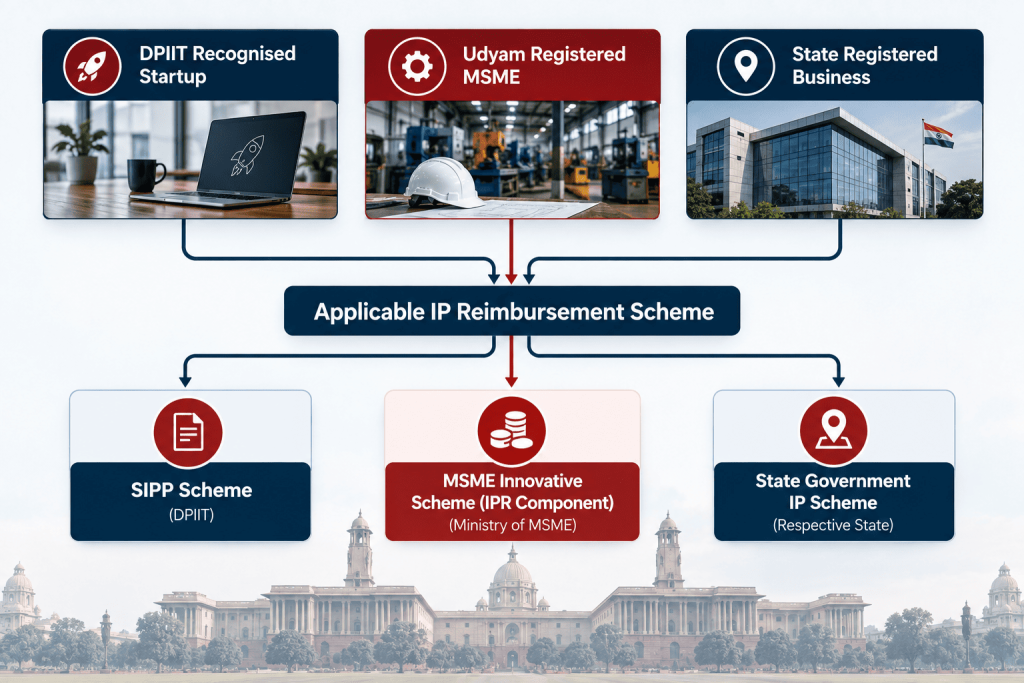
SIPP stands for the Scheme for Facilitating Start-ups’ Intellectual Property Protection. It began in 2016 as a pilot and was extended multiple times since, most recently through a version that ran from 1 April 2023 to 31 March 2026.
Under SIPP, a DPIIT-recognised startup does not pay the facilitator at all. The startup engages a patent agent or trademark agent from a panel empanelled by the Controller General of Patents, Designs and Trade Marks (CGPDTM), and that facilitator claims their professional fee directly from the concerned IP office. The startup pays only the statutory government fee, which itself carries a separate discount (more on that below).
SIPP’s coverage expanded over the years to include:
- DPIIT-recognised startups filing patents, trademarks or designs in India
- Individual innovators and creators filing through a Technology and Innovation Support Centre (TISC)
- Eligible educational institutions under the Patents Rules, 2003
- Indian applicants filing international patent applications where India acted as the searching authority
If you have not yet secured DPIIT status, our Startup India registration guide covers the recognition process, which is a precondition for this route.
Is the SIPP Scheme Still Active?
This is the part that catches people out. The most recent notified version of SIPP ended on 31 March 2026, and as of the latest available official updates, no extension, renewal or replacement scheme had been announced. Startups that had not begun the filing process before that date can no longer access the facilitator-fee benefit for new applications, and empanelled facilitators are largely operating outside the scheme for fresh work.
This does not mean startup IP support has disappeared entirely. Two things are worth separating clearly:
- The facilitator-fee reimbursement under SIPP is currently paused, pending any fresh notification.
- The statutory fee concession (the 80% patent rebate and 50% trademark rebate) is a separate rule under the Patents Rules and Trade Marks Rules, and it continues regardless of SIPP’s status.
Given how often these schemes get extended or redesigned, check the current position on the official IP India or Startup India portal before assuming either way. If SIPP is unavailable when you file, the MSME Innovative Scheme below is usually the better route for an Udyam-registered applicant.
How Much Can MSMEs Claim Under the MSME Innovative Scheme’s IPR Component?
The Ministry of MSME runs a broader “MSME Innovative Scheme” with three parts: Incubation, Design, and IPR. The IPR component is the one relevant here, and unlike SIPP, it is not tied to startup status. It works off Udyam registration instead, which makes it accessible to a wider set of small businesses.
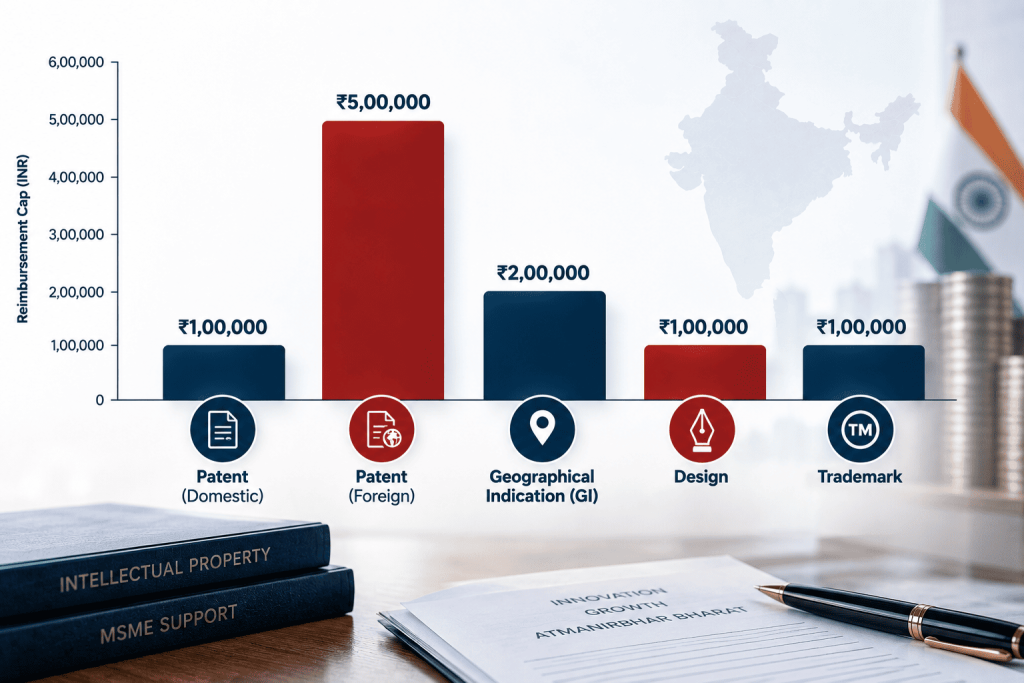
Reimbursement is calculated as 100% of the actual cost incurred, subject to these caps:
| IP Type | Maximum Reimbursement |
| Domestic patent | Up to ₹1,00,000 |
| Foreign patent | Up to ₹5,00,000 |
| Geographical Indication (GI) registration | Up to ₹2,00,000 |
| Design registration | Up to ₹15,000 |
| Trademark registration | Up to ₹10,000 |
Three conditions decide eligibility here. The applicant needs a valid Udyam Registration Number. The reimbursement is one-time per IP asset. And it cannot be claimed if the same patent, trademark, design or GI has already received funding under any other central or state government scheme, since applicants must submit a self-declaration confirming this.
Applications go through the official portal at innovative.msme.gov.in, and the scheme works through a network of empanelled Intellectual Property Facilitation Centres (IPFCs), which also offer free advisory support, patentability searches and drafting help before you even reach the reimbursement stage. If your Udyam details need a refresh before applying, our Udyam registration guide walks through that separately.
One honest limitation worth flagging: reimbursement is generally released after the patent or design is granted, or the trademark or GI is registered, not at the point of filing. A patent can take several years to reach grant, so treat this as a delayed refund on a cost you fund upfront, not a same-day payout. Confirm the exact submission stage and required proof with your IPFC before you plan your cash flow around it.
Do State Governments Offer Their Own IP Reimbursement Schemes?
Yes. Several Indian states provide financial assistance for intellectual property (IP) protection through their startup and MSME policies. This support can help businesses manage the costs of patent drafting, filing, prosecution, international filings, trademarks and designs.
In addition to central government schemes, eligible startups and MSMEs may be able to access state-level assistance, depending on their location, registration status and the type of IP being protected.
State-Wise IP Reimbursement Schemes in India
| State | Patent/IP Assistance |
|---|---|
| Karnataka | Up to ₹2 lakh for an Indian patent and ₹10 lakh for a foreign patent, subject to applicable conditions. |
| Telangana | Up to ₹2 lakh for an Indian patent and ₹10 lakh for an awarded foreign patent, subject to eligibility. |
| Maharashtra | Up to ₹2 lakh for domestic IP and ₹10 lakh for international IP under the State Innovation Society’s IPR scheme, covering eligible patents, designs, trademarks and certain copyrights. |
| Uttar Pradesh | Eligible startups can receive up to ₹2 lakh for Indian patents and ₹10 lakh for international patents. |
| Madhya Pradesh | The Startup Policy 2022 provides patent assistance of up to ₹5 lakh. |
| Odisha | The MSME Development Policy provides assistance of up to ₹5 lakh towards eligible patent/IPR registration costs, along with separate trademark assistance. |
Important: The reimbursement amounts, eligible expenses, application windows and payment conditions vary by state. Verify the latest policy guidelines with the relevant state authority before applying.
Can You Combine Central and State IP Assistance?
Before claiming assistance under multiple schemes, check whether the relevant guidelines permit it. Some schemes prohibit receiving duplicate funding for the same IP asset or expense. Applicants should confirm the applicable conditions before submitting a reimbursement claim.
What Is the Difference Between a Fee Concession and an IP Reimbursement?
These two get mixed up constantly, so it is worth putting side by side.
| Aspect | Fee Concession | IP Reimbursement |
| When it applies | At the time of filing, automatically | After a milestone, on a separate claim |
| What it reduces | The government’s own statutory fee | Professional/attorney fee or total registration cost |
| Who provides it | Built into Patents Rules and Trade Marks Rules | DPIIT, Ministry of MSME, or state government |
| Example | Startups pay 20% of the standard patent fee (an 80% rebate) | MSME Innovative Scheme pays back up to ₹1 lakh after grant |
| Do you apply separately? | No, claimed on the application form itself | Yes, a distinct application with supporting documents |
A DPIIT-recognised startup that is also Udyam-registered can often use both mechanisms together: the lower statutory fee at filing, and a reimbursement claim afterward, as long as the specific scheme rules for that reimbursement do not exclude it.
Who Is Eligible for IP Reimbursement Schemes in India?
Eligibility depends on which scheme you are targeting. Use this checklist to see where you fit before you start an application.
- DPIIT-recognised startup: Incorporated as a private limited company, LLP or partnership; generally under 10 years old; annual turnover below the scheme’s prescribed threshold; recognised under current DPIIT notification.
- Udyam-registered MSME: Valid Udyam Registration Number with investment and turnover within current micro, small or medium limits; can be a company, LLP, partnership or proprietorship.
- Individual innovator: Filing through a recognised Technology and Innovation Support Centre (TISC), where SIPP coverage applies.
- Educational institution: Recognised under the applicable Patents Rules provision for institutional filings.
- State-scheme applicant: Business registered and operating within the specific state offering the scheme.
If you are not sure whether a private limited company or an LLP suits your plans in the first place, our comparison of types of business entities can help before you lock in a structure that affects your eligibility later.
How Can You Apply for an IP Reimbursement Scheme?
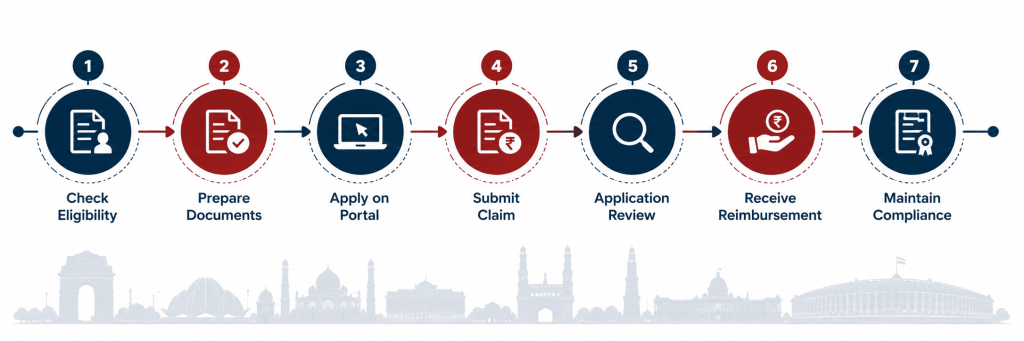
The process for claiming IP reimbursement depends on the government scheme you are applying under. While some schemes provide assistance through an empanelled facilitator, others require applicants to submit a reimbursement claim through the implementing department or its designated portal.
Here is how startups and MSMEs can approach the process.
Step 1: Identify the Right IP Reimbursement Scheme
Check whether you qualify for a central government scheme, such as the MSME Innovative Scheme’s IPR component, or a state-level IP assistance scheme.
Review the eligibility criteria, reimbursement limits, eligible IP types and application deadlines before proceeding.
Step 2: Confirm Your Eligibility and Required Documents
Check whether the scheme requires DPIIT recognition, Udyam registration or registration under a particular state policy.
Review the scheme’s official guidelines to identify the documents and expenses accepted for reimbursement.
Step 3: File Your IP Application
Complete the relevant patent, trademark, design or geographical indication (GI) application through the appropriate IP registration process.
You can complete your trademark registration, patent application or design registration through the normal process.
Follow the scheme’s instructions on whether you must obtain approval or register your IP before submitting a reimbursement claim.
Step 4: Keep Proof of Expenses and Registration
Maintain copies of your IP application acknowledgement, government fee receipts, professional fee invoices and relevant registration or grant certificates.
These documents may be required to establish that the expenses were incurred and the qualifying IP milestone was achieved.
Step 5: Submit Your Reimbursement Claim
Visit the official website of the department or agency implementing your selected scheme. Follow its prescribed application procedure, submit the required documents and provide the requested bank and applicant details.
If the scheme requires an empanelled facilitator or an Intellectual Property Facilitation Centre (IPFC), follow that route instead of assuming you can submit the claim independently.
For the MSME Innovative Scheme, check the official MSME Innovative Scheme portal for the current IPR application instructions.
Step 6: Track Your Application
Keep your application or claim reference number and monitor its status through the designated portal or implementing authority.
Respond promptly if additional documents or clarifications are requested.
Step 7: Receive the Approved Reimbursement
Once the claim has been verified and approved, the eligible amount is disbursed according to the scheme’s payment procedure.
The amount received depends on the actual eligible expenses, the applicable reimbursement cap and the scheme’s conditions.
Where Can You Find the Official Application Process?
The myScheme IPR Reimbursement Scheme page is a useful starting point for identifying scheme information and reviewing the available application guidance.
However, myScheme generally directs applicants to the relevant ministry or department’s application page rather than processing every application itself.
For this reason, always follow the official application instructions for the specific scheme you intend to use. Do not assume that the same application portal, documents or reimbursement timeline applies to every central and state-level IP scheme.
What Documents Are Needed to Claim IP Reimbursement?
Keep this checklist ready before you start a claim, since gaps here are the single biggest cause of delay.
- Valid DPIIT recognition certificate or Udyam Registration Certificate
- IP application acknowledgement or filing receipt
- Grant certificate (patent), registration certificate (trademark, design or GI), as applicable to the scheme’s milestone requirement
- Original fee payment receipts, both statutory and professional
- Facilitator or agent invoice, where a facilitator route is used
- Self-declaration confirming no other central or state scheme has funded the same IP asset
- PAN and GST details of the applicant entity
- Bank account details for disbursement
- Authorisation letter, if a facilitator or consultant is filing the claim on your behalf
What Common Mistakes Reduce or Delay IP Reimbursement Claims?
A few patterns show up again and again in claims that get stuck or rejected outright.
Applying under the wrong scheme. A DPIIT startup without Udyam registration cannot fall back on the MSME Innovative Scheme, and an Udyam-registered company that is not DPIIT-recognised cannot use SIPP. Confirm which registration you actually hold before you plan around a scheme.
Letting registration lapse mid-process. If your DPIIT or Udyam status expires before the claim is submitted, some schemes will not process the reimbursement even if it was valid at filing. Renew before it lapses, not after.
Trying to double-claim. Submitting the same patent or trademark cost to two different schemes, whether central-central or central-state, is the fastest way to have a claim rejected and possibly flagged for scrutiny on your other applications.
Assuming reimbursement covers everything. Working capital costs, unrelated legal fees, and IP maintenance or renewal fees generally fall outside these schemes. They exist for the registration cost itself, not the ongoing upkeep of the IP asset.
Treating it as instant. Reimbursement is a claim-based process tied to a milestone, not a same-day refund. Build your cash flow around paying the full cost upfront and recovering part of it later.
Is Company Registration or GST Needed Before Applying?
Most reimbursement schemes require an existing, verifiable legal entity with consistent PAN and GST records, since the claim gets checked against these. If you have not yet formalised your business structure, review our guides to company registration or LLP registration first, and confirm your GST registration status is current, since mismatched entity records across PAN, GST and Udyam is a common reason applications stall during verification.
Can Individual Inventors, Not Just Companies, Claim IP Reimbursement?
Yes, within limits. SIPP historically extended to individual innovators and creators who file through a recognised Technology and Innovation Support Centre, separate from the company or LLP route. Under the MSME Innovative Scheme, a sole proprietorship with a valid Udyam Registration also qualifies, since Udyam registration is open to proprietors, not only incorporated entities. What does not work is an unregistered individual with no Udyam number and no DPIIT recognition trying to claim directly. Some form of formal registration is a precondition across every scheme covered here.
FAQs
Can I claim patent reimbursement before my patent is granted, or do I have to wait?
Most reimbursement routes, including the MSME Innovative Scheme, release payment after the patent is granted, not at filing. You fund the drafting and filing cost yourself first, then claim it back once the grant certificate is issued. Confirm the exact stage requirement with your IPFC, since some interim documentation may be accepted earlier in specific cases.
I already used a SIPP facilitator for my trademark. Can I also claim under the MSME Innovative Scheme for the same mark?
No. The self-declaration required under the MSME Innovative Scheme specifically confirms that no other central or state scheme has funded the same IP asset. Using SIPP’s facilitator-fee benefit and then also claiming MSME Innovative reimbursement for the identical trademark counts as double-claiming and will be rejected.
My startup’s DPIIT recognition lapsed while my patent application was still pending. Will I still get facilitator support?
This depends on when the lapse occurred relative to your facilitator engagement and the scheme’s specific rules at that time. As a general practice, keep your DPIIT recognition renewed throughout the application lifecycle rather than assuming your status at the original filing date protects you later.
Does trademark reimbursement cover opposition or hearing charges, or just the initial filing?
The MSME Innovative Scheme’s reimbursement is generally calculated against the actual registration cost incurred, which can include professional charges tied to prosecution stages like responding to examination reports. It is not designed to cover unrelated legal costs such as fighting an infringement action after registration. Check the current guideline with your IPFC for what counts as an eligible cost head in your specific case.
Do private limited companies without Udyam registration qualify for the MSME Innovative Scheme’s IPR reimbursement?
No. Udyam Registration is the core eligibility test for this scheme, regardless of company type. A private limited company that meets MSME investment and turnover limits can and should register on the Udyam portal before applying, since incorporation alone does not satisfy this scheme’s requirement.
How long does it typically take to actually receive the reimbursement amount after applying?
There is no single published turnaround time across all schemes, and it varies by how complete your documentation is, the specific IPFC or IP office handling your file, and the volume of pending claims. Ask for a written timeline estimate from your facilitator or IPFC rather than assuming a fixed number of weeks.
Can an Indian company claim reimbursement for filing a patent in a foreign country, like the US or Europe?
Yes, the MSME Innovative Scheme specifically allows up to ₹5 lakh in reimbursement for a foreign patent, a higher cap than the ₹1 lakh available for a domestic filing, recognising that international filings cost significantly more.
What happens if my patent application is abandoned or rejected before grant? Do I lose the facilitator fee benefit under SIPP?
Under SIPP’s historical structure, if an application was withdrawn or abandoned before disposal, the facilitator was entitled to claim fees only for the filing stage, not for stages tied to final disposal. In practice, this means an abandoned application does not retroactively cancel the fee support already earned for work genuinely completed.
Is there a cap on how many patents or trademarks one startup can get reimbursed for under these schemes?
The published scheme documents for SIPP describe coverage for “any number” of patents, trademarks or designs a startup may file, subject to the scheme being active and each application independently meeting eligibility. The MSME Innovative Scheme’s caps apply per IP asset rather than capping the total number of assets you can file, though your overall funding still depends on scheme budget availability at the time.
Can I apply for reimbursement myself, or does it have to go through a lawyer, CA or facilitator?
For SIPP, the facilitator handles the claim directly with the IP office, since the entire structure is built around empanelled professionals. For the MSME Innovative Scheme, the applicant typically submits the claim through the innovative.msme.gov.in portal, often with guidance from an empanelled IPFC rather than a private CA or lawyer being mandatory. A consultant can still help you prepare the documentation correctly, but you are not legally required to route every step through one.
You may also like

IP Reimbursement Schemes: Benefits, Eligibility & How to Apply
IP reimbursement schemes in India pay back part of the cost of filing a patent,