
FEMA Guidelines: Rules, Regulations & Compliance Guide
- by kapil
- Updated September 28, 2026
- 34 mins read

FEMA guidelines are the rules under the Foreign Exchange Management Act, 1999, that govern how foreign exchange, foreign investment, and cross-border remittances work in India. They classify every transaction as current account or capital account, set limits like the USD 250,000 Liberalised Remittance Scheme, and are enforced jointly by the RBI and the Enforcement Directorate.
If you are sending money abroad, receiving foreign investment, opening an NRI account, or setting up an office for a foreign company, FEMA decides what you can do without approval, what needs RBI sign-off, and what gets you a penalty notice. The rules sound intimidating on paper. Once you see how they are structured, most situations turn out to have a clear answer.
This guide walks through what FEMA actually covers, how the current account and capital account split works, what NRIs and foreign investors need to track, and what happens when someone gets it wrong.
What Are FEMA Guidelines?
FEMA guidelines are the rules, regulations, and directions issued under the Foreign Exchange Management Act, 1999. Parliament passed the Act to replace an older, stricter law and to give India a framework that manages foreign exchange instead of tightly controlling it.
The Act itself is short. Most of the actual detail sits in three layers issued below it:
- Rules, made by the Central Government, usually covering policy questions like who can invest and in what sectors.
- Regulations, issued by the Reserve Bank of India (RBI), covering the operational mechanics such as forms, timelines, and limits.
- Directions and Master Directions, issued by the RBI to guide banks and Authorised Dealers on how to actually process a transaction.
So when someone says “FEMA guidelines,” they usually mean this entire stack, not just the 49 sections of the parent Act. A company incorporating in India with foreign shareholders will deal with FEMA guidelines the same day it deals with company law, since receiving that first tranche of investment money is itself a FEMA event. If you are exploring company incorporation for foreigners in India, the FEMA compliance calendar starts from the day funds hit your bank account, not from the date of registration.
Why Was FEMA Introduced, and How Is It Different From FERA?
FEMA replaced the Foreign Exchange Regulation Act (FERA), 1973, and came into force on 1 June 2000. FERA treated almost every foreign exchange transaction as prohibited unless the government specifically allowed it, and a violation was a criminal offence that could lead to arrest.
India’s economy opened up through the 1990s, and a law built for a closed economy no longer fit. FEMA flipped the default position for a large chunk of transactions, made violations civil rather than criminal, and set out to do three things:
- Facilitate external trade and payments.
- Promote the orderly development of the foreign exchange market in India.
- Help conserve and manage the country’s foreign exchange reserves.
The civil versus criminal distinction still confuses people. A FEMA contravention normally ends in a monetary penalty, not a police case. Genuinely serious matters, like money laundering tied to a foreign exchange offence, get handled under separate legislation such as the Prevention of Money Laundering Act, not through FEMA’s own machinery.
Who Do FEMA Guidelines Apply To?
FEMA applies to the whole of India, and it also reaches branches, offices, and agencies located outside India if an Indian citizen owns or controls them. In practical terms, four groups deal with FEMA guidelines most often:
- Indian residents, meaning individuals and businesses based in India, whenever they send money abroad, receive foreign investment, or hold assets outside India.
- Non-Resident Indians (NRIs) and Overseas Citizens of India (OCIs), for their accounts, property, and investments connected to India.
- Foreign companies and foreign nationals, when they invest in an Indian entity, set up a local office, or borrow from an Indian lender.
- Authorised Persons, mainly Authorised Dealer Category-I banks, who process the transactions on everyone else’s behalf and carry their own compliance obligations under Section 11.
Residency under FEMA is decided by purpose and intention, not a fixed day count. Someone who leaves India for a job abroad becomes a person resident outside India from the date of departure, even though the Income Tax Act would still look at how many days they spent in India during the year. This gap between FEMA residency and tax residency trips up a lot of returning NRIs, since the two laws can classify the same person differently in the same financial year.
What Is the Difference Between Current Account and Capital Account Transactions?
Every foreign exchange transaction under FEMA falls into one of two buckets, and the compliance burden is completely different depending on which one applies.
A current account transaction is a payment made in the ordinary course of business, trade, or personal life, and it does not create or extinguish an asset or liability outside India. Paying for imported machinery, sending money for a child’s tuition abroad, or receiving a client’s payment for services rendered are all current account transactions.
A capital account transaction changes what someone owns or owes across borders. Buying shares in a foreign company, taking a loan from an overseas lender, or purchasing property abroad falls here.
The default rule for each category runs in opposite directions, and this single point causes more confusion than anything else in FEMA.
| Aspect | Current Account Transactions | Capital Account Transactions |
| Default position | Freely permitted unless specifically restricted | Restricted unless specifically permitted |
| Governing rules | Foreign Exchange Management (Current Account Transactions) Rules, 2000 | Non-Debt Instruments Rules, 2019 (Central Government) and Debt Instruments Regulations (RBI), split since October 2019 |
| Examples | Import and export payments, travel, education, medical treatment, remittances for services | FDI, ODI, ECB, purchase or sale of property abroad, opening a foreign bank account |
| Who decides restrictions | Central Government, in consultation with RBI | RBI and Central Government jointly, depending on the instrument |
| Common trigger | Everyday trade and personal remittances | Investment, borrowing, and asset ownership across borders |
Current account transactions sit in three schedules under the 2000 Rules. Schedule I lists transactions where drawing foreign exchange is prohibited outright, such as remittances for lottery winnings or for banned magazines. Schedule II and Schedule III list transactions that need government or RBI approval beyond certain limits, such as large gifts or donations. Anything not mentioned in these schedules is generally free to go through an Authorised Dealer bank without special permission.
What Are the New FEMA Export-Import Regulations Effective From 1 October 2026?
The Reserve Bank of India (RBI) has introduced the Foreign Exchange Management (Export and Import of Goods and Services) Regulations, 2026, which will come into force from 1 October 2026. The new regulations supersede the Foreign Exchange Management (Export of Goods & Services) Regulations, 2015 and establish a consolidated framework for exports and imports of goods and services, including software.
The framework was originally notified on 13 January 2026. However, RBI subsequently amended Regulation 5 through Notification No. FEMA 23(R)/(1)/2026-RB dated 22 September 2026. The amendment reduces the export realisation period from 15 months to 9 months and the special period under the first proviso from 18 months to 12 months, with the changes effective from 1 October 2026.
Key Changes Under the New FEMA Export-Import Regulations
1. A Unified Export Declaration Form (EDF)
The 2026 regulations introduce the Export Declaration Form (EDF) as the common export declaration framework for goods and services, with software included within services for the purposes of the regulations. For service exports, the EDF is to be furnished within 30 days from the end of the month in which the invoice is issued. A single EDF can cover multiple service export invoices for the month.
The new framework replaces the separate SOFTEX-based declaration mechanism for software exports from 1 October 2026. Exporters should therefore review their existing software-export reporting process and coordinate with their Authorised Dealer (AD) bank before the new framework takes effect.
For goods exported through EDI ports, the shipping bill is treated as the export declaration. The regulations also specify the authorities and procedures applicable to exports from non-EDI ports and exports of services.
2. Export Realisation Period Changes From 1 October 2026
The export realisation period under the 2026 regulations was originally set at 15 months. RBI’s September 2026 amendment has now reduced this period to 9 months.
From 1 October 2026, the export value must generally be realised and repatriated within:
- 9 months from the date of shipment for goods, except goods exported to a warehouse outside India.
- 9 months from the date of invoice for services.
- 9 months from the date of sale of goods from an overseas warehouse.
For exports invoiced and/or settled in Indian rupees, the applicable period under the first proviso is 12 months.
An AD bank may allow an extension beyond the specified period when the exporter requests it and the bank is satisfied with the reasons for the delay.
Important: The earlier figures of 15 months and 18 months should not be used for the post-1 October 2026 position because RBI amended these periods on 22 September 2026.
3. Simplified Closure of Small-Value EDPMS and IDPMS Entries
The new regulations introduce a simplified mechanism for small-value export and import transactions.
For an export where the shipping bill or service invoice is up to ₹10 lakh, or its equivalent in foreign currency, an EDPMS entry may be closed based on a declaration from the exporter stating that the payment has been realised, either in full or otherwise.
The exporter may also submit this declaration to the AD bank quarterly for bulk closure of eligible EDPMS entries.
A similar provision applies to imports. Where the Bill of Entry or service invoice is up to ₹10 lakh, or its equivalent in foreign currency, the IDPMS entry may be closed based on a declaration from the importer that the import payment has been made. Importers can also submit a quarterly declaration for bulk closure of eligible entries.
This mechanism can reduce administrative work for eligible low-value transactions, but the declaration must accurately reflect the status of the underlying payment.
4. Greater Role for Authorised Dealer Banks
The 2026 framework gives Authorised Dealer banks a greater operational role in handling export and import transactions.
AD banks are responsible for monitoring EDPMS and IDPMS entries, following up on outstanding transactions, and handling specified extensions, reductions and closures where the regulations permit them. The bank must also satisfy itself about the genuineness of the transaction before processing the relevant receipt or payment.
The September 2026 amendment goes further for certain older transactions. From 1 October 2026, AD banks will handle export, import and merchanting trade transactions undertaken before 1 October 2026 that previously required RBI approval under the earlier framework, subject to the scope of the new Regulation 20.
5. Set-Off of Export Receivables Against Import Payables
The new regulations allow an AD bank to permit set-off of export receivables against import payables involving the same overseas buyer or supplier.
The set-off can also involve the overseas group or associate companies of the buyer or supplier, subject to the conditions under the regulations and the applicable period for realisation of export proceeds or any extension allowed by the AD bank.
This means that, where the prescribed conditions are met, eligible export receivables and import payables can be adjusted rather than requiring separate settlement of each amount.
6. Third-Party Receipts and Payments
The 2026 regulations permit third-party receipts and payments for export and import transactions.
An AD bank may permit a receipt or payment involving a third party, rather than the direct exporter/importer and overseas buyer/supplier, when the bank is satisfied about the bona fides of the transaction.
Businesses using third-party arrangements should therefore maintain documentation explaining the parties involved and the commercial basis of the transaction so that the AD bank can establish the genuineness of the arrangement.
7. Restrictions When Export Proceeds Remain Unrealised
The regulations introduce a compliance consequence for exporters whose export proceeds remain unrealised for an extended period.
Where export proceeds remain unrealised beyond one year from the due date for realisation, or beyond an extended period allowed by the AD bank or RBI, future exports by the exporter may be permitted only against:
- Full advance payment; or
- An irrevocable Letter of Credit (LC).
Exporters should therefore monitor outstanding export receivables closely and obtain an extension from their AD bank where appropriate instead of allowing export proceeds to remain unresolved indefinitely.
8. Rules for Import Advances
The new framework also changes the treatment of advance payments for imports.
The earlier fixed USD 200,000 threshold for import advances is replaced by a threshold determined by the AD bank. Above the applicable threshold, the bank may require security such as a standby Letter of Credit or bank guarantee, subject to the applicable conditions.
Where an import advance is not adjusted because the import does not take place, the importer is required to repatriate the advance within the original contractual period or any permitted extension.
If the advance is not repatriated or the relevant IDPMS entry remains unmarked, future advance import payments may be permitted only against an unconditional and irrevocable standby LC or an appropriate bank guarantee, subject to the applicable requirements.
9. Merchanting Trade Transactions Must Follow the Six-Month Remittance Rule
The 2026 regulations specifically provide for Merchanting Trade Transactions (MTT).
For an MTT, the period between the outward remittance and inward remittance, or vice versa, must not exceed six months. An AD bank may extend this period when the customer requests an extension and the bank is satisfied with the reasons given.
The outward remittance should generally be made only to the overseas seller and the inward remittance should generally be received only from the overseas buyer. An AD bank may permit third-party receipt or payment when it is satisfied with the reasons provided.
The person undertaking the merchanting trade must also provide documents establishing the genuineness of the transaction. The AD bank is responsible for monitoring the transaction and ensuring that both legs are completed in accordance with the regulations.
10. Reporting Through EDPMS and IDPMS
The 2026 regulations prescribe reporting responsibilities for AD banks through the Export Data Processing and Monitoring System (EDPMS) and Import Data Processing and Monitoring System (IDPMS).
Among other requirements, an AD bank must enter:
- EDF details received from a non-EDI port into EDPMS within five working days of receiving the EDF.
- Service-export EDF details into EDPMS within five working days of receiving the EDF.
- Import details received from a non-EDI port into IDPMS within five working days of receiving the documents.
- Import-service details into IDPMS within five working days of receiving the relevant documents.
AD banks must also report inward and outward remittances relating to exports, imports and merchanting trade transactions in EDPMS and/or IDPMS and monitor outstanding entries for closure.
These five-working-day requirements are primarily AD-bank reporting obligations, so exporters and importers should provide the required documentation to their bank promptly.
Transitional Provision for Exporters on the Caution List
The September 2026 amendment contains a specific transitional provision for exporters who are on the RBI’s Caution List as of 30 September 2026.
Such exporters will continue to be governed by the relevant order issued by RBI under Regulation 16 of the earlier Foreign Exchange Management (Export of Goods & Services) Regulations, 2015 until they are removed from the Caution List.
This means the transition to the 2026 regulations does not automatically cancel an existing Caution List order.
What Exporters and Importers Should Do Before 1 October 2026
Businesses involved in cross-border exports or imports should review their FEMA compliance processes before the new framework becomes effective.
Key steps include:
- Confirm the new EDF process with your AD bank, particularly if you export services or software.
- Review pending export receivables and track the applicable realisation deadline for each transaction.
- Use the correct post-1 October 2026 timelines: generally 9 months, with the applicable 12-month period for exports invoiced and/or settled in INR.
- Review EDPMS and IDPMS entries up to ₹10 lakh and identify eligible entries that can be closed through the declaration mechanism.
- Consider quarterly bulk closure where multiple eligible small-value entries are outstanding.
- Review outstanding import advances and ensure that required imports or repatriation are completed within the applicable period.
- Check merchanting trade transactions to ensure that the six-month period between the outward and inward remittances is being monitored.
- Maintain supporting documents for set-offs and third-party receipts or payments so that the AD bank can verify the genuineness of the transactions.
- Check whether any existing RBI approval or Caution List order applies to transactions entered into before 1 October 2026.
The exact compliance requirement can depend on the nature of the transaction, the applicable FEMA provisions and the instructions of the AD bank. Businesses should therefore reconcile their outstanding export and import transactions with their AD bank before the new framework takes effect.
How Do FEMA Guidelines Regulate Foreign Direct Investment (FDI)?
FDI into India moves through one of two routes, and getting the route wrong is one of the most common early mistakes foreign investors make.
Under the Automatic Route, an Indian company can receive foreign investment and simply report it to the RBI afterward, with no prior approval needed. Under the Government Route, the investment needs approval from the relevant ministry or department before the money comes in.
Most sectors sit under the Automatic Route today, with government approval reserved for areas the government treats as sensitive, such as defence beyond a threshold, multi-brand retail, and print media. Investment from an entity based in, or with beneficial ownership traced to, a country sharing a land border with India also needs government approval under Press Note 3 of 2020, regardless of the sector, though a 2026 amendment now allows a small non-controlling stake from such investors under the Automatic Route.
Sectoral caps change often. Insurance moved from a 74% cap to 100% FDI under the Automatic Route through a 2025-26 reform, defence sits at 74% Automatic and higher only through government approval, and space sector satellite manufacturing opened up to 100% Automatic Route investment in 2026. Always confirm the current cap against the DPIIT’s latest press note before closing a deal, since these percentages have shifted more than once in the last two years alone.
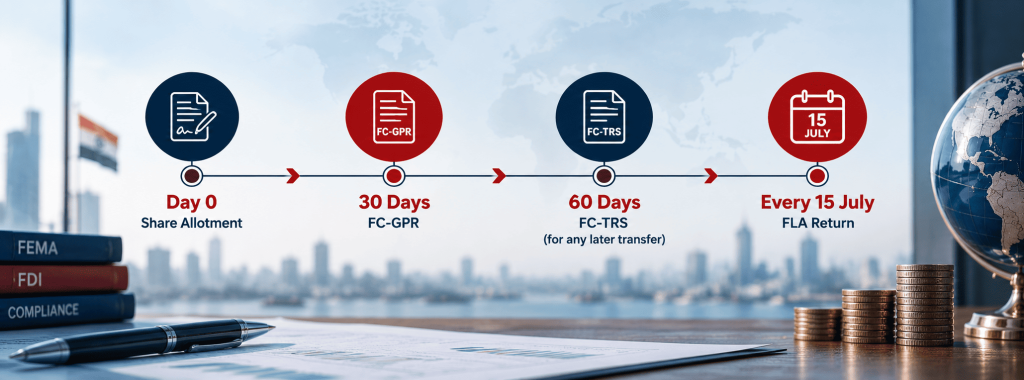
Once the money lands, three filings keep the investment compliant:
- Form FC-GPR, filed within 30 days of allotting shares to the foreign investor, confirming the issue price and instrument type.
- Form FC-TRS, filed within 60 days when existing shares change hands between a resident and a non-resident.
- The FLA Return, an annual filing due by 15 July every year, covering the company’s outstanding foreign liabilities and assets as of 31 March, whether or not any new investment happened that year.
Every share issued to a foreign investor also needs to be priced at or above fair value, calculated using an internationally accepted pricing methodology by a SEBI-registered merchant banker or a practising chartered accountant. Getting a proper valuation report before the share allotment, not after, avoids a mismatch that can hold up the FC-GPR filing for weeks.
Missing any of these deadlines does not usually mean a criminal problem. It means a Late Submission Fee, and if that is not paid, the matter escalates toward a formal FEMA contravention that needs compounding to resolve.
What Are the FEMA Rules for Overseas Investment (ODI and OPI)?
When an Indian entity or resident individual invests abroad, FEMA calls it Overseas Investment, and it splits into two categories under the Foreign Exchange Management (Overseas Investment) Rules, 2022.
Overseas Direct Investment (ODI) covers any investment that gives lasting ownership or control, meaning unlisted equity of any size, or 10% or more of a listed foreign entity, or even a smaller stake if it comes with control.
Overseas Portfolio Investment (OPI) covers a passive holding in listed foreign securities below the ODI threshold, with no control involved.
The classification matters because it decides the paperwork. An Indian entity making an ODI investment must obtain a Unique Identification Number for the foreign entity, file Form FC through an Authorised Dealer bank, and then keep filing an Annual Performance Report every year by 31 December for as long as the investment exists. Skip a couple of these reports and the entity typically cannot make any further financial commitment to that same foreign entity until the backlog is cleared.
The overall financial commitment an Indian entity can make abroad under the Automatic Route is capped at 400% of its net worth, based on the last audited balance sheet, and this figure includes equity, debt, and any guarantee or other non-fund based support given on the foreign entity’s behalf. A promoter or director can also personally guarantee the foreign entity’s borrowings without needing separate RBI approval, as long as the total stays inside that 400% ceiling. Round-tripping through more than two layers of foreign entities back into India remains prohibited.
Before committing capital abroad, running proper due diligence on the foreign entity and its ownership structure helps avoid discovering, only after the money has moved, that the target does not qualify as claimed.
How Have FEMA Guidelines on External Commercial Borrowings (ECB) Changed in 2026?
External Commercial Borrowings let Indian entities borrow foreign currency from recognised overseas lenders, and this framework went through its biggest overhaul in years on 16 February 2026.
Before the change, ECB rules sat across a separate Master Direction with tiered maturity and cost caps depending on the sector and loan size. The Foreign Exchange Management (Borrowing and Lending) (First Amendment) Regulations, 2026, folded all of that into a single, more flexible set of regulations and dropped the old Master Direction on ECB entirely.
Here is what changed for anyone planning to raise an ECB today:
- The Minimum Average Maturity Period (MAMP) is now standardised at 3 years for most borrowers, though manufacturing companies can still raise ECBs with a maturity between 1 and 3 years, and their annual borrowing cap under this shorter window went up from USD 50 million to USD 150 million.
- The all-in cost ceiling is gone. Pricing is now expected to reflect prevailing market conditions rather than a fixed benchmark-plus-spread formula, which gives borrowers and lenders more room to negotiate.
- The borrowing limit for most eligible borrowers now sits at the higher of USD 1 billion outstanding, or 300% of net worth based on the last audited balance sheet, up from the earlier caps.
- LLPs are now included as eligible borrowers, alongside companies and other entities incorporated under a Central or State Act.
ECBs raised before 16 February 2026 continue under the old framework except for reporting requirements, so an existing loan does not automatically move to the new rules. If your business is comparing an ECB against domestic bank credit or an NBFC loan, this is worth revisiting even if you looked at ECB pricing as recently as late 2025, since the math has genuinely changed.
What Is the Liberalised Remittance Scheme (LRS), and How Much Can You Remit?
The Liberalised Remittance Scheme lets a resident individual send up to USD 250,000 abroad in a financial year, without needing RBI’s prior approval for each transaction. The RBI introduced LRS in 2004 with a much smaller cap and has raised it in stages since then, and the figure has held steady at USD 250,000 for FY 2026-27.
LRS covers both current and capital account purposes, and this is where people often get confused. Foreign travel, education fees, and medical treatment abroad are current account uses. Buying property abroad, investing in foreign shares or mutual funds, and opening a foreign bank account are capital account uses. Both draw from the same USD 250,000 pool, and once you use it up in a financial year, further remittances need specific RBI approval, even if some of the earlier amount later comes back to India.
A few practical points worth knowing:
- LRS is available only to resident individuals, including minors through a guardian’s signature on Form A2. Companies, partnership firms, trusts, and HUFs cannot use it.
- Spending on a debit card or a forex card while abroad counts toward the limit. Credit card spending abroad, as of mid-2026, still sits outside LRS following a CBDT deferral that has not been reversed, though this is a narrow carve-out worth confirming before relying on it for a large transaction.
- Tax Collected at Source (TCS) applies on the remittance under the Income Tax Act, separately from the FEMA limit itself. The TCS threshold and rate depend on the purpose of remittance and have changed with recent Budgets, so this is worth checking with a tax advisor rather than assuming last year’s rate still applies.
What FEMA Guidelines Should NRIs Know?
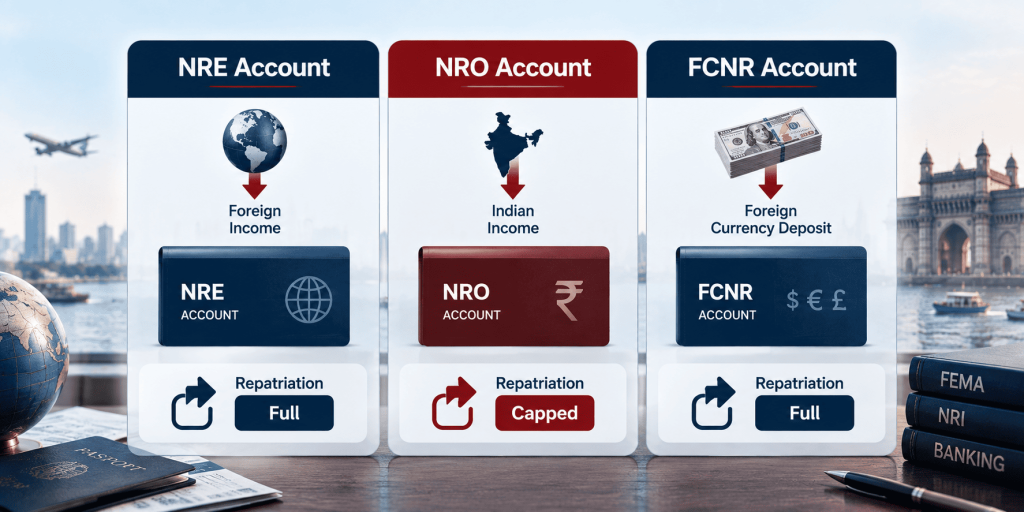
NRIs cannot hold a regular resident savings account in India. FEMA gives them three account types instead, and picking the right one affects taxability and how easily the money can leave India again.
| Account Type | Purpose | Repatriation | Tax on Interest | Currency |
| NRE (Non-Resident External) | Foreign income brought into India | Fully repatriable, principal and interest | Tax-free in India | Held in INR |
| NRO (Non-Resident Ordinary) | India-sourced income like rent, dividends, or pension | Up to USD 1 million per financial year, after taxes and Form 15CA/15CB | Taxable | Held in INR |
| FCNR(B) (Foreign Currency Non-Resident) | Term deposits in a foreign currency | Fully repatriable, principal and interest | Tax-free in India | Held in foreign currency |
The moment someone’s status changes from resident to NRI, or the other way around, FEMA expects the accounts to be re-designated. Someone returning to India after years abroad must get their NRE and NRO accounts converted to resident accounts, and move FCNR balances into a Resident Foreign Currency account or a resident deposit, since holding NRE or FCNR accounts once you are a resident is itself a contravention. There is no statutory grace period for this, so it is worth raising with the bank within a few months of moving back rather than waiting for a renewal notice to remind you.
On property, an NRI can buy residential or commercial property in India without special permission, but not agricultural land, plantation property, or a farmhouse, and inheriting such property works differently from buying it outright. Sale proceeds from up to two residential properties can be repatriated, capped at the original foreign currency investment in that property, and anything routed through an NRO account still falls inside the USD 1 million annual limit.
Gifts follow their own logic. An NRI can gift money to a relative in India from an NRE or NRO account with no FEMA-imposed cap on the amount, as long as it moves through banking channels rather than cash. A resident sending a rupee gift the other way, to an NRI relative, counts against that resident’s own USD 250,000 LRS limit for the year, which is easy to overlook when a family is moving money between generations for a wedding or a house purchase.
Can a Foreign Company Open a Liaison, Branch, or Project Office in India?
Yes, but only with the Reserve Bank’s approval under the Foreign Exchange Management (Establishment in India of a Branch Office or a Liaison Office or a Project Office or Any Other Place of Business) Regulations, 2016, commonly called FEMA 22(R).
A Liaison Office can only represent the parent company, share information, and promote its business. It cannot invoice anyone in India or earn local income, and its entire running cost must come from inward remittances from the head office abroad. A Branch Office can invoice and earn income in India, but only within the specific activities the RBI’s approval permits, such as export or import of goods, professional or consultancy services, or research work. A Project Office exists for the duration of a specific contract awarded to the foreign company in India, usually funded either by that contract itself or by inward remittance.
The application process runs through an Authorised Dealer Category-I bank:
- The foreign entity submits Form FNC along with its last five years of audited financials and a banker’s certificate confirming its net worth and profitability track record.
- The AD bank reviews the application against the RBI’s criteria, including the applicant’s business background and the source of funds.
- Straightforward cases clear through the AD bank itself under a delegated route. Applications from sectors the RBI treats as sensitive, such as defence, telecom, private security, and information and broadcasting, or from an applicant based in certain countries, get referred to the RBI directly.
- Once approved, the office registers with the Registrar of Companies within 30 days and obtains a PAN.
- Every year, the office files an Annual Activity Certificate through its AD bank confirming it has stayed within the permitted activities.
One carve-out trips up a lot of NGOs and foreign non-profits. If the applicant’s work in India would fall under the Foreign Contribution (Regulation) Act, 2010, it needs FCRA registration instead, and cannot seek approval under FEMA 22(R) for that activity. Mixing the two up at the application stage is one of the more common reasons these applications bounce back for clarification.
If your business model needs a fuller presence than a Liaison Office allows, setting up an Indian subsidiary through company incorporation for foreigners is usually a cleaner long-term structure than a Branch Office, since a subsidiary can raise its own capital and take on liabilities separately from the parent. For businesses weighing the three formats specifically, comparing a liaison office, a branch office, and a project office side by side against the actual activities planned in India is worth doing before filing Form FNC, not after.
How Are FEMA Guidelines Different From FCRA Rules?
FEMA and FCRA both deal with money crossing India’s borders, and this is exactly why people confuse them. The dividing line is simple once you see it: FEMA governs money exchanged for something, and FCRA governs money given with nothing expected in return.
| Aspect | FEMA | FCRA |
| Governs | Foreign exchange used for trade, investment, and business | Foreign donations and contributions with no quid pro quo |
| Regulator | Reserve Bank of India, under the Finance Ministry | Ministry of Home Affairs |
| Who it applies to | Businesses, individuals, investors, exporters | NGOs, trusts, societies, and associations receiving donations |
| Default approach | Permitted unless restricted | Not permitted unless registered or specifically approved |
| Nature of violation | Civil, resolved mainly through penalty or compounding | Can involve registration suspension and criminal liability in serious cases |
| Typical trigger | Investment, remittance, export or import payment | Grant, donation, or CSR-style transfer with no service in return |
A Section 8 non-profit company that both runs paid training programmes and accepts foreign donations needs to track both laws at once, and keep the two income streams in genuinely separate accounts. The training fee income follows FEMA. The donation follows FCRA, and must be received into the organisation’s designated FCRA account at the specified SBI branch in New Delhi, not into a general operating account.
What Happens If You Violate FEMA Guidelines?
FEMA violations are civil contraventions, not criminal offences, which is one of the main things that changed when FEMA replaced FERA. That said, the penalties are real and calculated to sting.
Under Section 13, if the contravention involves an amount that can be quantified, the penalty can run up to three times that amount. If the amount cannot be quantified, the cap sits at Rs 2 lakh. For a contravention that continues day after day, such as an unfiled return that stays unfiled, a further penalty of up to Rs 5,000 accrues for each day it continues beyond the first.
Directors, managers, and officers responsible for a company’s contravention can be held personally liable under Section 42, separate from any penalty on the company itself. And while FEMA does not send people to jail for the contravention itself, someone who fails to pay an imposed penalty within 90 days of the demand notice does become liable for civil imprisonment, so the criminal-versus-civil line is not quite as absolute as it first sounds.
High-profile enforcement actions over the years, involving everything from large e-commerce platforms to global technology and education companies, show this is not a small-business-only risk. The common thread in most of these cases is delayed or missing FDI documentation and unrealised export proceeds, not exotic or deliberately fraudulent structures.
How Does Compounding of FEMA Contraventions Work?
Compounding lets someone who has committed a FEMA contravention approach the RBI voluntarily, admit the issue, pay a calculated amount, and close the matter without going through a full adjudication before the Enforcement Directorate.
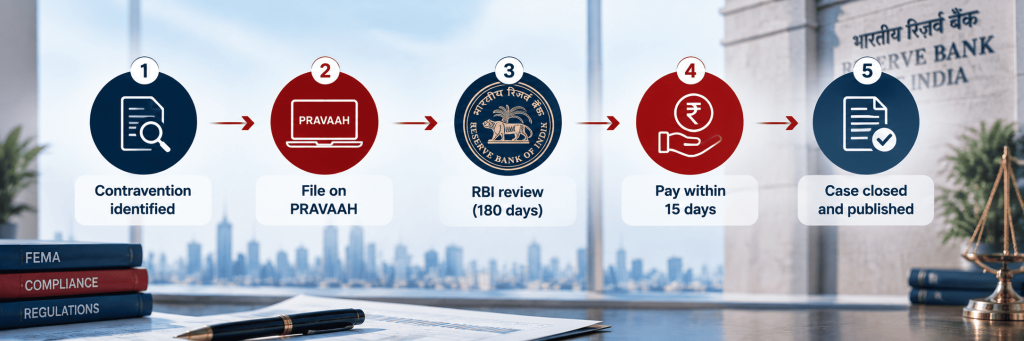
The Foreign Exchange (Compounding Proceedings) Rules, 2024, replaced the older 2000 rules, and the RBI has continued refining the process since. Since April 2025, applications go through the PRAVAAH portal, certain residual non-reporting categories now carry a capped compounding amount of Rs 2 lakh per regulation contravened, and the earlier practice of adding a 50% penalty on top when someone reapplies after missing a payment has been dropped.
The process itself runs like this:
- Identify the exact contravention and regulate any pending filings first, since RBI generally expects the underlying compliance gap to be fixed before or alongside the compounding application.
- File the application with the RBI (or the Enforcement Directorate, if the contravention falls under Section 3(a), which covers unauthorised dealing in foreign exchange).
- The compounding authority reviews the application and is expected to dispose of it within 180 days.
- If compounding is granted, pay the compounding amount within 15 days of the order. Missing this deadline voids the compounding and reopens the matter.
- The RBI publishes compounded contraventions on its website, so the resolution is not confidential, even though it avoids formal adjudication.
Not everything qualifies. Repeat contraventions within three years, matters connected to money laundering or terror financing, and cases affecting national sovereignty get referred straight to the Enforcement Directorate instead of being compounded. For a genuinely accidental filing miss, though, compounding is almost always faster and cheaper than waiting for a show-cause notice to arrive.
Can You Appeal a FEMA Penalty Order?
Yes, and the appeal path has more than one layer depending on who issued the original order.
If an Assistant Director or Deputy Director of Enforcement passed the adjudication order, the first appeal goes to the Special Director (Appeals), within 45 days of receiving the order. If a Special Director or higher officer passed the original order, the appeal skips straight to the Appellate Tribunal for Foreign Exchange in New Delhi, also within 45 days. A second appeal against the Special Director (Appeals)’ order also goes to the Appellate Tribunal.
Filing an appeal against a penalty order generally requires depositing the penalty amount first, though the Tribunal can waive this if depositing it would cause genuine hardship and the appellant can show a reasonable case on merits. The Tribunal aims to dispose of appeals within 180 days, and if it cannot, it has to record its reasons in writing for the delay.
Beyond the Tribunal, an aggrieved party can appeal to the High Court within 60 days, but only on a question of law, not a fresh review of the facts. There is no direct further appeal to the Supreme Court. A Special Leave Petition is the only route left after the High Court stage.
FEMA Compliance Checklist: What Should Businesses and Individuals Track?
Use this as a running checklist rather than a one-time review, since most FEMA obligations repeat annually or trigger on specific events.
- Classify every cross-border transaction as current account or capital account before it happens, not after.
- Confirm which FDI route applies (Automatic or Government) and the current sectoral cap before accepting foreign investment.
- File Form FC-GPR within 30 days of any share allotment to a foreign investor.
- File Form FC-TRS within 60 days of any share transfer involving a non-resident.
- File the FLA Return by 15 July every year if the company has outstanding foreign investment or overseas investment.
- Obtain a fresh valuation certificate for every fresh share issue or transfer priced for a foreign investor.
- Re-designate NRE, NRO, or FCNR accounts within a few months of any change in residential status.
- Track the USD 250,000 LRS limit across all Authorised Dealer banks used during the financial year, not just one bank.
- File the Annual Performance Report by 31 December for any live overseas direct investment.
- Renew the Annual Activity Certificate for any Liaison, Branch, or Project Office through the AD bank each year.
- Regularise any missed filing through compounding before it compounds into a larger adjudication matter.
Businesses juggling several of these deadlines alongside routine tax and MCA compliance often find it easier to route this through a dedicated finance function. CFO services built around FEMA reporting, ROC filings, and tax deadlines in one calendar tend to catch a missed deadline before it becomes a compounding application.
FAQS
Does FEMA apply to cryptocurrency transactions in India?
FEMA does not yet have a dedicated framework naming cryptocurrency as a specific instrument, and this remains one of the genuinely unsettled areas of the law. Cross-border crypto transactions are still assessed against general FEMA principles, and using unauthorised channels to move crypto-linked funds across the border can attract FEMA scrutiny alongside separate income tax and anti-money-laundering rules. Treat this as a grey zone that needs specific professional advice rather than a settled position.
Do freelancers and consultants need RBI approval to receive foreign client payments?
No, receiving payment for services rendered is a current account transaction, and an individual can receive any amount for legitimate freelance or consulting work without special approval. The practical requirement is using an authorised channel, such as a bank wire or an RBI-authorised payment aggregator, tagging the correct purpose code, and keeping the Foreign Inward Remittance Certificate for each payment as proof for tax filing.
What happens if a company misses the 30-day deadline to file Form FC-GPR?
The company can usually regularise the delay by paying a Late Submission Fee through the FIRMS portal, calculated based on how late the filing is and the amount involved. If the fee route is not used and the delay continues or repeats, it can escalate into a formal FEMA contravention that needs a compounding application to close out.
Can a resident Indian gift money to an NRI relative, and does this affect the LRS limit?
Yes, and it does count. A resident gifting money to an NRI or OCI relative, including a rupee gift credited to the relative’s NRO account, draws from that resident’s own USD 250,000 LRS limit for the financial year. This is easy to miss when a family sends money for a wedding or a property purchase without treating it as a “remittance” in their own head.
I just became a resident again after years abroad. Do I have to close my NRE account immediately?
You need to get it re-designated, not necessarily closed. FEMA requires NRE and NRO accounts to convert to resident accounts once your status changes, and any FCNR balance to move into a Resident Foreign Currency account or a resident deposit. There is no fixed grace period in the regulations, so most banks expect this within a few months of your return, and continuing to run an NRE account as a resident is itself a contravention.
Can someone go to jail for a FEMA violation?
Not for the underlying contravention itself, since FEMA treats these as civil matters resolved through penalties. The exception is non-payment: if someone does not pay an imposed penalty within 90 days of the demand notice, they can become liable for civil imprisonment for that non-payment, which is a different trigger from the original violation.
Does spending on a debit or credit card abroad count toward my USD 250,000 LRS limit?
Debit card and forex card spending abroad counts toward the limit. Credit card spending abroad, as of mid-2026, still sits outside LRS because of a CBDT deferral on classifying it as an LRS remittance, though this has been under periodic review and is worth reconfirming before you plan a large purchase around it.
Is FEMA residency the same as tax residency under the Income Tax Act?
No, and this catches a lot of people out. FEMA looks at your purpose and intention, such as leaving India for employment or business, and changes your status from that date. The Income Tax Act counts the actual number of days you spent in India during the financial year. It is entirely possible to be a resident under one law and a non-resident under the other in the same year.
Do startups need FEMA reporting for funding raised through convertible notes or SAFE agreements?
Yes. A convertible note issued to a foreign investor needs Form CN filed within 30 days of issue. If the note later converts into equity, a separate Form FC-GPR filing is needed within 30 days of that share allotment. Treating the note and the eventual conversion as one event is a common error that leaves one of the two filings undone.
Can a foreign individual, rather than a company, open a liaison office in India?
No. FEMA 22(R) restricts Liaison, Branch, and Project Office approval to a body corporate incorporated outside India, including a firm or other association of individuals, not an individual person acting alone. A foreign individual wanting a presence in India typically needs to route through incorporating an Indian entity instead.
You may also like


What GLA Membership Can Mean for Logistics Businesses
GLA Membership can help a logistics business find overseas partners, but the de