
Higher education can create a large cash requirement before a student begins earning. Tuition is only one part of the cost: accommodation, equipment, books, travel, insurance and deposits can widen the gap. An education loan in India can fund eligible study expenses and defer full repayment until the agreed moratorium ends, but it is still a credit contract, not a scholarship or guaranteed entitlement.
The right application begins with three questions. Is the course and institution acceptable to the lender? Can the student and co-applicant document the full cost and their contribution? Will the expected post-course income reasonably support repayment? A student loan in India should be selected against these facts, not an advertised rate alone. This guide explains how to get an education loan in India, from eligibility and documentation to appraisal, sanction, disbursement and repayment. It also distinguishes minimum RBI directions from lender-specific policies and explains the current PM-Vidyalaxmi, interest-subsidy and tax routes.
What is an education loan and what can it cover?
An Education Loan is usually a term loan granted to a student, commonly with a parent, guardian or another accepted person as co-borrower, to pay recognised higher-education costs. The lender assesses the student’s admission, academic record, course prospects, institution, total cost, available contribution, co-applicant and security, where applicable.
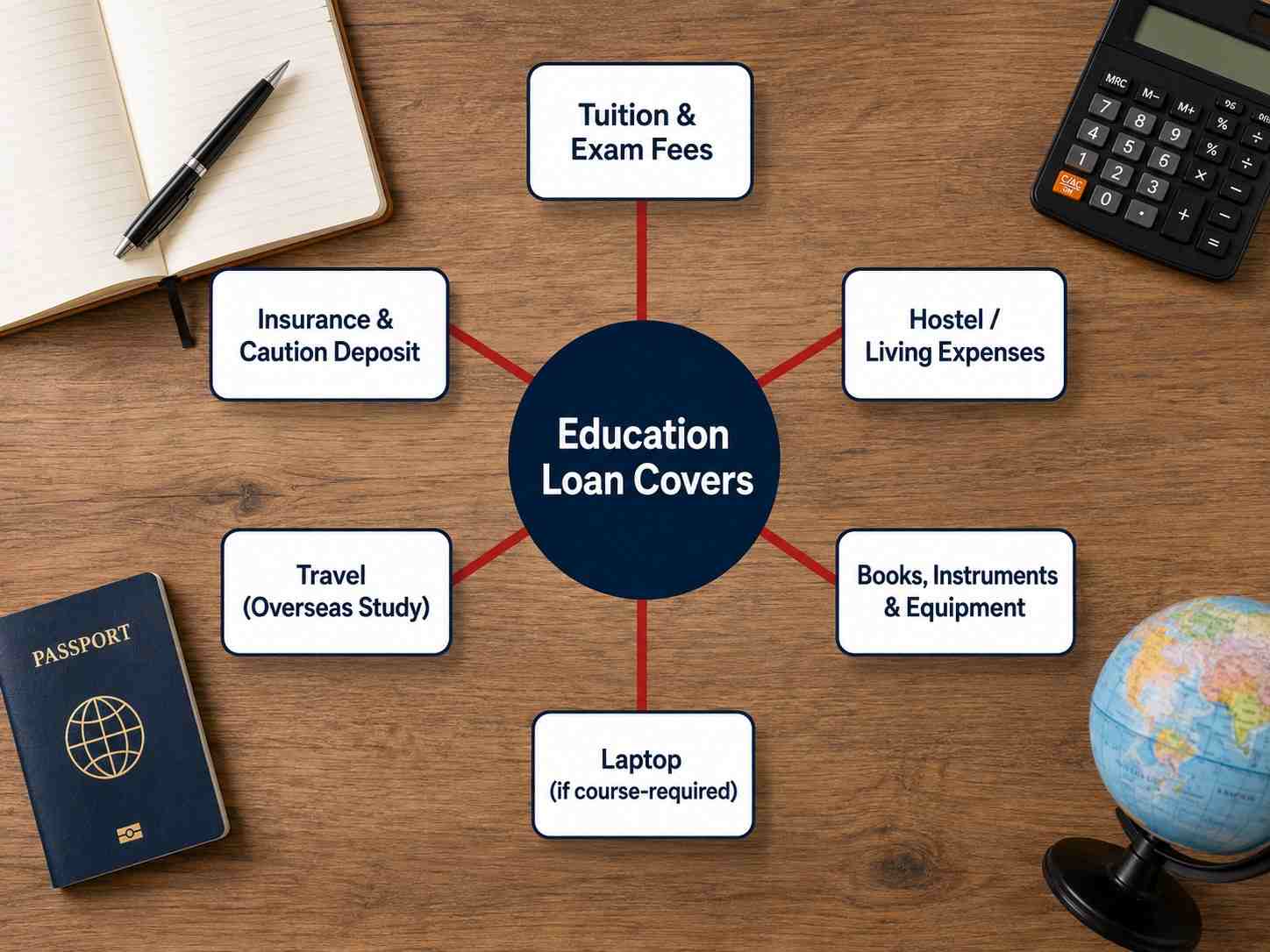
The amount is generally disbursed in stages according to the institution’s demand rather than handed over as unrestricted cash. The exact heads depend on the lender and scheme.
|
Cost head |
Common treatment |
What to verify |
|
Tuition and examination fees |
Commonly considered |
Institution-issued fee schedule and payment dates |
|
Hostel or reasonable living expenses |
May be considered within the approved estimate |
Lender caps, location and documentary proof |
|
Books, instruments and equipment |
Often considered when course-related |
Invoices, specifications and scheme limits |
|
Laptop or computer |
Sometimes allowed when necessary for the course |
Maximum eligible amount and direct-payment rule |
|
Travel for overseas study |
May include one economy fare |
Whether visa and travel costs are reimbursable |
|
Insurance |
May be required or financed in some products |
Premium, beneficiary and effect on the loan cost |
|
Caution deposit |
May be restricted to a stated percentage |
Refundability and lender cap |
|
Study tours, projects or thesis costs |
Case-specific |
Certification from the institution |
Prepare a year-by-year cost sheet rather than quoting a rounded amount. Deduct confirmed scholarships, grants, assistantships and savings to identify the actual funding gap.
Read more: LegalBabu’s EMI planning calculator can test repayment scenarios, while its compound-interest calculator helps show how unpaid interest can increase the balance.
Who is eligible for an education loan in India?
There is no single nationwide approval checklist. The RBI education-loan explains regulatory points, but banks and other regulated lenders set their own board-approved credit policies. A government scheme may add separate course, institution, income or admission conditions.
Student and course eligibility
Lenders commonly examine whether the student:
-
is an Indian citizen or falls within another expressly permitted category;
-
has secured admission, normally through the recognised selection process;
-
is joining an eligible degree, diploma, professional, technical or skill programme;
-
has a consistent academic record or a reasonable explanation for gaps;
-
is studying at a recognised or lender-accepted institution; and
-
can provide the admission letter, course duration and official course fee schedule.
Age limits are not uniform. Some products prescribe a range, while others assess age with course duration and repayment feasibility. Applicants should therefore check the chosen scheme instead of treating an age shown on a comparison website as a legal rule.
The recognised institution test also depends on the programme and the competent regulator. Recognition alone does not compel a lender to finance the course, because its approved institution list and credit policy may be narrower.
Co-applicant and repayment assessment
A parent or guardian commonly signs as the co-applicant for an education loan because many students do not yet have income. The lender may examine the co-applicant’s salary or business income, existing EMIs, dependants, banking conduct, tax returns and credit history. A spouse or another relative may be accepted under some products, but the relationship and income requirements are lender-specific.
Neither the RBI nor law publishes one universal CIBIL score that guarantees sanction. A limited student credit history is not the same as an adverse record; however, existing overdue accounts, settlements, write-offs or repeated cheque returns involving an applicant or co-borrower can affect appraisal. Self-employed co-applicants should reconcile ITRs, bank credits and financial statements.
LegalBabu’s small-business accounting guide explains why consistent records matter when income is not evidenced by salary slips.
What is regulatory and what is lender-specific?
Below are the differences between regulatory and lender-specific decisions:
|
Issue |
Regulatory or official position |
Lender-specific decision |
|
Interest rate |
RBI has deregulated scheduled commercial-bank lending rates, subject to applicable directions |
Benchmark, spread, concessions, reset and final rate |
|
Collateral up to ₹4 lakh |
RBI states banks must not take collateral for education loans up to ₹4 lakh |
Documentation and credit appraisal still apply |
|
Higher collateral-free limits |
May arise under PM-Vidyalaxmi, CGFEL or a bank product |
Eligibility, institution list and product conditions |
|
Loan amount |
No universal maximum for every product |
Need-based amount, eligible cost, margin and repayment capacity |
|
Approval time |
No universal RBI promise for every application |
Product, completeness, verification and collateral title work |
|
Co-applicant |
Common under model and bank schemes |
Accepted relationship, income and documentation |
How much can a student borrow and is collateral required?
The sanctioned amount is usually need-based. A lender may start with the institution’s official cost, subtract scholarships and the applicant’s contribution, exclude ineligible expenses, and then test repayment. For an overseas course, it may also use its own ceiling for living costs, travel and equipment.
Margin money
Loan margin is the portion of eligible cost that the borrower must fund. For example, if eligible cost is ₹20 lakh and the applicable margin is 10%, the borrower contributes ₹2 lakh and finance may cover up to ₹18 lakh, subject to appraisal. Some products have nil margin for lower amounts or selected institutions; others apply a percentage above a threshold. Scholarships may be counted towards margin under certain schemes.
Collateral and guarantee thresholds
The terms “collateral-free” and “guarantor-free” do not mean appraisal-free. The borrower must still satisfy admission, documentation, end-use and credit conditions.
-
RBI’s FAQ records the minimum direction that banks should not obtain collateral security for education loans up to ₹4 lakh.
-
The NCGTC education-loan guarantee scheme supports eligible loans up to ₹7.5 lakh through member lending institutions. NCGTC does not lend to the student directly.
-
PM-Vidyalaxmi provides collateral-free and guarantor-free finance for students who obtain merit-based admission to designated Quality Higher Educational Institutions, subject to the scheme rules.
-
A lender’s premium-institution or overseas product may offer a different unsecured limit. That is a product feature, not a universal entitlement.
For secured finance, acceptable security may include residential property, certain deposits or other assets permitted by the lender. Property security can require title documents, searches, valuation, insurance and creation of a valid charge. If a family is comparing a mortgage-backed alternative, understand the different end use and risk in LegalBabu’s loan against property guide. The family home is at risk if a secured facility is not repaid.
If an FD is proposed as security, compare the loan terms with the deposit’s maturity value using the FD return calculator before deciding whether pledging or breaking the deposit is preferable.
What documents are required for an education loan?
The documents required for an education loan in India vary by lender, course, country, amount, co-applicant and security. Submit clear, current and consistent records; a generic list cannot override the lender’s checklist.
|
Applicant or stage |
Common education loan documents |
|
Student KYC |
PAN or Form 60 where accepted, Aadhaar or another officially valid document, address proof, photographs and signature proof |
|
Academic record |
Class 10 and 12 marksheets, graduation records for postgraduate study, entrance-test results and gap explanation where relevant |
|
Admission and course |
Unconditional or accepted offer/admission letter, course details, duration, institution recognition and official fee schedule |
|
Funding plan |
Year-wise cost sheet, scholarship or assistantship letter, savings evidence and source of margin |
|
Co-applicant KYC |
PAN, identity and address proof, relationship proof and photographs |
|
Salaried co-applicant |
Salary slips, Form 16, ITR where requested, employment proof and bank statements |
|
Self-employed co-applicant |
ITRs, computation of income, financial statements, business proof and bank statements |
|
Existing liabilities |
Loan statements, EMI details, guarantees and explanation of any past credit issue |
|
Overseas study |
Passport, visa when available, foreign-university offer, cost-of-attendance statement, test scores and country-specific evidence |
|
Property collateral |
Title and sale deeds, chain documents, approved plan, tax receipts, encumbrance/search records and valuation documents as requested |
|
Other security |
FD receipt, demat or investment statements, assignment forms or policy documents where accepted |
|
Subsidy or scheme |
Family-income certificate, category or scheme declarations, Aadhaar and proof of qualifying admission/institution |
|
Disbursement |
Fee demand, academic-progress evidence, margin-payment proof, invoice and beneficiary account details |
Names, addresses and dates of birth should match across KYC, admission and bank records. Explain changes with proper evidence rather than editing documents. For an education loan for abroad studies, check that the passport name matches the offer, visa and test records.
Keep the same indexed file for appraisal and later loan disbursement requests. This reduces the risk of submitting an outdated fee demand, bank statement or academic record at a later stage.
How to apply for an education loan in India
The education loan application process should begin as soon as the admission and reliable cost information are available. Do not wait until the fee deadline if collateral valuation or legal verification may be required.
1. Verify the institution, course and admission route
Confirm recognition with the relevant regulator and ask whether the lender lists or categorises the institution. For PM-Vidyalaxmi, verify the current QHEI list and merit-based admission condition on the official PM-Vidyalaxmi portal. Management or NRI quota admission does not qualify for that scheme benefit under the current official description.
Students considering vocational training should first check whether a grant-funded or subsidised route reduces borrowing.
LegalBabu’s PMKVY guide for skill courses gives a starting point for comparing training support, while applicants for aviation-related training can review the IATA-approved training-centre guide before approaching a lender.
2. Calculate the funding gap
Prepare a year-wise table covering tuition, mandatory fees, accommodation, food, books, equipment, travel, insurance and contingency. Subtract confirmed scholarships, assistantships and family funds. Keep evidence for every major figure.
3. Select the appropriate route
Check the normal lender product, an institution-specific scheme and any government-supported route. Students eligible for PM-Vidyalaxmi should apply through its unified portal. Other applicants may use the bank’s official website or branch as permitted by the product.
4. Compare more than the headline rate
Request the applicable rate basis, spread, reset frequency, margin, moratorium, security, processing charges, legal and valuation expenses, insurance, prepayment terms and late-payment charges. Compare the annual percentage rate and total repayment, not only the nominal rate.
5. Prepare the student and co-applicant file
Arrange documents by category and reconcile income with bank statements and tax records. A salaried co-applicant can use LegalBabu’s salary calculator for an initial take-home estimate, but the lender will rely on verified income and liabilities.
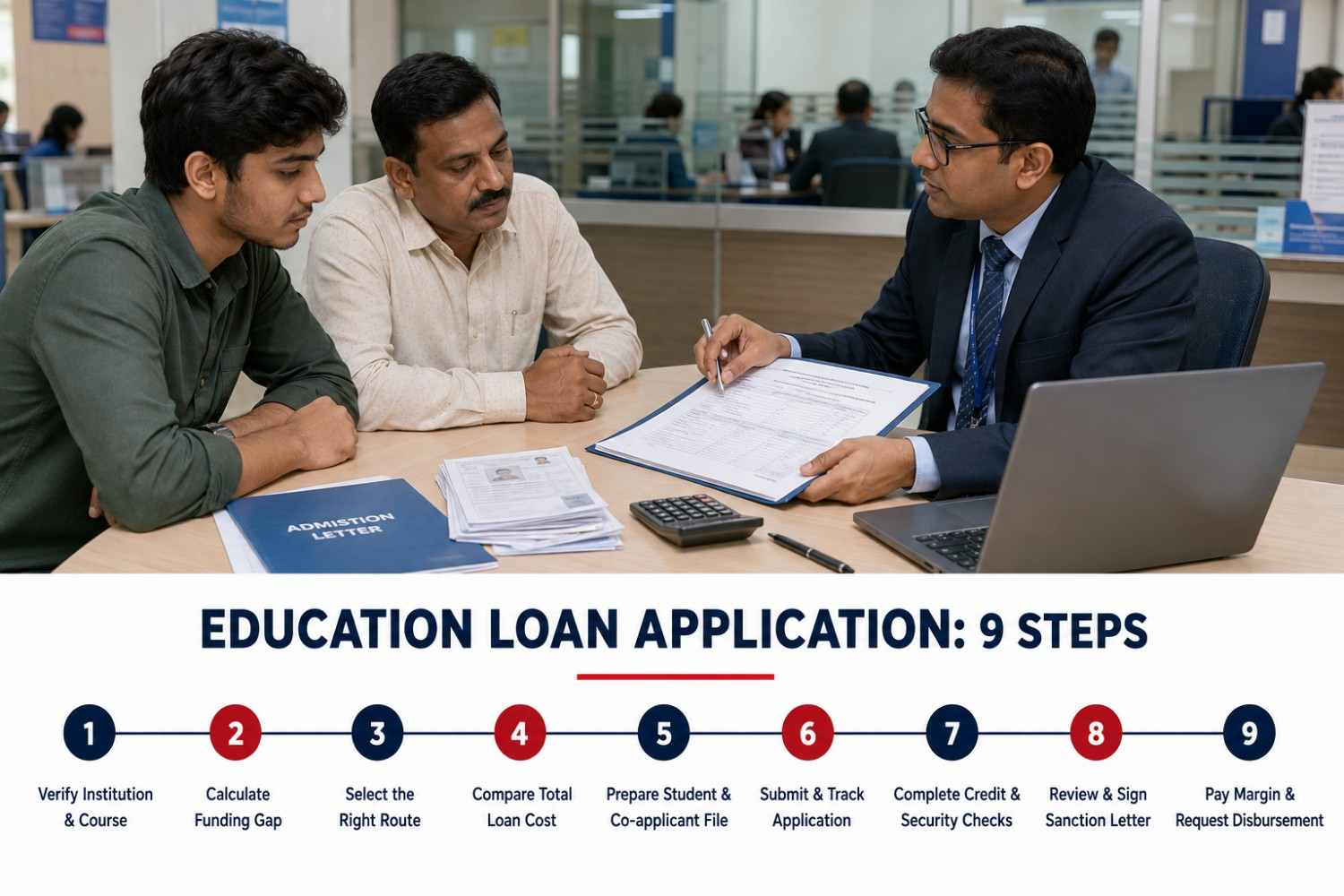
6. Submit the application and track it
Complete every mandatory field and upload readable documents. Retain the application number, submitted cost sheet and acknowledgements. Respond promptly to requests, but share records only through the lender’s verified channel.
7. Complete credit and security verification
The lender may verify admission, academic results, co-applicant income, credit reports, employment or business, bank statements and collateral. Property-backed cases normally need a legal search and valuation. Do not pay an intermediary who promises guaranteed sanction or asks for a fee to “fix” a credit report.
8. Review the sanction letter and execute documents
Read the approved amount, rate, benchmark, spread, margin, moratorium, EMI start, security, guarantee, insurance, conditions before each disbursement and events of default. Ask for corrections in writing before signing. A sanction is conditional until the documents and pre-disbursement requirements are completed.
9. Pay the margin and request each disbursement
Provide the fee demand and proof of the borrower’s contribution where required. The lender commonly pays the institution or another approved beneficiary directly. Later instalments may depend on academic progress, fee demands and continued compliance.
How do interest, moratorium and total cost work?
There is no single education loan interest rate for India. The final rate may depend on the lender, scheme, benchmark, institution category, loan amount, security, co-applicant profile and concessions. The RBI confirms that scheduled commercial-bank rates are deregulated, subject to its applicable interest-rate directions.
Rate, spread and annual percentage rate
For a floating-rate loan, ask for:
-
the external or internal benchmark;
-
the spread added to it;
-
the reset frequency;
-
the conditions under which the spread can change; and
-
how rate changes alter the EMI or tenure.
RBI’s Key Facts Statement direction requires regulated entities to give prospective retail term-loan borrowers standardised key information, including the annual percentage rate and amortisation schedule, under the applicable framework. The annual percentage rate is more useful than the nominal rate because it captures interest and specified charges used in the prescribed calculation.
A moratorium is not automatically interest-free
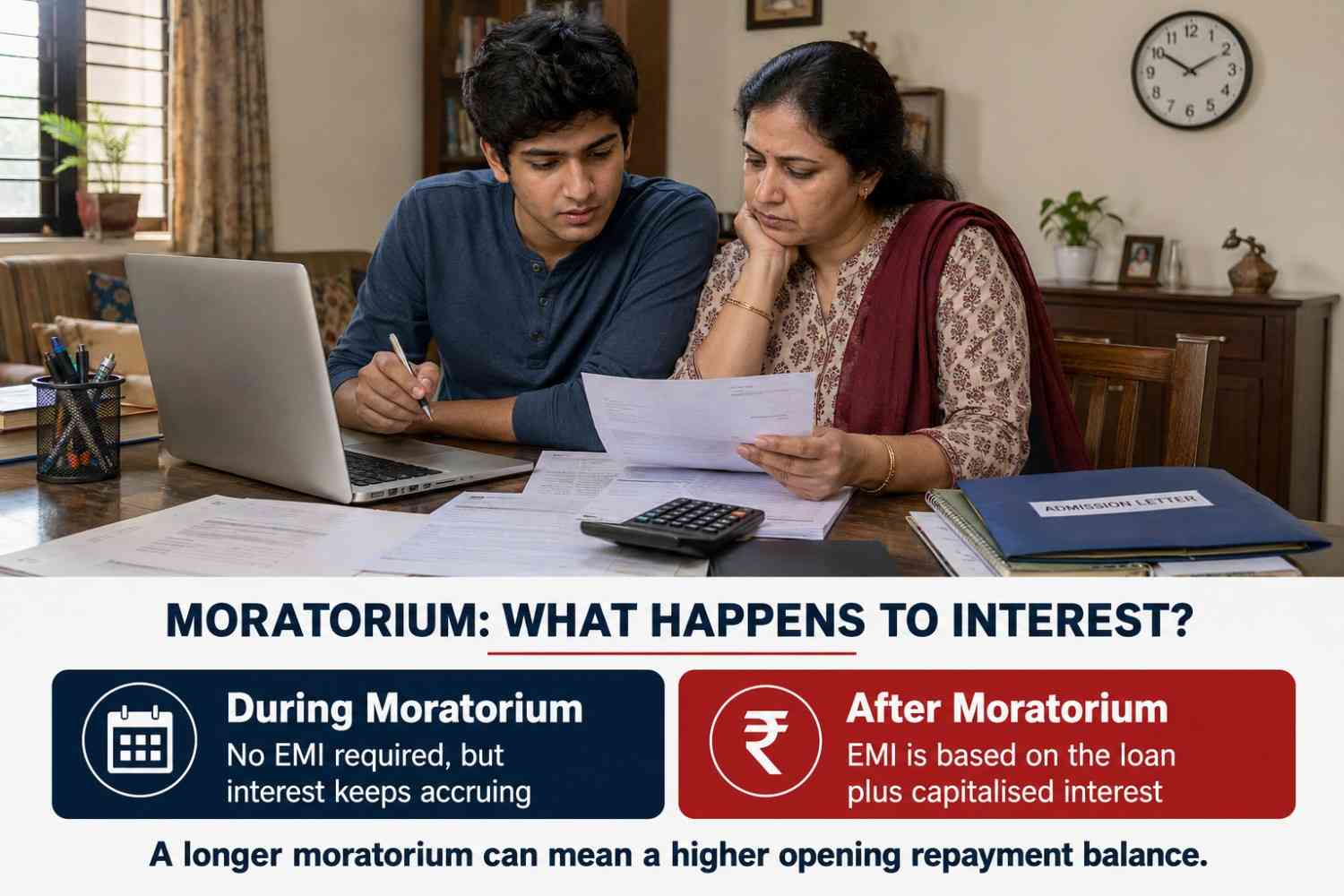
The education loan moratorium period is a repayment holiday defined by the product, commonly the course period plus a stated period after completion, or another job-linked condition. Interest may continue to accrue during this time. If unpaid interest is added to principal, the EMI is calculated on a higher balance. A longer loan tenure can reduce the monthly instalment but usually increases total interest when other assumptions remain the same.
Illustration only: if ₹10 lakh is fully outstanding for three years at a simple 10% annual rate during the moratorium, ₹3 lakh of interest would accrue before repayment. If that amount is capitalised, repayment starts on ₹13 lakh, not ₹10 lakh. Actual results differ because education loans are often disbursed in stages, rates can reset, and lender methods vary.
Some products offer a concession when interest is serviced during study. Compare the cash-flow benefit with the saving in total interest; do not assume that servicing is compulsory or that every lender provides a concession.
Costs to compare
|
Cost or term |
Why it matters |
|
Nominal interest rate |
Determines periodic interest but does not show all charges |
|
Annual percentage rate |
Supports like-for-like cost comparison under the KFS framework |
|
Processing charge |
May be fixed, percentage-based, waived or non-refundable |
|
Legal and valuation cost |
Relevant mainly where property or another asset is offered |
|
Insurance premium |
Can add to the amount financed or require separate payment |
|
Margin contribution |
Determines how much the family must pay from its own funds |
|
Moratorium treatment |
Unpaid interest can increase the starting repayment balance |
|
Penal charges |
Apply to specified non-compliance; check amount, trigger and taxes |
|
Prepayment terms |
Affect the benefit of early repayment or refinancing |
|
Currency movement |
Can widen the funding gap for overseas education |
Which government schemes and tax benefits may apply?
PM-Vidyalaxmi scheme
The PM Vidyalaxmi scheme supports students admitted on merit to designated Quality Higher Educational Institutions in India. The Ministry of Education guidelines and the official portal should be checked for the current institution list and procedure.
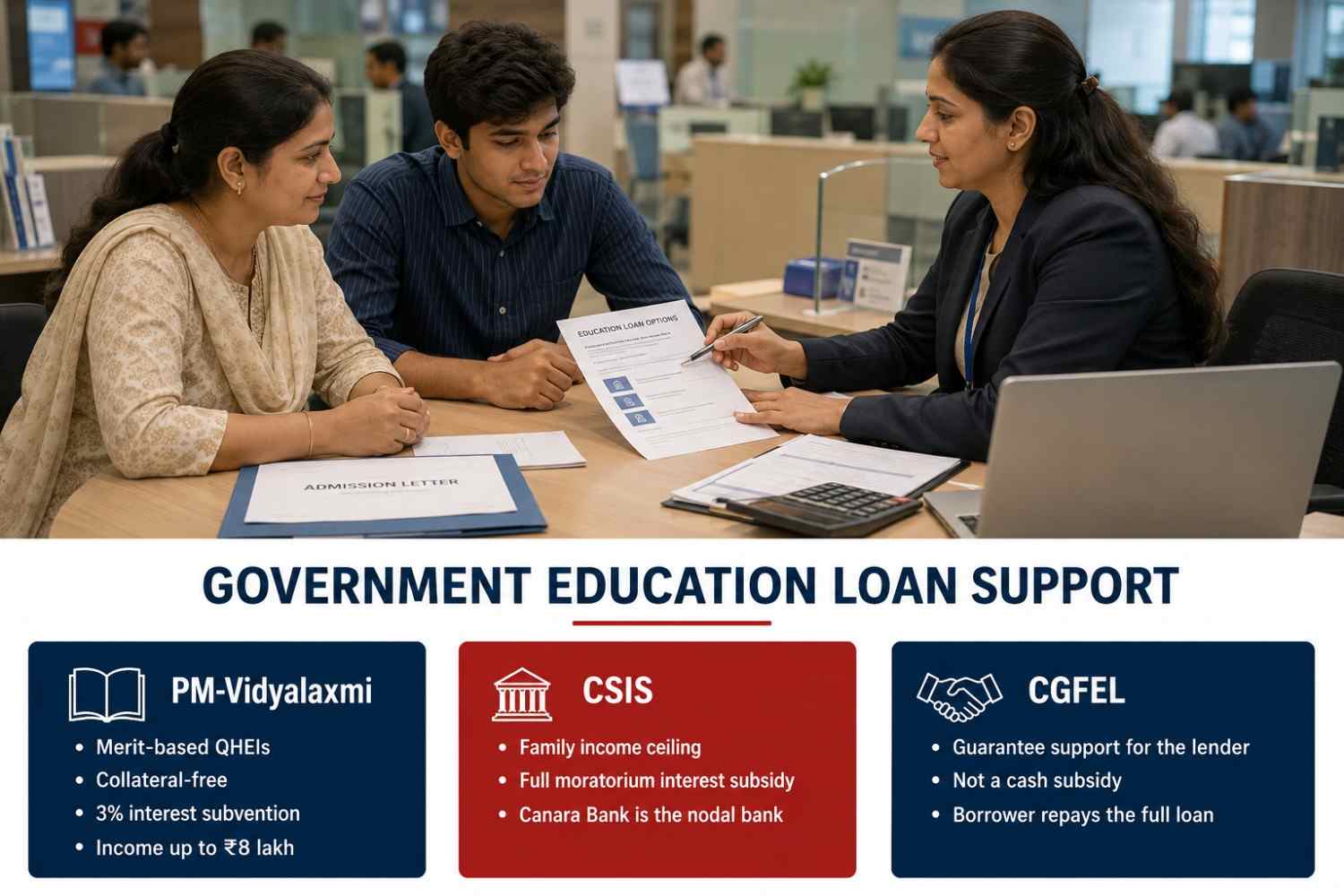
As reported by the Press Information Bureau in July 2026, the scheme then covered 1,425 QHEIs. It provides collateral-free and guarantor-free education loans for eligible merit-based admissions. Loans up to ₹7.5 lakh receive a 75% Government of India credit guarantee to support lenders, while eligible students with annual family income up to ₹8 lakh may receive 3% interest subvention on loan amounts up to ₹10 lakh during the moratorium, subject to scheme conditions and exclusions.
The loan itself has no stated universal upper cap under the scheme description, but the amount remains need-based and lender-appraised. Management quota and NRI quota admissions are excluded from the scheme benefit. An applicant cannot treat interest subvention as automatic merely because the institution appears on the list.
PM-USP CSIS and CGFEL
Under the Central Sector Interest Subsidy route, eligible students from families within the prescribed income ceiling may receive full moratorium-period interest subsidy on qualifying loans and courses, subject to the current guidelines. Canara Bank, the designated nodal bank, publishes the current CSIS information. The 2022 framework covers interest on qualifying loan amounts up to ₹10 lakh and sets course, institution, income and other conditions. An education loan subsidy reduces eligible interest; it does not erase principal, excluded interest or other contractual obligations.
CGFEL is a guarantee to eligible member lenders for qualifying education loans; it is not a cash subsidy paid directly to the borrower. The student still owes the loan according to the contract. The Ministry’s scholarships and education-loan should be checked for official scheme links and updates.
Section 80E education loan tax benefit
Section 80E permits an eligible individual to deduct interest actually paid on a qualifying higher-education loan taken from a specified financial or approved charitable institution. The Income Tax Department’s Section 80E sets out the legal conditions. Principal repayment does not qualify.
The deduction is available for the initial assessment year in which interest payment begins and the next seven assessment years, or until the interest is fully paid, whichever is earlier. There is no separate rupee cap in the section on the qualifying interest, but the taxpayer must satisfy the borrower, lender, purpose and payment requirements.
Under the current regime structure, Section 80E is an old-regime Chapter VI-A deduction. The Income Tax Department’s AY 2026–27 guide lists the limited deductions available under the new regime and Section 80E among old-regime benefits. Compare the total tax under both regimes rather than selecting the old regime only for one deduction;
Read more: LegalBabu’s new-versus-old tax regime guide and income-tax calculator can support the initial comparison.
Keep the annual interest certificate and loan details required in the return. LegalBabu’s income-tax filing guide explains the broader filing process. Tax treatment can change, so verify the applicable assessment year before claiming the education loan tax benefit under Section 80E.
How should students compare loan offers?
Use the same assumptions for every offer: identical disbursement dates, rate scenario, moratorium and tenure. Ask each lender for the KFS and sanction terms.
|
Comparison point |
Questions to ask |
|
Eligible cost |
Which fee, living, travel and equipment heads are excluded? |
|
Sanction and disbursement |
Is the full course cost sanctioned, and what conditions apply to each instalment? |
|
Interest |
What are the benchmark, spread, reset and effective APR? |
|
Moratorium |
When does it end, what interest is due and will unpaid interest be capitalised? |
|
Security |
Is collateral required, what value is accepted and who bears legal costs? |
|
Co-applicant |
Whose income is considered and what continuing obligations apply? |
|
Margin |
What must be paid from personal funds and when? |
|
Repayment |
What are the EMI, tenure, prepayment rule and consequence of rate changes? |
|
Default |
What are penal charges, notices, reporting and enforcement rights? |
|
Service |
How are subsequent disbursements and grievances handled? |
Do not use a commercial business loan for personal tuition without checking the permitted end use. LegalBabu’s guides explain how a business-purpose loan, working-capital facility and project finance serve different commercial needs. A term loan structure may look similar because it uses scheduled instalments, but education products have their own admission, moratorium and disbursement rules.
Likewise, a bank guarantee is a contingent undertaking, not cash for course fees, and LegalBabu’s CGTMSE collateral-free loan guide concerns eligible business credit rather than a student’s higher-education borrowing. These distinctions prevent an applicant from selecting an unsuitable facility merely because it is described as “collateral-free”.
Why can an education loan application be rejected or delayed?
Common weaknesses include:
-
an unrecognised or lender-ineligible institution or course;
-
admission through a route excluded by the selected scheme;
-
an incomplete or inconsistent fee and living-cost estimate;
-
missing KYC, income, academic or collateral records;
-
adverse credit conduct or undisclosed liabilities;
-
insufficient, unstable or unverified co-applicant income;
-
weak or disputed collateral title;
-
unrealistic post-course income assumptions;
-
unexplained academic gaps; or
-
applying too close to the fee deadline.
Improve the file by reconciling names and figures, documenting the funding gap, disclosing existing liabilities, correcting genuine credit-report errors through the proper channel and selecting a lender whose product accepts the course and institution. If one application is declined, ask for the stated reason. Do not submit multiple rushed applications without addressing the underlying issue.
No adviser can guarantee approval. Strong preparation makes appraisal easier, but the lender retains its credit decision within applicable law, regulation and policy.
What happens after sanction and disbursement?
Sanction is not the end of the process. The borrower may need to complete documents, create security, take insurance, pay margin and submit a fresh fee demand before the first disbursement. Later disbursements can depend on marksheets, continuation in the course and proof of prior payment.
Track every disbursement, interest debit and rate reset. During the moratorium, decide whether voluntary interest payments are affordable and beneficial. Before EMI commencement, request the final amortisation schedule and confirm the repayment account.
An education loan repayment affects the credit records of the borrower and co-borrower. Set payment instructions before the due date, maintain a buffer and contact the lender early if genuine difficulty arises. A moratorium does not permit missed payments after the contractually stated start date.
If collateral documents are held, obtain closure confirmation and document-release instructions after full repayment. Never assume a no-dues certificate automatically removes every registered security interest; verify completion with the lender.
How can a borrower raise a complaint?
First write to the lender’s branch or designated grievance officer and keep the complaint number, documents and response. Describe the service deficiency clearly; disagreement with a valid credit decision is different from delay, non-disclosure or failure to follow an accepted sanction.
If the lender does not respond within the applicable period or the reply is unsatisfactory, eligible complaints can be filed under the RBI Integrated Ombudsman framework through the RBI Complaint Management System. The RBI education-loan FAQ also explains this escalation route. Scheme-portal issues should be raised through the official portal’s grievance facility.
Conclusion
An Education Loan works best when the course is verified, the cost sheet is realistic, and the family understands the full repayment obligation. Check education loan eligibility, prepare complete education loan documents, compare the KFS and annual percentage rate, and read the sanction conditions before accepting an offer.
Government support can reduce collateral or interest for eligible students, but PM-Vidyalaxmi, CSIS and CGFEL each have different purposes and conditions. Treat advertised rates, unsecured limits and timelines as lender-specific unless an official rule states otherwise. A disciplined education loan application process, from admission verification to post-disbursement tracking, protects both the student’s academic plan and the family’s finances.
FAQS
FAQs About Education Loan
-
Can I get an education loan without collateral in India?
Yes, an education loan without collateral in India is possible, but the applicable limit and conditions depend on the regulatory minimum, government scheme and lender product. RBI says banks should not take collateral for education loans up to ?4 lakh, while eligible CGFEL, PM-Vidyalaxmi and institution-specific products may provide higher collateral-free support. The lender will still assess admission, course, co-applicant, documentation and repayment prospects.
- What is the education loan eligibility for students in India?
- Is a co-applicant compulsory for an education loan?
- What CIBIL score is required for an education loan?
- How is education loan interest calculated?
- Does the moratorium make an education loan interest-free?
- How can I apply for an education loan online?
- How long does an education loan take to be approved?
- Can I claim an education loan tax deduction under Section 80E?
- Can I obtain an education loan before confirmed admission?


