
Mandatory Comprehensive Inspection Programme (CIP) for All DGMA-Approved Maritime Training Institutes
- by kapil
- Updated August 16, 2026
- 17 mins read
India’s maritime training sector received a landmark regulatory update on 20 March 2026, when the Directorate General of Maritime Administration (DGMA) – formerly known as the Directorate General of Shipping (DGS) – issued DGMA Order No. 3 of 2026, a single unified framework governing the Comprehensive Inspection Programme (CIP)for all DGMA-approved Maritime Training Institutes (MTIs).
Whether you run a pre-sea institute, conduct competency courses, or operate modular STCW training, the Comprehensive Inspection Programme now applies to you under one consolidated order. This guide breaks down everything you need to know – from applicability and grading to fees, non-conformities, and placement criteria.
What Is the Comprehensive Inspection Programme (CIP)?
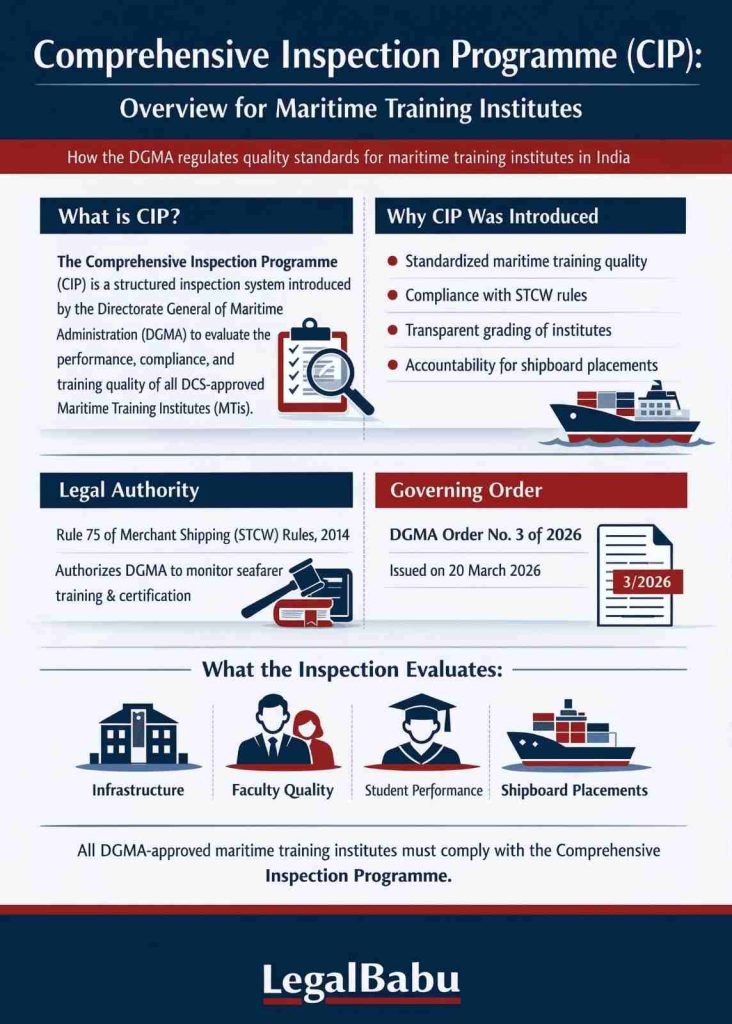
The Comprehensive Inspection Programme is a structured, graded audit system introduced by the Directorate General of Maritime Administration to standard is equality, ensure STCW compliance, and bring transparency to maritime training across India. The CIP assesses Maritime Training Institutes against objective parameters covering faculty quality, infrastructure, student outcomes, and – critically – shipboard placement performance.
Before 2026, three separate orders governed CIP inspections:
- DGMA Order No. 23 of 2014 – Competency courses
- DGMA Order No. 04 of 2016 – Pre-sea training
- DGMA Training Circular No. 33 of 2018 – Modular/basic STCW courses
DGMA Order No. 3 of 2026 integrates all three into one Comprehensive Inspection Programme, effective from its date of issue. The result is a harmonised, clearer, and more rigorous inspection regime that covers every DGMA-approved course type under a single framework.
Regulatory Basis: The CIP derives its authority from Rule 75 of the Merchant Shipping (STCW) Rules, 2014, which authorises the Director General of Maritime Administration to supervise and monitor all matters related to seafarer training, assessment, and certification in compliance with the STCW Convention.
Applicability – Which Institutes Must Undergo CIP?
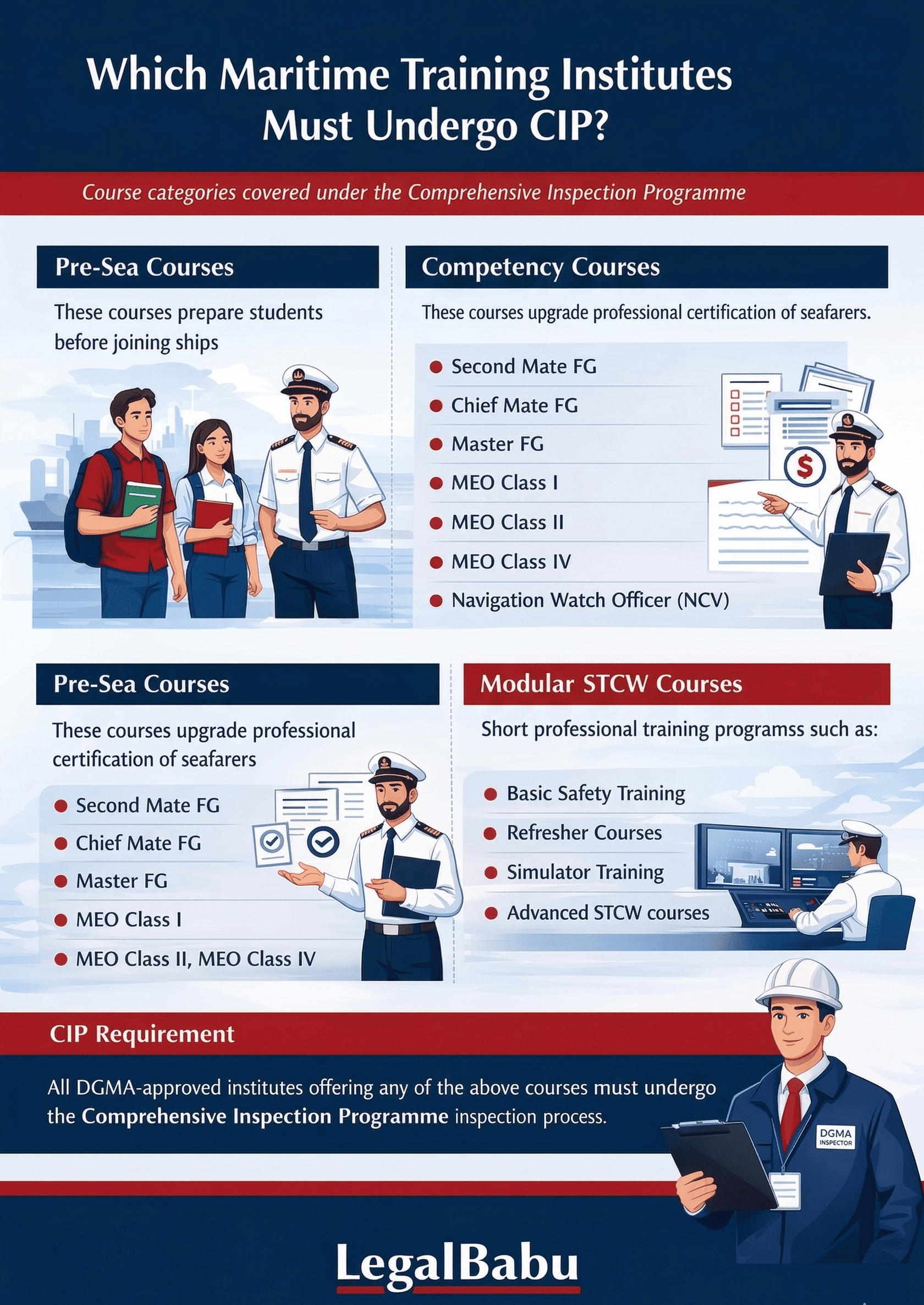
The Comprehensive Inspection Programme applies to all DGMA-approved Maritime Training Institutes, regardless of which course type they offer.
Pre-Sea Courses
- B.Sc. Nautical Science / B.S. Nautical Technology (3/4 years)
- Diploma in Nautical Science (DNS) – 1 year
- Marine Engineering Degree – 4 years
- Graduate Marine Engineering (GME), DME, ATS, ETO
- GP Rating Course (6 months)
- Certificate Course in Maritime Catering (CCMC)
Post-Sea Competency Courses
- Second Mate FG, Chief Mate FG Phase I & II, Master FG
- MEO Class I, II, IV (FG), MEO Class III (SEO/CEO)
- Navigation Watch Officer (NCV), Chief Mate (NCV), Master (NCV)
Modular STCW Courses
All DGMA-approved modular and post-sea courses not listed above – including basic safety training, simulator courses, and any other DGMA-approved programme.
| Course Type | CIP Required? | Checklist |
| Pre-Sea | Yes | Annexure II (Max 11,000 pts) |
| Competency | Yes | Annexure III (Max 3,000 pts) |
| Modular | Yes | Annexure IV (Max 3,500 pts) |
Any existing CIP – whether Initial, Renewal, or Annual – falling due after the order’s issue date must follow this new framework.
Pre-sea institutes must also comply with infrastructure norms, including pool requirements. Read our detailed guide on DGMA Swimming Pool Compliance Rules for MTIs to ensure full readiness before your CIP inspection.
Key Compliance Requirements of the Comprehensive Inspection Programme
Every MTI must meet the following requirements before and during the Comprehensive Inspection Programme:
Registration & Approvals
- Valid DGMA course approval for every course being conducted, with approval numbers and validity on record
- MTI must be a registered non-profit public trust or Section 8 company
- Batch details are submitted to DGMA E-Governance regularly and kept current
- Annual DGMA fees paid on time
Quality Management System
- Valid ISO 9001:2015 QMS certification mandatory – certificate must be from a NABCB – accredited body only
- Internal QMS audits by a qualified auditor with corrective actions monitored
- Management review meetings are held with documented minutes
- Non-conformity records with corrective and preventive actions are maintained
Faculty Requirements
- Minimum 50% of all classes must be taken by full-time faculty
- All faculty must comply with TOTA/VICT/TOTI/TSTA/AECS requirements
- Faculty age limits, medical fitness, and teaching hours must meet prescribed norms
- Any single non-compliance in faculty adequacy renders the entire section score zero
Infrastructure
- Valid statutory clearances – commercial operations license, non-agricultural land use, and local body registration
- Floor plans uploaded to DGMA E-Governance; smart boards or projectors in classrooms as per norms
- Digital library with IMO mandatory publications and industry subscriptions maintained
- Swimming pool compliant with DGMA Circular 59 of 2025 is mandatory for applicable pre-sea courses – outsourcing scores zero
- CAS biometric attendance machines are installed, operational, and the fire plan has been uploaded to E-Governance
Placement & Shipboard Training
- A dedicated placement cell with active staff and records published on the MTI website is mandatory
- MoUs with shipping companies or RPSL-registered placement providers are required for sea berths
- Sign-on date in DGMA E-Governance is the only accepted proof of placement
- Quarterly course completion certificate reports submitted as per DGMA Training Circular 18/2020
- MTI must track all trainees through the complete onboard training period
Transparency & Disclosure
- Current CIP grading for each course type is displayed permanently on the MTI website and in all print media – same font, colour, and size
- Non-compliance with display requirements is a breach of the code of ethics
- CIP certificate uploaded to DGMA E-Governance within one week of receiving final grading
Inspection Window Compliance
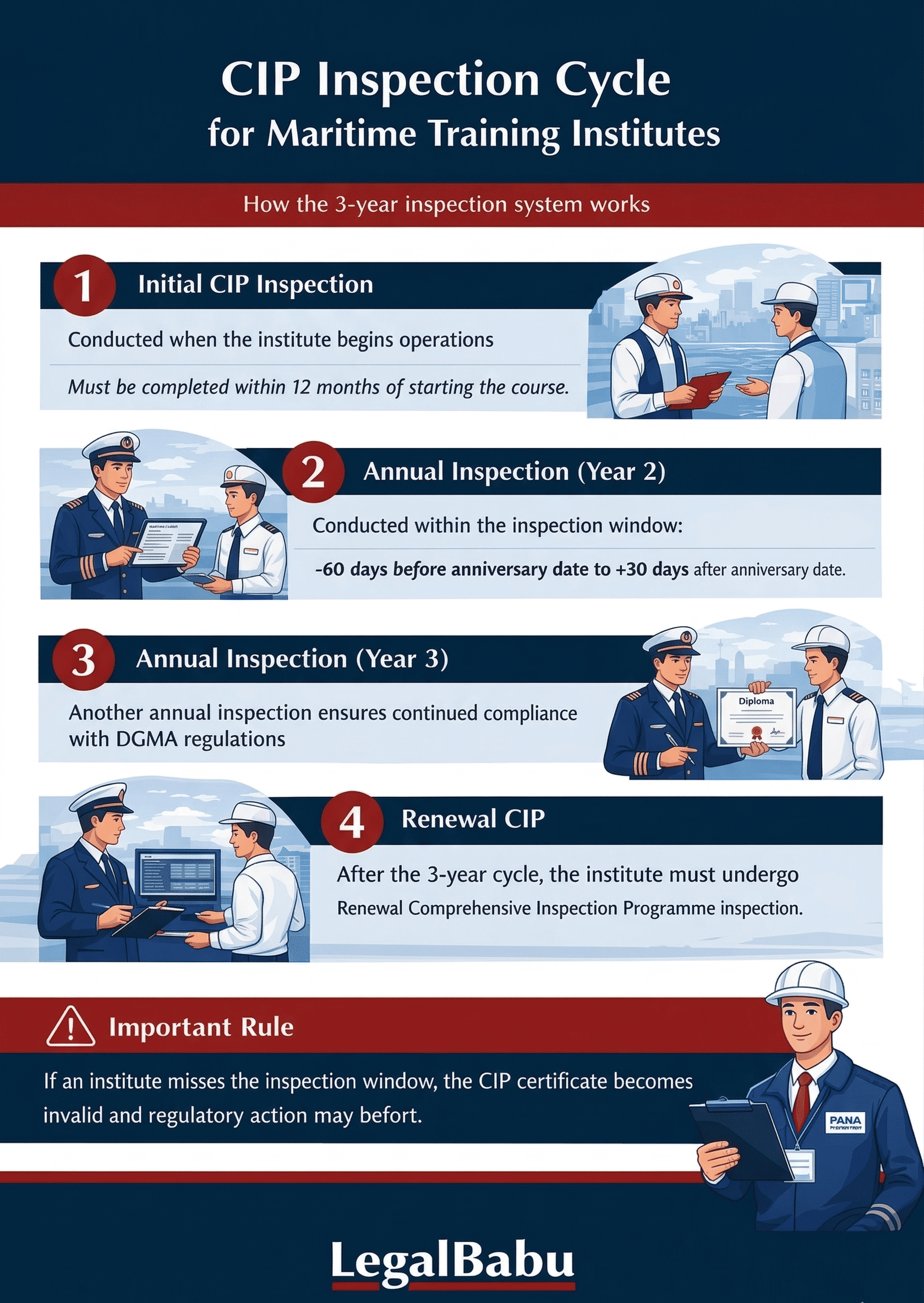
- Annual CIP must fall within -60 to +30 days from the anniversary date – missing the window can invalidate all CIP certificates
- Renewal CIP must begin within 60 days before expiry; maximum 30 days after expiry to complete
- Any deviation requires prior written approval from DGMA with supporting documents
Inspecting Authority – Who Conducts the Comprehensive Inspection Programme?
The CIP is conducted by either the Mercantile Marine Department (MMD)or an authorised Recognised Organisation (RO), typically a classification society empanelled by the DGMA under Notification S.O. 3316(E) dated 26.12.2014.
Key points about the inspecting authority:
- The inspection team must include auditors (management-level seafarers), with at least 50% holding a Certificate of Competency as Master (Foreign Going) or Chief Engineer (Unlimited).
- An MTI may approach any authorised RO or its jurisdictional MMD for the Comprehensive Inspection Programme.
- Once a CIP certificate is issued, the same RO/MMD must conduct all subsequent annual inspections within that 3-year cycle – changes require DGMA permission and a full initial inspection.
- The jurisdictional Principal Officer (PO), MMD, must confirm all grading before the RO issues the final CIP certificate.
Related: How to Start a Maritime Training Institute in India – LegalBabu
Inspection and Certification – How the CIP Process Works
The 3-Year CIP Cycle
Each Comprehensive Inspection Programme cycle spans three years: one initial inspection followed by two annual inspections.
| Inspection Type | When | Window Period | Key Consequence if Missed |
| Initial CIP | On commencement | Within 12 months of the first course | Non-compliance action by DGMA |
| Annual CIP | Year 2 & 3 | -60 days to +30 days from anniversary | All CIP certificates are invalidated |
| Renewal CIP | End of 3-year cycle | Within 60 days before expiry; max 30 days after | Cannot be conducted after the window |
- Anniversary date = date on which the initial CIP physical inspection was completed.
- If an MTI cannot meet the window period, it must seek specific prior approval from DGMA with supporting documentation.
- No CIP can be undertaken by any MMD or RO after the window period expires without DGMA permission.
Separate CIP Certificates per Course Type
The Comprehensive Inspection Programme issues separate CIP certificates for Pre-Sea, Competency, and Modular courses – each with a maximum validity of 3 years, subject to annual CIPs.
Grading Confirmation Process
After the CIP, the RO submits a draft report to the PO and jurisdictional MMD. The PO must confirm grading within 30 days of receiving the draft report. If no response is received within 30 days (unless additional time is sought), the report is deemed approved. MTIs must then upload the CIP certificate to DGMA E-Governance within one week of receiving final grading.
CIP Grading System – What the Grades Actually Mean
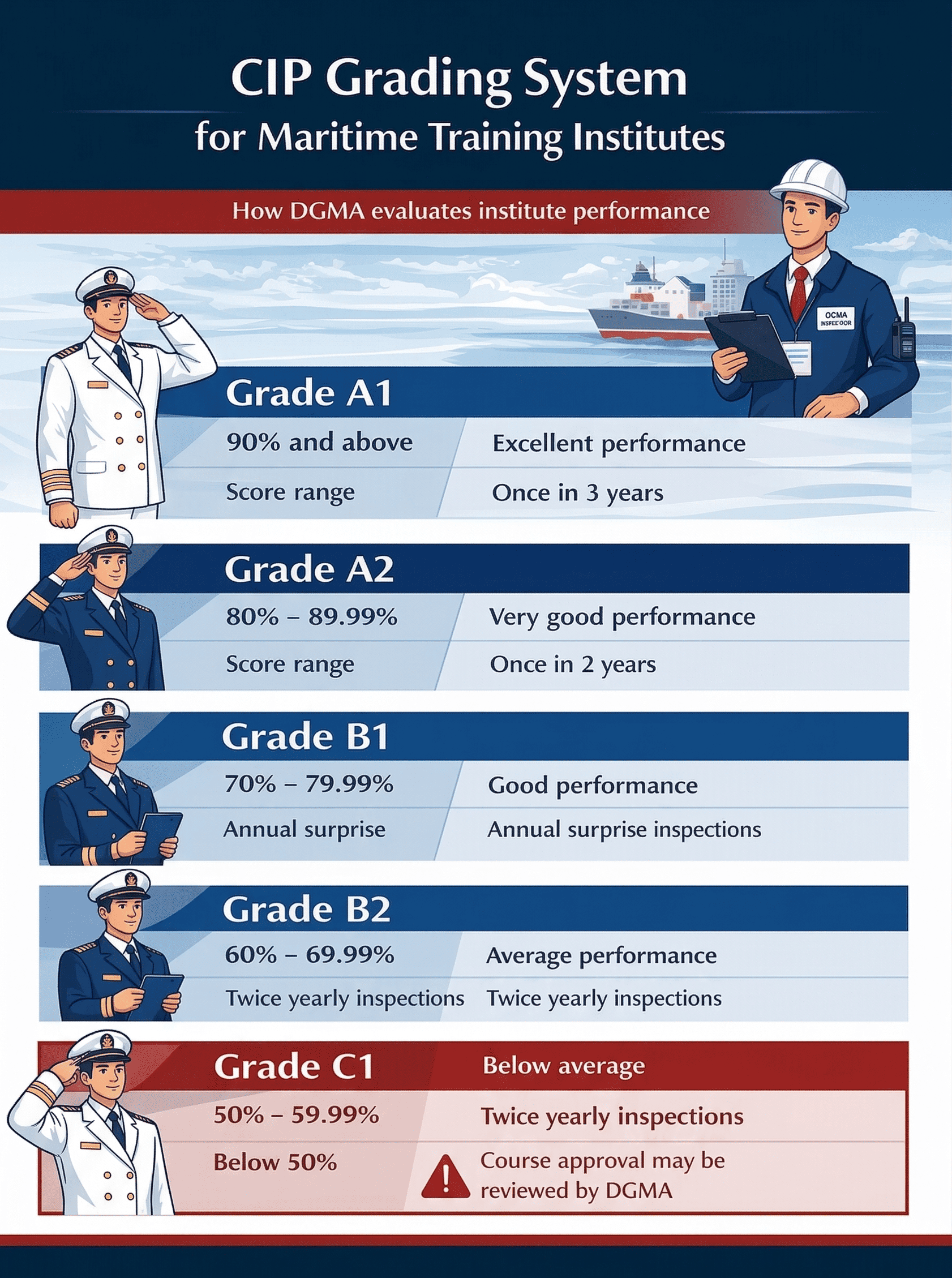
The Comprehensive Inspection Programme uses a six-tier grading scale based on the percentage of credit points scored:
| Grade | % Score | Meaning | Surprise Inspection Frequency |
| A1 | 90% and above | Excellent | Once in 3 years |
| A2 | 80%–89.99% | Very Good | Once in 2 years |
| B1 | 70%–79.99% | Good | Annually |
| B2 | 60%–69.99% | Average | Annually |
| C1 | 50%–59.99% | Below Average | Twice a year |
| C2 | Below 50% | Poor | Course approval reviewed by DGMA |
Critical rule – batch strength enhancement: For pre-sea institutes, batch size can only be increased if the MTI holds an A1 or A2 CIP grade and has a minimum 85% shipboard placement record per approved batch.
When an MTI conducts more than one course type, the final grading displayed on the DGMA website follows a hierarchy: Pre-Sea grading takes precedence, followed by Competency, then Modular. However, compliance benefits and restrictions apply separately – a B2 pre-sea grade cannot be offset by an A1 modular grade.
Transparency requirement: Every MTI must permanently display its current CIP grading for each course type on its website and in all print media advertisements – in the same font, colour, and size. Non-compliance is treated as a breach of the code of ethics.
Methodology for Grading – The CIP Checklist Explained
The Comprehensive Inspection Programme uses course-specific checklists with qualitative and quantitative parameters.
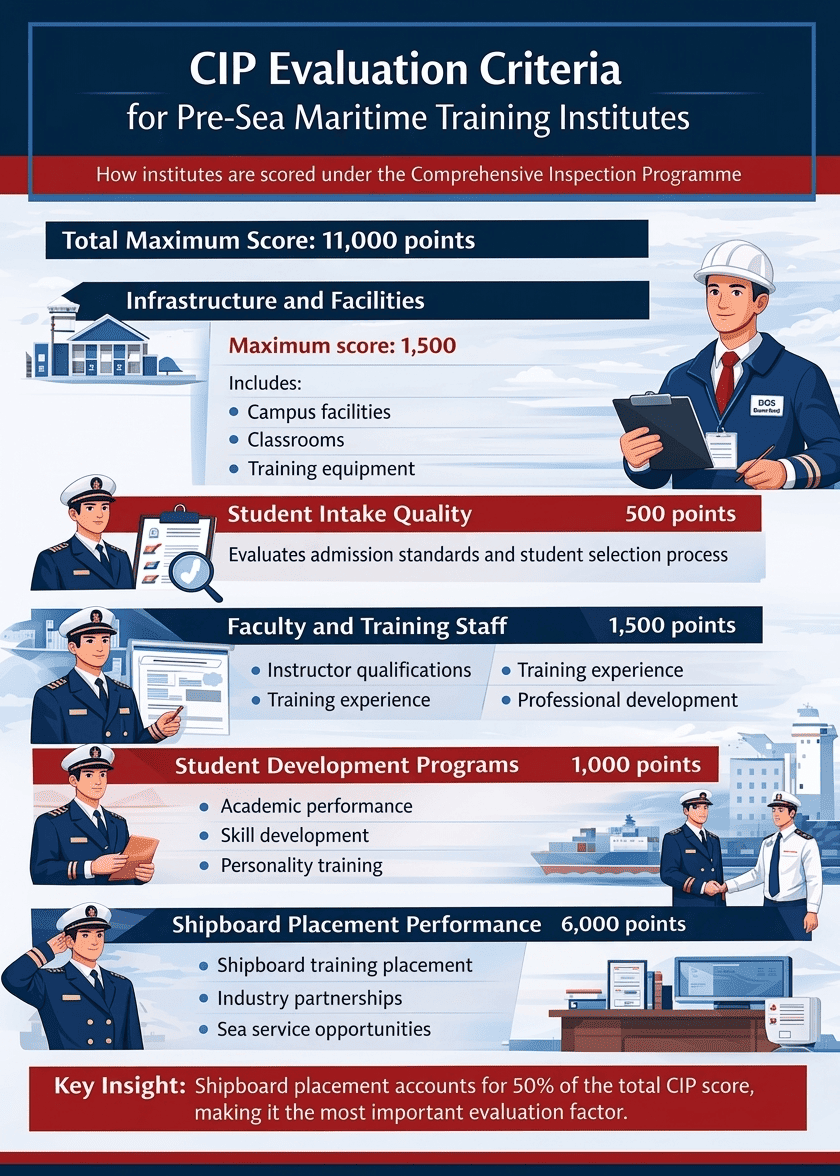
Pre-Sea CIP Checklist – Section-wise Breakdown (Max: 11,000 Points)
| Section | Area | Max Points | % Weight |
| I | Infrastructure Facility Maintenance & Ambience | 1,500 | 15% |
| II | Student Intake Quality | 500 | 5% |
| III | Faculty & Human Resource Development | 1,500 | 15% |
| IV | Student Development Programmes (Personality & Academic) | 1,000 | 10% |
| V | Placement Records | 6,000 | 50% |
| VI | Overall Performance & Management | 500 | 5% |
| Total | 11,000 | 100% |
Note: The total marks for pre-sea CIP have been increased from 10,000 to 11,000 under the new Comprehensive Inspection Programme order, with Section V (Placement) going from 5,000 to 6,000 points.
Competency Course CIP (Max: 3,000 Points)
- Infrastructure Set-up & Maintenance: 950 pts
- Faculty & Human Resource Development: 1,000 pts
- Student Performance & Sustainability: 500 pts
- Overall Performance & Management: 550 pts
Modular Course CIP (Max: 3,500 Points)
- Infrastructure Set-up & Maintenance: 1,200 pts
- Faculty, Students & Course Performance: 1,500 pts
- Overall Performance & Management: 800 pts
Items marked with an asterisk (*)in the checklist are split: 75% of base credit for meeting minimum DGMA norms and 25% additional credit for exceeding those standards. MTIs must hold a valid ISO 9001 certification from a body accredited by the National Accreditation Board for Certification Bodies (NABCB).
MTIs must hold a valid ISO 9001 QMS certification from a NABCB-accredited body. LegalBabu can help you obtain ISO 9001 QMS Certification for your MTI seamlessly.
Shipboard Training Criteria – The Heart of Pre-Sea CIP
Section V carries 50% of all marks in the pre-sea Comprehensive Inspection Programme – making placement performance the single most important factor in determining an institute’s grade.
What Counts as “Placement”?
Placement is considered achieved only when a trainee’s Sign-on date is recorded in the DGMA E-Governance system. The passing-out date varies by course – BEST result date for GP Ratings, university declaration date for DNS/B.Sc./B.E., and DGMA E-Governance batch details for GME/DME/ATS/ETO.
Placement Marks Calculation
| Placement Within 12 Months | Points (out of 4,000) | Placement 12–24 Months | Points (out of 1,000) |
| 100% | 4,000 | 100% | 1,000 |
| 90% | 3,600 | 90% | 900 |
| 80% | 3,200 | 80% | 800 |
| 70% | 2,800 | 70% | 700 |
| 60% | 1,200 | 60% | 500 |
| <10% | Nil | <20% | Nil |
For DNS / BSc / BE or B.Tech, it will be the date results are declared by the Indian Maritime University (IMU) or the respective university.
Intermediate percentages are interpolated. For MTIs offering multiple pre-sea courses, a weighted average across all batches is used. Up to 5% of the batch size may be treated as placed if a trainee can document pursuing an alternate career (e.g., armed forces, higher studies) – with evidence submitted to the Principal Officer.
MTIs must provide quarterly placement reports as per DGMA Training Circular 18 of 2020 and may enter into MoUs with shipping companies or RPSL-registered placement providers to secure sea berths – though the MTI remains responsible regardless of any tie-up arrangement.
Special Rules for New Maritime Training Institutes
A newly established MTI must undergo the Comprehensive Inspection Programme within 12 months of commencing its first DGMA-approved course. Key restrictions:
- No grading is assigned until all trainees from the first batch have been placed onboard ships OR 24 months have elapsed from passing-out, whichever comes first.
- No batch enhancement and no new pre-sea courses are permitted until the above condition is fulfilled.
- For a new pre-sea course started by an existing MTI, the same 24-month rule applies for that specific course’s grading.
Understanding the Course Approval Fee structure is essential before applying for course approvals.
Non-Conformities Under the Comprehensive Inspection Programme
| Type | Definition | Closure Deadline | Consequence if Unresolved |
| Minor NC | Procedural deviations from DGMA/IMO Model Course norms | 1–3 months | Converts to Major NC |
| Major NC | Serious deviations affecting institute performance or student output | Maximum 90 days | Suspension/withdrawal of course approval |
Examples of Minor Non-Conformities: improper faculty selection, faculty without TOTA/VICT compliance, incomplete attendance registers, inadequate lab maintenance.
Examples of Major Non-Conformities: admissions exceeding sanctioned strength, false submission of information, certificates awarded to absent candidates, and excessive minor NCs left unresolved.
During the tenure of a Major NC, the CIP grading is not valid. The STCW Compliance Board must be updated within 30 days of any Major NC. If a Major NC cannot be rectified, the Board deliberates on further action, which may include permanent withdrawal of approval.
CIP Inspection Fees – Annexure V
| Type of CIP | Course Types Covered | Fee (INR) |
| Initial / Renewal | Any one course type | ₹75,000 |
| Initial / Renewal | Any two course types | ₹1,00,000 |
| Initial / Renewal | All three course types | ₹1,25,000 |
| Annual Inspection | Irrespective of types | ₹75,000 |
| Appeal (Para 12) | – | ₹50,000 |
Note: RO fees are determined by mutual agreement between the RO and the MTI and are separate from MMD fees.
Appeal Process and Dispute Settlement
If an MTI disagrees with its Comprehensive Inspection Programme grading, the head of the institute may formally appeal to the Principal Officer of the jurisdictional MMD, along with the prescribed appeal fee of ₹50,000. The PO reviews the CIP assessment on merits and communicates the outcome. The PO’s decision is final and binding on both the MTI and the RO.
If a DGMA-appointed inspection team finds the original grading was off by two or more grades – and this pattern recurs – the Director General of Maritime Administration may suspend or cancel the concerned RO’s authorisation to conduct CIP inspections.
All disputes on the implementation of DGMA Order No. 3 of 2026 are ultimately settled by the Director General of Maritime Administration, whose decision is final and binding on all parties.
Conclusion
The Comprehensive Inspection Programme introduced through DGMA Order No. 3 of 2026, is the most significant overhaul of maritime training quality assurance in India in over a decade. By consolidating three separate frameworks into one unified Comprehensive Inspection Programme, the Directorate General of Maritime Administration (DGMA) has brought clarity, consistency, and greater accountability to MTI oversight nationwide.
The most critical takeaway for institutes is that the weight of Section V– placement performance now accounts for half of all CIP marks. Institutes that genuinely support their trainees through the complete training journey, from classroom to sea service, will be rewarded with higher grades, batch enhancement eligibility, and reduced regulatory scrutiny. Those that do not will find the Comprehensive Inspection Programme’s grading system working against them in the marketplace.
If your institution needs guidance on CIP compliance, ISO 9001 certification, DGMA course approval, or RPSL Annual Compliance Service, LegalBabu’s maritime compliance experts are ready to assist.
Also read:
Frequently Asked Questions (FAQs)
What is the Comprehensive Inspection Programme (CIP) for maritime training institutes?
The Comprehensive Inspection Programme is a graded quality audit system mandated by the Directorate General of Maritime Administration (DGMA) for all Maritime Training Institutes. It assesses faculty, infrastructure, student performance, and shipboard placement to assign a grade from A1 (Excellent) to C2 (Poor).
Which order governs the current CIP for MTIs?
DGMA Order No. 3 of 2026, issued on 20 March 2026, is the current governing order. It supersedes and consolidates DGMA Order 23/2014, DGMA Order 04/2016, and DGMA Training Circular 33/2018 into a single unified Comprehensive Inspection Programme. Note that DGMA – formerly DGS – is now the governing authority under the Merchant Shipping Act, 2025.
How often must a maritime training institute undergo the Comprehensive Inspection Programme?
The CIP follows a 3-year cycle: one initial inspection, followed by annual inspections in years 2 and 3, then a renewal CIP. Annual inspections must fall within a window of -60 to +30 days from the anniversary date.
What is the grading scale used in the DGMA Comprehensive Inspection Programme?
Grades range from A1 (90%+, Excellent) to C2 (below 50%, Poor). Each grade determines the frequency of surprise inspections – from once in 3 years for A1 institutes to twice a year for C1-graded institutes.
What is the maximum CIP score for a pre-sea maritime training institute?
The maximum total credit points for a pre-sea Comprehensive Inspection Programme is 11,000 under DGMA Order 3 of 2026 – increased from the earlier 10,000 points.
Why does Section V (Placement Records) carry 50% of the total marks in pre-sea CIP?
The DGMA has identified a significant backlog of trainees who complete pre-sea courses but fail to get shipboard training berths. By allocating 6,000 out of 11,000 marks to placement, the Comprehensive Inspection Programme directly incentivises institutes to actively support trainees in securing sea service after graduation.
What happens if a maritime training institute gets a C2 grade in the Comprehensive Inspection Programme?
A C2 grade means the institute scored below 50%. The DGMA will review the continuation of its course approvals, and the institute will be subject to surprise inspections. It cannot enhance batch sizes and may face suspension of approvals.
Can a newly established MTI receive a CIP grading before its first batch is placed onboard?
No. Under the Comprehensive Inspection Programme, a newly established pre-sea MTI will only receive a CIP certificate mentioning section-wise marks – no grading is assigned until all trainees of the first batch are placed onboard ships, or 24 months have passed from the passing-out date.
What is the difference between a Minor and a Major Non-Conformity in the Comprehensive Inspection Programme?
A Minor NC is a procedural deficiency that must be closed in 1–3 months, failing which it becomes a Major NC. A Major NC is a serious deviation that must be resolved within 90 days; failure to do so can result in suspension or withdrawal of course approvals. During a Major NC, the CIP grading is not valid.
What is the MMD fee for a CIP inspection of all three course types?
An MTI conducting Pre-Sea, Competency, and Modular courses pays ₹1,25,000 for an Initial or Renewal CIP inspection by the MMD. Annual inspection fees are ₹75,000 regardless of course types.
Can an MTI change its Recognised Organisation (RO) during a CIP cycle?
An MTI may change its RO only with prior permission from the DGMA and a detailed explanation. After obtaining permission, the institute must undergo a full initial inspection with the new RO – the previous grading does not transfer.
What ISO standard is mandatory for maritime training institutes under the Comprehensive Inspection Programme?
All MTIs must hold a valid ISO 9001 Quality Management System certification, issued by a certification body accredited by the National Accreditation Board for Certification Bodies (NABCB). This is a mandatory compliance requirement for every Comprehensive Inspection Programme cycle.
You may also like


What Does Project Logistics Alliance Membership Offer?
Project Logistics Alliance membership offers an Indian project cargo business a