
How to Transfer Share from Shareholder to Foreign Individual in Private Limited Company?
- by kapil
- Updated July 15, 2026
- 17 mins read

Table of Content
- What is Share Transfer in a Private Limited Company?
- Can Share Transfer to Foreign Individual in Private Company?
- What are the Key Laws Governing Share Transfer to Foreign Individual in Private Company?
- What is the Eligibility Criteria for Foreign Individuals to Acquire Shares?
- What are the Sectoral Caps and FDI Restrictions You Must Check while transfering Private Company Share to Foreign Individuals?
- What are the Pricing Guidelines for Share Transfer to Foreign Individual in Private Company?
- What are the FEMA and RBI Regulations for Share Transfer to Foreign Individual in Private Company?
- What are the Penalties for Non-Compliance with FEMA and RBI Regulations?
- What is the Role of Authorized Dealer (AD) Bank in Share Transfer?
- What is the Step-by-Step Process of Share Transfer to Foreign Individual in Private Company?
- What are the Documents Required for Share Transfer to Foreign Individual in Private Company?
- What is Form FC-TRS? Why Is It Important?
- What is the Process to File FC-TRS Form?
- What is the Time Limit for Filing FC-TRS and Consequences of Late Filing?
- What is the Pricing Rule for Filing FC-TRS?
- Who Files FC-TRS?
- What are the Tax Implications on Share Transfer to Foreign Individual in Private Company?
- What is the Timeline for Share Transfer to Foreign Individual in Private Company?
What is Share Transfer in a Private Limited Company?

Share transfer in a private limited company refers to the process by which ownership of shares is legally moved from one shareholder to another. Under the Companies Act, 2013, shares are considered movable property and can be transferred in accordance with the company’s Articles of Association (AoA). This concept plays an important role in bringing in new investors, restructuring ownership, or allowing existing shareholders to exit the company, making it a fundamental aspect of how private companies operate and evolve.
Can Share Transfer to Foreign Individual in Private Company?

Shares of a private limited company in India can be transferred to foreign individuals, subject to compliance with applicable laws and regulations. Such transfers are primarily governed by the Foreign Exchange Management Act, 1999, and the Foreign Direct Investment (FDI) policy issued by the Government of India.
The transfer is permitted in sectors where foreign investment is allowed, either under the automatic route or with prior government approval, depending on the nature of the business. Additionally, the transaction must adhere to prescribed pricing guidelines and reporting requirements. Once these conditions are fulfilled, a foreign individual can legally acquire shares and become a shareholder in the company.
What are the Key Laws Governing Share Transfer to Foreign Individual in Private Company?
Here’s an overview of the key laws governing share transfer from a shareholder to a foreign individual in a private limited company in India:
| Law / Regulation | Governing Authority | Key Provisions for Share Transfer |
| Companies Act, 2013 | Ministry of Corporate Affairs (MCA) | Governs the legal framework for transfer of shares, including execution of share transfer deed, recording in register of members, and overall corporate compliance. |
| Foreign Exchange Management Act, 1999 | Reserve Bank of India (RBI) | Regulates cross-border transactions involving foreign exchange, including the transfer of shares between residents and non-residents. |
| Foreign Exchange Management (Non-Debt Instruments) Rules, 2019 | Government of India / RBI | Specifies rules for foreign investment in India, including sectoral caps, entry routes (automatic/approval), and pricing guidelines for share transfer. |
| Consolidated FDI Policy | Department for Promotion of Industry and Internal Trade (DPIIT) | Provides sector-wise foreign investment limits, conditions, and restrictions applicable to foreign individuals acquiring shares. |
| RBI Master Directions (Reporting under FEMA) | Reserve Bank of India (RBI) | Prescribes reporting requirements such as filing of Form FC-TRS and timelines for reporting share transfers to RBI. |
What is the Eligibility Criteria for Foreign Individuals to Acquire Shares?
Foreign individuals can acquire shares in an Indian private limited company, subject to compliance with applicable foreign investment laws and regulatory conditions governing cross-border transactions. The key eligibility requirements include the following:
- The individual must qualify as a non-resident under the Foreign Exchange Management Act, 1999
- Investment should be permitted under India’s FDI policy (automatic or approval route)
- The company’s business must fall within sectors open to foreign investment
- Must comply with applicable sectoral caps and investment limits
- Consideration must be paid through permitted banking channels (inward remittance)
- Must adhere to RBI-prescribed pricing guidelines for share transfer
- Required to complete KYC and due diligence formalities through an authorised dealer (AD) Bank
- The individual should not belong to restricted countries or prohibited jurisdictions, as per government guidelines
What are the Sectoral Caps and FDI Restrictions You Must Check while transfering Private Company Share to Foreign Individuals?
For share transfer to foreign individual in private company, you must comply with FDI sectoral caps, and report to the RBI within 30 days. Key restrictions include the following:
| Key Aspect | Explanation |
| Sectoral Caps | Refers to the maximum percentage of foreign investment allowed in a particular sector. For example, sectors like insurance and defence permit foreign investment up to specified limits (e.g., 74%), beyond which approval may be required. |
| Entry Route (Automatic vs. Government) | Foreign investment may be permitted under the automatic route (no prior approval) or the government route (approval required). Sectors such as broadcasting, defence (in certain cases), and print media may require prior approval. |
| Prohibited Sectors | Certain sectors do not permit foreign investment at all, including lottery business, gambling and betting, chit funds, Nidhi companies, real estate business (trading in land), and tobacco manufacturing. |
| Reporting Requirements | The transaction must be reported to RBI through prescribed forms such as Form FC-TRS (for transfer of shares) within the specified timeline via an Authorised Dealer (AD) Bank. |
| Ownership & Control Rules | Post-transfer, it must be assessed whether the company remains Indian-owned or becomes foreign-owned, as this impacts downstream investment and compliance requirements. |
What are the Pricing Guidelines for Share Transfer to Foreign Individual in Private Company?
The pricing of shares in case of a transfer between a shareholder and a foreign individual is strictly regulated under the Foreign Exchange Management Act, 1999 and the Foreign Exchange Management (Non-Debt Instruments) Rules, 2019. The key guidelines are:
| Aspect | Guideline |
| Fair Market Value (FMV) | Share transfer to foreign individual must be based on fair market value, determined using internationally accepted valuation methods on an arm’s length basis. |
| Resident to Foreign Individual | The transfer price must be equal to or higher than FMV (cannot sell shares below fair value). |
| Unlisted Company Valuation | FMV must be determined using methods like DCF (Discounted Cash Flow) and certified by a Chartered Accountant (CA) or SEBI-registered merchant banker. |
| Listed Company Pricing | Pricing must be in accordance with Securities and Exchange Board of India guidelines, generally based on market price. |
| Valuation Certification | A valuation report from a qualified professional (CA/merchant banker) is mandatory. |
| No Arbitrary Pricing | Parties cannot mutually decide any price outside the prescribed FMV limits. |
| Mode of Payment | Consideration must be received through banking channels (inward remittance) or debited to an NRE/FCNR account. |
| Regulatory Compliance | Pricing must align with FDI policy and sectoral caps prescribed by the Department for Promotion of Industry and Internal Trade. |
What are the FEMA and RBI Regulations for Share Transfer to Foreign Individual in Private Company?
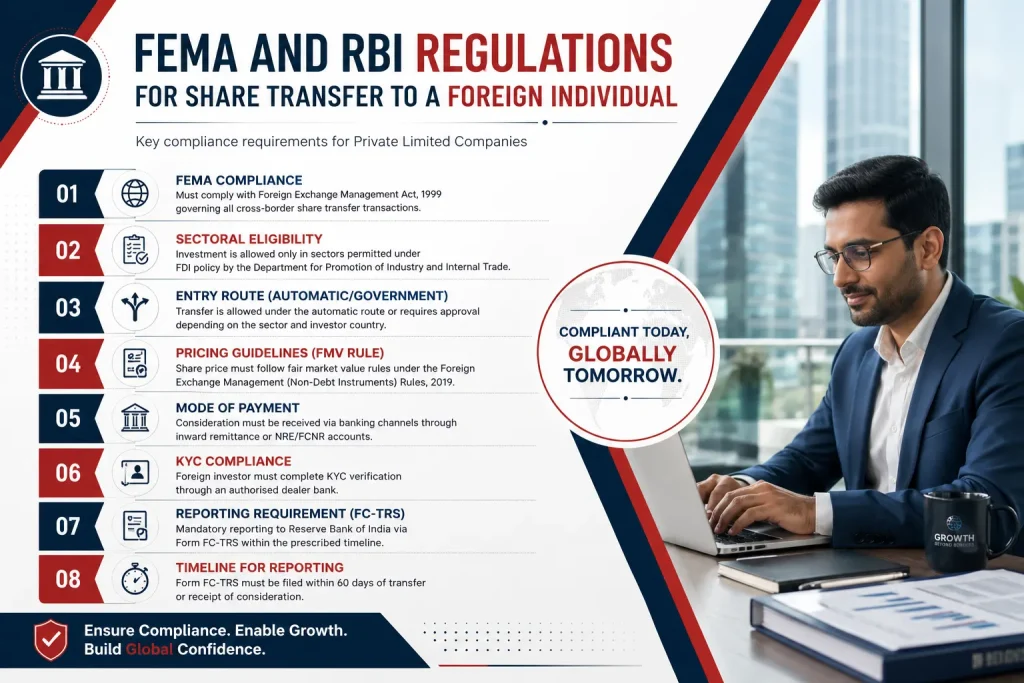
The following are the key FEMA and RBI Regulations that govern share transfer to a foreign individual in private company:
- FEMA Compliance: Must comply with Foreign Exchange Management Act, 1999 governing all cross-border share transfer transactions.
- Sectoral Eligibility: Investment is allowed only in sectors permitted under FDI policy by the Department for Promotion of Industry and Internal Trade.
- Entry Route (Automatic/Government): Transfer is allowed under the automatic route or requires approval depending on the sector and investor country.
- Pricing Guidelines (FMV Rule): Share price must follow fair market value rules under the Foreign Exchange Management (Non-Debt Instruments) Rules, 2019.
- Mode of Payment: Consideration must be received via banking channels through inward remittance or NRE/FCNR accounts.
- KYC Compliance: Foreign investor must complete KYC verification through an authorised dealer bank.
- Reporting Requirement (FC-TRS): Mandatory reporting to Reserve Bank of India via Form FC-TRS within the prescribed timeline.
- Timeline for Reporting: Form FC-TRS must be filed within 60 days of transfer or receipt of consideration.
What are the Penalties for Non-Compliance with FEMA and RBI Regulations?
Non-compliance with FEMA and RBI regulations can result in serious financial and legal consequences under the Foreign Exchange Management Act, 1999. A person may be liable to pay a penalty up to three times the amount involved in the contravention, or upto Rs. 2 lakhs. In case of continuing default, an additional penalty of Rs. 5,000 is also imposed per day till the default continues. The Reserve Bank of India may also restrict future transactions, delay approvals, or initiate enforcement actions. In severe cases, compounding proceedings or legal action may be required to regularise the default.
What is the Role of Authorized Dealer (AD) Bank in Share Transfer?
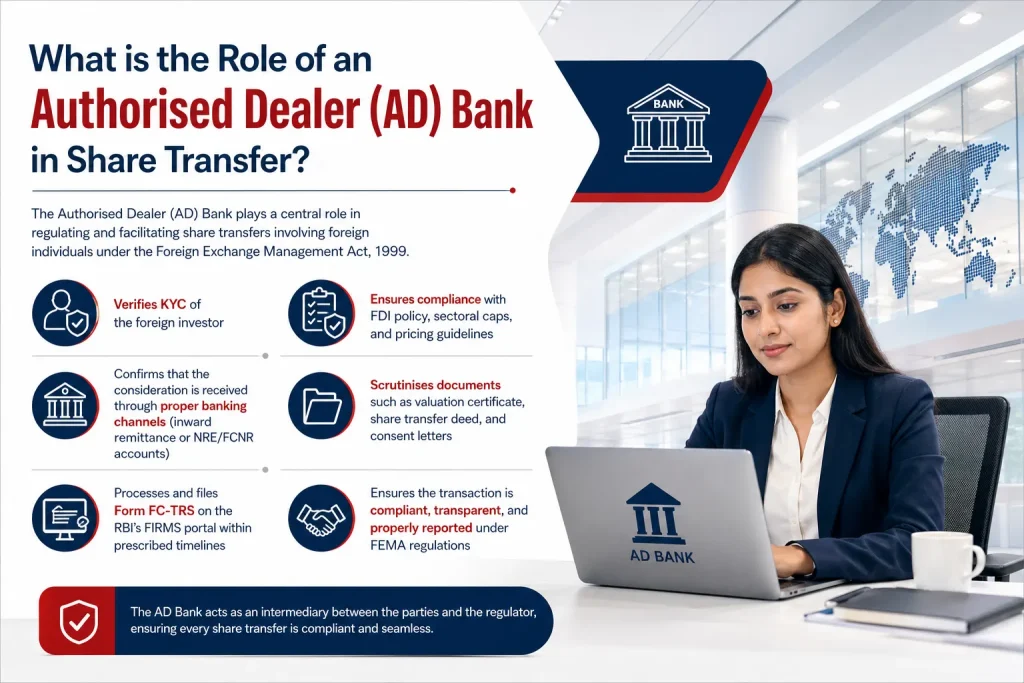
The Authorised Dealer (AD) Bank plays a central role in regulating and facilitating share transfers involving foreign individuals under the Foreign Exchange Management Act, 1999. Authorised by the Reserve Bank of India, the AD Bank acts as an intermediary between the parties and the regulator.
It verifies the KYC of the foreign investor, ensures that the transaction complies with FDI policy, sectoral caps, and pricing guidelines, and confirms that the consideration is received through proper banking channels (inward remittance or NRE/FCNR accounts). The AD Bank also scrutinises documents such as the valuation certificate, share transfer deed, and consent letters.
Importantly, it is responsible for processing and filing Form FC-TRS on the RBI’s FIRMS portal within prescribed timelines. Overall, the AD Bank ensures that the transaction is compliant, transparent, and properly reported under FEMA regulations.
What is the Step-by-Step Process of Share Transfer to Foreign Individual in Private Company?
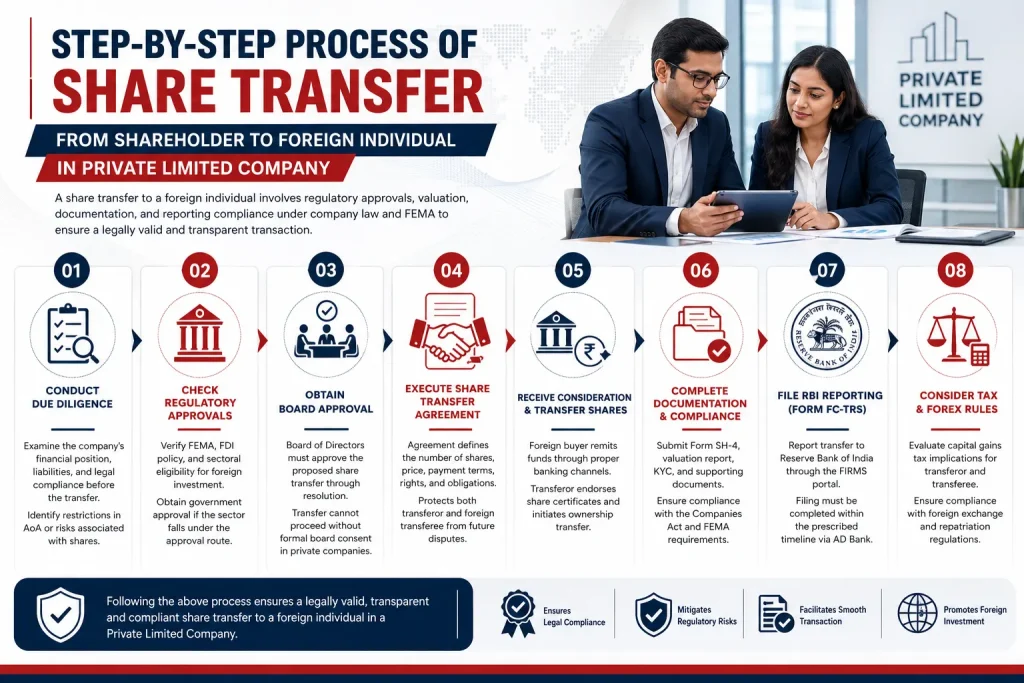
A share transfer to foreign individual in private company involves regulatory approvals, valuation, documentation, and reporting compliance under company law and FEMA to ensure a legally valid and transparent transaction. Here is the step-by-step process:
1. Conduct Due Diligence
- Examine the company’s financial position, liabilities, and legal compliance before the transfer.
- Identify restrictions in AoA or risks associated with shares.
2. Check Regulatory Approvals
- Verify FEMA, FDI policy, and sectoral eligibility for foreign investment.
- Obtain government approval if the sector falls under the approval route.
3. Obtain Board Approval
- Board of Directors must approve the proposed share transfer to foreign individual in private company through resolution.
- Transfer cannot proceed without formal board consent in private companies.
4. Execute Share Transfer Agreement
- Agreement defines the number of shares, price, payment terms, rights, and obligations.
- Protects both transferor and foreign transferee from future disputes.
5. Receive Consideration & Transfer Shares
- Foreign buyer remits funds through proper banking channels.
- Transferor endorses share certificates and initiates ownership transfer.
6. Complete Documentation & Compliance
- Submit Form SH-4, valuation report, KYC, and supporting documents.
- Ensure compliance with the Companies Act and FEMA requirements.
7. File RBI Reporting (Form FC-TRS)
- Report transfer to Reserve Bank of India through the FIRMS portal.
- Filing must be completed within the prescribed timeline via AD Bank.
8. Consider Tax & Foreign Exchange Rules
- Evaluate capital gains tax implications for transferor and transferee.
- Ensure compliance with foreign exchange and repatriation regulations.
What are the Documents Required for Share Transfer to Foreign Individual in Private Company?
The following documents are required for share transfer from shareholder to foreign individual in private limited company:
- Share Transfer Deed (Form SH-4)
- Original Share Certificates
- Board Resolution
- Share Transfer Agreement
- Valuation Certificate (FMV)
- KYC Documents of Foreign Investor
- FIRC / Banking Proof (Inward Remittance)
- Consent Letters (Transferor & Transferee)
- Form FC-TRS
- Declaration / Undertaking under FEMA
What is Form FC-TRS? Why Is It Important?
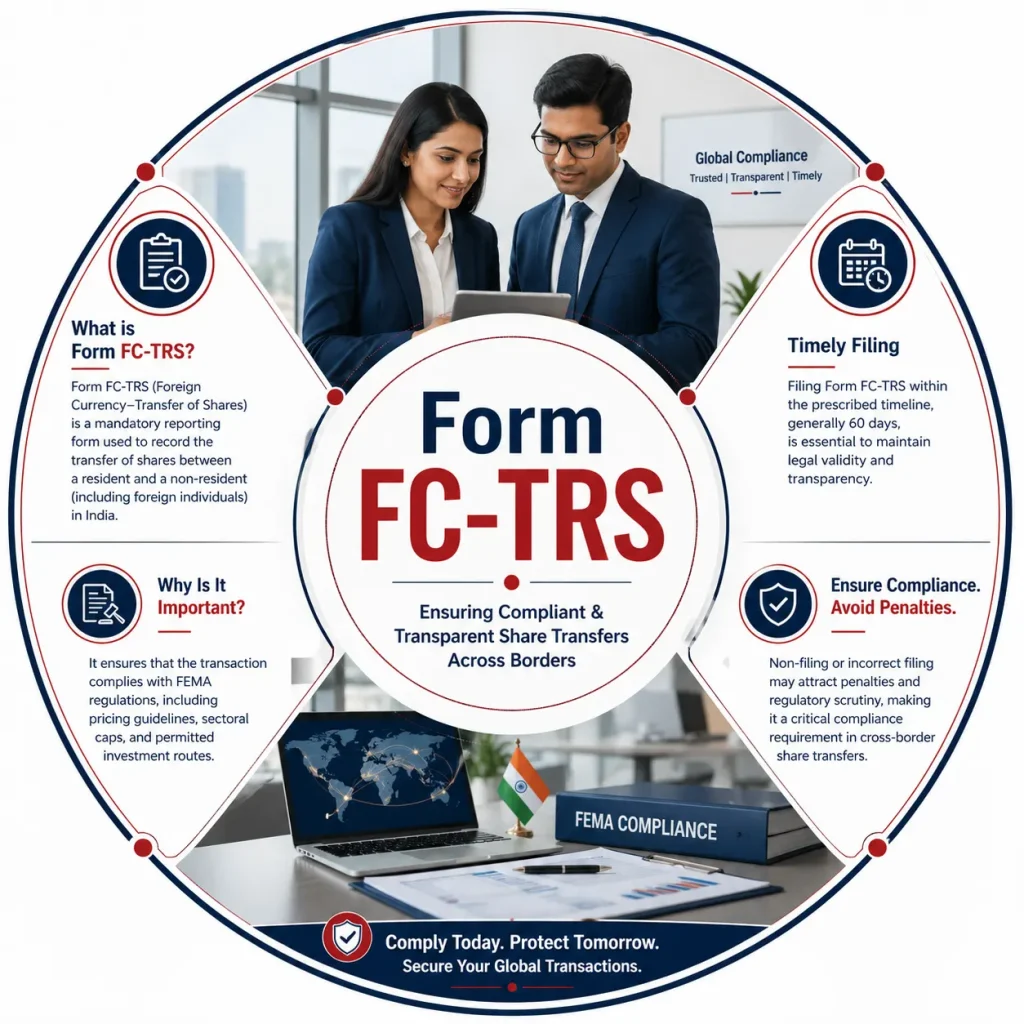
Form FC-TRS (Foreign Currency–Transfer of Shares) is a mandatory reporting form used to record the transfer of shares between a resident and a non-resident (including foreign individuals) in India. It is important because it ensures that the transaction complies with FEMA regulations, including pricing guidelines, sectoral caps, and permitted investment routes. Filing Form FC-TRS within the prescribed timeline, generally 60 days, is essential to maintain legal validity and transparency. Non-filing or incorrect filing may attract penalties and regulatory scrutiny, making it a critical compliance requirement in cross-border share transfers.
What is the Process to File FC-TRS Form?
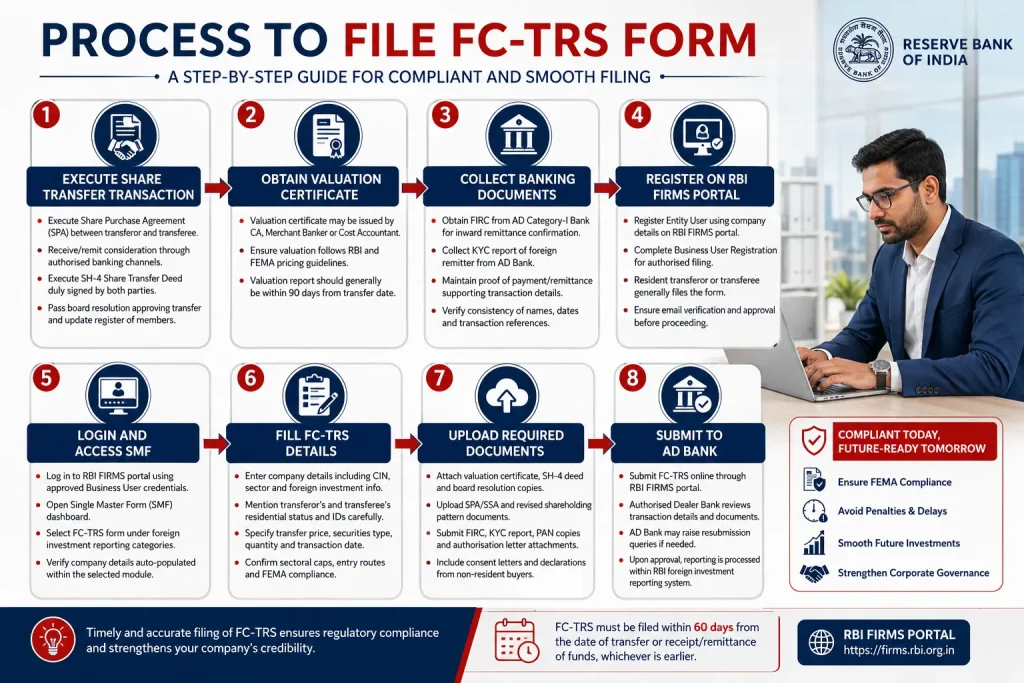
Here is the step-by-step process you need to follow to file the FC-TRS form:
Step 1: Execute Share Transfer Transaction
Complete the commercial share transfer process before initiating FEMA reporting.
- Execute Share Purchase Agreement (SPA) between transferor and transferee, wherever commercially required.
- Receive or remit consideration strictly through authorised banking channels under FEMA regulations.
- Execute the SH-4 Share Transfer Deed duly signed by both transfer parties.
- Pass a board resolution approving the transfer and update the register of members accordingly.
Step 2: Obtain Valuation Certificate
Obtain a valuation report to justify fair pricing under FEMA guidelines.
- A valuation certificate may be issued by a chartered accountant or merchant banker.
- A practising cost accountant may also issue valuation in eligible transactions.
- Ensure valuation follows RBI and FEMA pricing guidelines for securities transfers.
- A valuation report should generally remain within 90 days from the transfer date.
Step 3: Collect Banking Documents
Arrange mandatory banking documents required for FC-TRS filing and verification.
- Obtain FIRC from Authorized Dealer Category-I Bank for inward remittance confirmation.
- Collect KYC report of foreign remitter from the concerned AD Bank.
- Maintain proof of payment or remittance supporting transfer consideration transaction details.
- Verify all banking documents contain consistent names, dates, and transaction references.
Step 4: Register on RBI FIRMS Portal
Create user registrations on the RBI FIRMS portal before accessing FC-TRS filing facility.
- Register Entity User using company details on RBI FIRMS online portal.
- Complete Business User Registration for authorised filing and compliance activities.
- Resident transferor or transferee generally undertakes FC-TRS filing responsibilities.
- Ensure email verification and approval before proceeding with the online reporting process.
Step 5: Login and Access SMF
Access the Single Master Form module after successful user registration approval.
- Log in to RBI FIRMS portal using approved Business User credentials.
- Open Single Master Form dashboard available within FIRMS reporting system.
- Select FC-TRS form under foreign investment reporting categories.
- Verify company details auto-populated within the selected FC-TRS filing module.
Step 6: Fill FC-TRS Details
Provide accurate transaction and shareholding information within the FC-TRS form.
- Enter company details including CIN, sector, and foreign investment information.
- Mention the transferor’s and transferee’s residential status and identification particulars carefully.
- Specify transfer price, securities type, quantity, and transaction execution date.
- Confirm sectoral caps, entry routes, and FEMA compliance before final submission.
Step 7: Upload Required Documents
Upload all supporting documents required for FEMA and RBI compliance verification.
- Attach valuation certificate, SH-4 deed, and board resolution copies.
- Upload SPA or SSA and revised shareholding pattern documents.
- Submit FIRC, KYC report, PAN copies, and authorisation letter attachments.
- Include consent letters and declarations from non-resident buyers where applicable.
Step 8: Submit to AD Bank
Submit the completed FC-TRS form for AD Bank scrutiny and the approval process.
- Submit FC-TRS online through RBI FIRMS portal after document verification.
- Authorised Dealer Bank reviews transaction details and attached compliance documents.
- AD Bank may raise resubmission queries for incomplete or incorrect filings.
- Upon approval, reporting is processed within RBI foreign investment reporting system.
What is the Time Limit for Filing FC-TRS and Consequences of Late Filing?
FC-TRS must be filed within 60 days from the date of share transfer to foreign individual in private company or receipt/remittance of consideration, whichever occurs earlier. Timely filing is mandatory under FEMA regulations. Failure to file FC-TRS within the prescribed timeline may attract Late Submission Fees (LSF), resulting in FEMA non-compliance. Delayed reporting can also create complications in future foreign investment transactions, funding rounds, regulatory approvals, and due diligence processes.
What is the Pricing Rule for Filing FC-TRS?
Under FEMA pricing guidelines, the transfer price of shares must comply with fair valuation norms during FC-TRS filing. In case of transfer from a resident to a non-resident, the share price cannot be lower than the fair value determined through valuation. Conversely, for a transfer from a non-resident to a resident, the transfer price cannot exceed the fair value. These pricing rules ensure transparency and prevent undervaluation or overvaluation in foreign investment transactions.
Who Files FC-TRS?
The responsibility for filing FC-TRS under FEMA regulations lies with the resident party involved in the share transfer transaction. Depending on the nature of transfer, the filing may be completed by:
- Resident transferor
- Resident transferee
What are the Tax Implications on Share Transfer to Foreign Individual in Private Company?
Transferring shares to a foreign individual (non-resident) in India involves capital gains tax for the seller, with rates varying based on the holding period and listing status. Here is a comprehensive overview of the tax implications:
| Capital Gains Tax | The resident seller is liable to pay tax on capital gains if the shares are sold at a profit |
| Short-Term vs Long-Term Gains | The tax rate depends on the holding period—short-term is taxed higher, and long-term is taxed at 12.5%. |
| Unlisted Shares | Long-term capital gains (held >24 months) are generally taxed at 20% with indexation. |
| Fair Market Value (FMV) Rule | If the sale price is lower than the Fair Market Value (FMV), tax authorities may deem the FMV as the sale price for tax calculation under Section 79 of the Income Tax Act 2025. |
| Withholding Tax (TDS) | The buyer may need to deduct tax at source (TDS) under Section 393 of the Income Tax Act 2025 before transferring the sale proceeds to the non-resident. |
What is the Timeline for Share Transfer to Foreign Individual in Private Company?
The timeline for a share transfer to foreign individual in private company (non-resident) primarily revolves around a 60-day reporting deadline for filing Form FC-TRS through an Authorised Dealer (AD) bank. The process begins with executing the share transfer, followed by payment of applicable stamp duty and updating company records, including the register of members. Consideration must be received through proper banking channels before reporting. The completed transaction must then be reported to the Reserve Bank of India within 60 days of receipt of funds or transfer of shares, ensuring full compliance with FEMA regulations.
Conclusion: Navigating Share Transfers to Foreign Investors
Share transfer to foreign individual in private company involves a careful blend of corporate compliance and foreign exchange regulations. From adhering to pricing guidelines and sectoral caps to ensure proper documentation like the Share Transfer Deed and timely reporting through Form FC-TRS, each step must align with RBI and FEMA norms. Companies must also verify eligibility under the automatic or approval route before proceeding. A well-executed share transfer not only ensures legal compliance but also facilitates smooth cross-border investment.
Frequently Asked Questions
1. Can a minor foreign individual acquire shares in an Indian company?
No, minors generally cannot invest directly unless through a guardian under specific legal structures.
2. Is stamp duty applicable on share transfers to foreign individuals?
Yes, stamp duty must be paid as per state laws before registering the share transfer to foreign individual in private company.
3. Can shares be gifted to a foreign individual?
Yes, but it requires prior approval from the RBI and must comply with FEMA gift provisions.
4. Is a share certificate mandatory for transfer?
Yes, original share certificates must be submitted and endorsed for a valid share transfer to foreign individual in private company.
5. Can a foreign individual appoint a nominee for shares?
Yes, nomination is allowed as per the Companies Act 2013 provisions.
6. Is PAN mandatory for foreign individuals investing in shares?
No, generally PAN is not required for foreign individuals investing in shares.
7. Can a share transfer to foreign individual in a private company without updating the Articles of Association?
No, AoA must permit such transfers; otherwise, amendments are required.
You may also like


What Does Project Logistics Alliance Membership Offer?
Project Logistics Alliance membership offers an Indian project cargo business a