

Every day in India, thousands of entrepreneurs are either quietly searching for a business for sale or planning a quiet exit from one they have built. Whether you are a buyer looking to skip the startup phase or an owner ready to move on, understanding the legal process, the right valuation, and the correct documentation is not optional - it is the difference between a successful deal and a costly mistake.
India's business resale and acquisition market is growing rapidly. According to IBEF, India's M&A activity has seen consistent annual growth, driven by entrepreneurship, investor confidence, and a maturing startup ecosystem. Yet most buyers and sellers still navigate this process without a clear roadmap.
This complete guide covers everything - from business valuation and sale structure to legal compliance, tax implications, and post-sale steps - for both buyers and sellers of a business for sale in India.
Why Do People Put a Business for Sale in India?
Understanding what drives a business for sale helps both sides set realistic expectations.
Sellers typically list a business for sale because of:
-
Retirement or a planned business exit
-
Financial restructuring or debt management
-
Pivoting to a new venture or industry
-
Partnership dissolution or family disputes
-
Business stagnation with no clear growth path
Buyers look for a business for sale because:
-
Acquiring a running business saves years of startup effort
-
An existing business comes with customers, cash flow, and systems
-
It offers faster entry into a new market or geography
-
It is a smarter investment compared to starting from scratch

Types of Business for Sale Structures in India
Before you list or buy a business for sale, it is critical to understand the type of sale being executed. The entire legal process, tax treatment, and documentation change based on this choice.
From the SELLER'S Side - How to Structure the Sale
|
Sale Structure |
What Transfers |
Best For |
Tax Impact |
|
Asset Sale |
Selected assets only (machinery, IP, stock) |
Buyers wanting specific assets only |
GST is applicable on each asset individually |
|
Share Sale / Transfer |
Ownership shares of the company |
Private Limited / OPC companies |
Capital Gains Tax on shares sold |
|
Slump Sale |
Entire business as a going concern — no individual asset breakup |
Full business exit in one transaction |
Section 50B Income Tax Act; GST exempt |
|
Business Transfer Agreement |
All assets + liabilities transferred via contract |
Proprietorship / Partnership firms |
Stamp duty + Capital Gains Tax |
|
Partial Stake Sale |
A percentage of ownership/shares sold; seller retains balance |
Sellers wanting partial exit while staying involved |
Capital Gains Tax on the proportion sold |
From the BUYER'S Side - How to Structure the Purchase
|
Acquisition Type |
What the Buyer Gets |
Best For |
Key Risk |
|
Asset Purchase |
Only specific assets — no liabilities |
Buyers who want machinery, IP, or client contracts without taking on debts |
Missing out on licenses tied to the entity |
|
Share / Equity Purchase |
Full ownership of the legal entity, including its history |
Buying a running Pvt Ltd or OPC with existing contracts and licenses intact |
Hidden liabilities, past litigation, and tax dues transfer to the buyer |
|
Slump Sale Purchase |
Entire operating business as a going concern |
Buyers wanting a fully operational business from day one |
Due diligence complexity; need to renegotiate all contracts |
|
Management Buyout (MBO) |
The existing management team buys the business from the owner |
Internal teams who know the business deeply, owner retirement scenarios |
Financing pressure on the buying team |
|
Leveraged Buyout (LBO) |
Business acquired primarily using borrowed funds |
High-value acquisitions where the business's own cash flow repays the debt |
High debt burden; risky if cash flows dip post-acquisition |
|
Distressed Business Acquisition |
Business acquired under IBC / NCLT proceedings at below-market price |
Buyers looking for undervalued turnaround opportunities |
Operational mess, pending litigation, employee disputes |
|
Franchise Acquisition |
The right to operate an established brand in a territory |
First-time buyers wanting a proven model with brand support |
Royalty fees; strict operational control by franchisor |
Combined View — Matching Seller Structure to Buyer Type
|
Seller's Sale Structure |
Ideal Buyer Acquisition Type |
Agreement Required |
|
Asset Sale |
Asset Purchase |
Asset Purchase Agreement |
|
Share Sale |
Share / Equity Purchase |
Share Purchase Agreement (SPA) |
|
Slump Sale |
Slump Sale Purchase |
Business Transfer Agreement |
|
Partial Stake Sale |
Equity / Minority Stake Purchase |
Shareholders Agreement + SPA |
|
Distressed Sale (IBC) |
Distressed Business Acquisition |
NCLT Resolution Plan |
|
Franchise Model |
Franchise Acquisition |
Franchise Agreement |
Choosing the wrong structure when putting a business for sale can trigger unnecessary taxes and legal disputes. Always consult a CA before deciding.
How Business Structure Affects the Sale Process
Your business's legal structure directly shapes how the business for sale transaction works.
-
Sole Proprietorship: No formal mechanism exists for share transfer. Assets are sold individually. The buyer must obtain fresh GST registration, trade licenses, and other approvals.
Learn more: Sole Proprietorship Registration
-
Partnership Firm: Requires a dissolution deed or reconstitution deed under the Indian Partnership Act, 1932.
Read about Partnership Firm Registration
-
LLP: Partner admission or resignation deed required; Form 4 filed with MCA.
See LLP Registration
-
Private Limited Company: Share transfer via Form SH-4, Board Resolution, Share Purchase Agreement (SPA), and ROC intimation within 30 days.
Learn more: Share Transfer in Private Limited Company
Business Valuation: How to Find the Right Price for a Business for Sale
Valuation is the most debated step in any business sale deal. Sellers tend to overprice; buyers tend to lowball. An independent, professionally prepared valuation protects both sides and is mandatory in several regulatory scenarios under the Companies Act, 2013.
Key Factors That Affect Business Valuation
-
Revenue and profitability trend over the last 3–5 years
-
Tangible assets: land, machinery, inventory, equipment
-
Intangible assets: brand, trademarks, goodwill, software, client contracts
-
Industry growth rate and competitive landscape
-
Legal compliance status: GST, MCA, PF/ESIC, pending litigation
Top Business Valuation Methods Used in India
|
Method |
Best For |
Simple Example |
|
Discounted Cash Flow (DCF) |
Tech, SaaS, service businesses |
₹50L/year for 5 years at 10% discount → ~₹1.9 Crore |
|
EBITDA Multiple |
Profitable SMEs, retail, manufacturing |
₹50L EBITDA × 5x multiple = ₹2.5 Crore |
|
Net Asset Value (NAV) |
Asset-heavy businesses (manufacturing, real estate) |
Assets ₹30L – Liabilities ₹10L = ₹20L |
|
Market Comparable |
M&A-active sectors |
Compare revenue/EBITDA multiples of similar sold businesses |
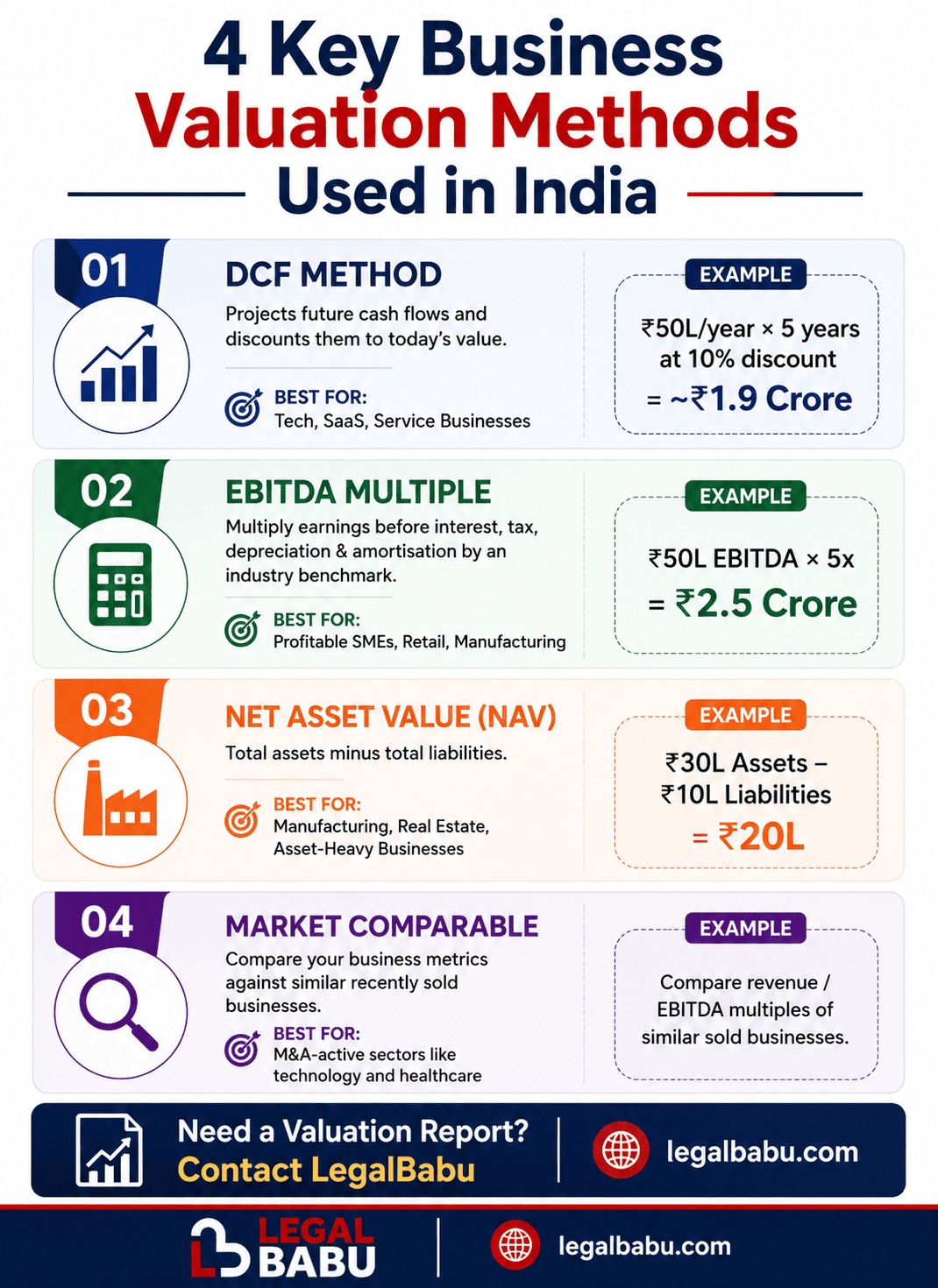
Under the Companies Act, 2013, a Registered Valuer is mandatory for mergers, ESOPs, preferential allotments, and IBC proceedings. For all other business for sale transactions, a CA-prepared valuation report is strongly recommended.
Need a professional valuation report? LegalBabu's Transaction Advisory team handles complete valuation and deal structuring.
Legal Framework Governing a Business for Sale in India
A business for sale in India is governed by a web of laws. Non-compliance at any point can invalidate the deal or trigger penalties.
|
Law / Regulation |
Applicability to Business for Sale |
|
Companies Act, 2013 |
Share transfer, asset sale, Registered Valuer requirement |
|
Income Tax Act, 1961 |
Capital Gains Tax; Section 50B for slump sale |
|
GST on individual asset transfers; exemption on going concern sale |
|
|
Cross-border transactions or foreign buyer involvement |
|
|
Distressed business for sale scenarios |
|
|
Stamp duty on sale deeds and agreements |
|
|
Validity and enforceability of sale agreements |
For foreign buyers or NRI investors, FEMA compliance and RBI guidelines must be followed. LegalBabu assists with company incorporation for foreigners and handles all FEMA filings.
Step-by-Step: How to Sell a Business in India
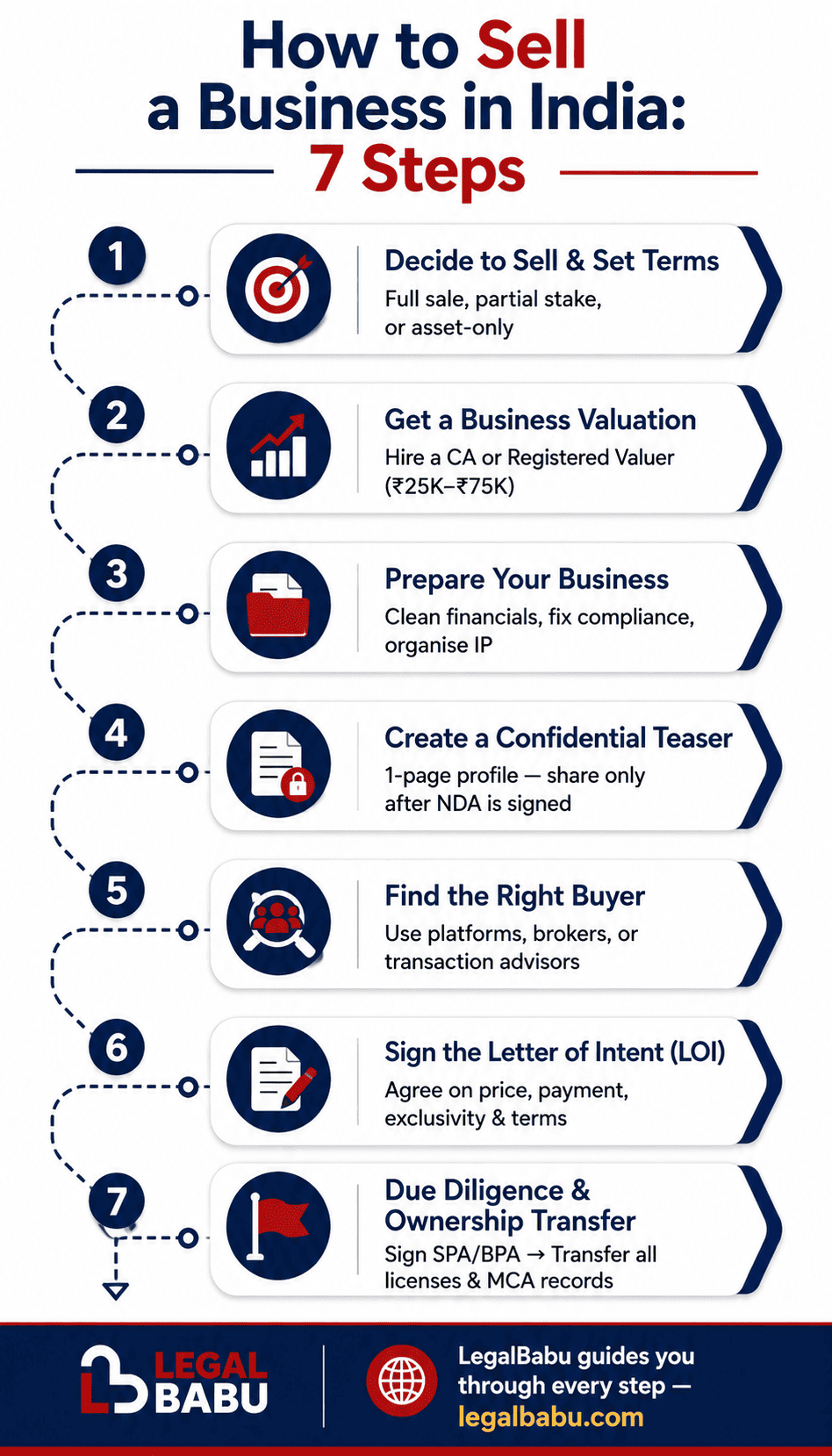
Putting a business for sale requires careful preparation. Follow these 7 steps to get the best outcome.
Step 1 - Decide to Sell and Define Your Terms: Clarify whether you are doing a full sale, partial stake sale, or asset-only sale. Know your minimum price and preferred timeline.
Step 2 - Get a Professional Business Valuation: Hire a Registered Valuer or CA. A formal valuation report costs approximately ₹25,000–₹75,000 and is your strongest negotiating tool for any business for sale deal.
Step 3 - Prepare Your Business for Sale: Clean up 3 years of financial records, ITR, GST returns, and MCA filings. Clear any pending compliance. Resolve outstanding PF/ESIC dues. Ensure trademarks and IP are registered.
Step 4 - Create a Confidential Business Profile: Prepare a one-page teaser: revenue, EBITDA, assets, and reason for sale. Never share sensitive data before the buyer signs an NDA.
Step 5 - Find the Right Buyer: List on verified platforms, engage a transaction advisor, or tap into professional networks. See our platform recommendations below.
Step 6 - Sign a Letter of Intent (LOI): An LOI confirms the buyer's intent and sets key terms: price, payment structure, exclusivity period, and confidentiality. It is non-binding but essential. It prevents both parties from wasting time and forms the legal backbone before due diligence begins. Key LOI clauses include the exclusivity window (typically 30–60 days), payment structure (lump sum vs earnout), and non-compete terms.
Step 7 - Due Diligence, Agreement & Ownership Transfer: The buyer verifies your financials, legal records, and operations. Both parties sign a Business Sale Agreement or Share Purchase Agreement. Then all registrations, licenses, and bank accounts are updated in the buyer's name.
Step-by-Step: How to Buy a Business for Sale in India
Step 1 - Define Your Investment Goal: Set your budget, preferred industry, geography, and growth objective before browsing any business for sale listing.
Step 2 - Sign an NDA and Request Full Disclosure: Never review sensitive financials without a signed Non-Disclosure Agreement. This protects both parties.
Step 3 - Conduct Independent Due Diligence
-
Financial DD: Verify 3–5 years of P&L, balance sheet, cash flow, and tax returns with your own CA
-
Legal DD: Check licenses, pending court cases, MCA compliance, and ownership clarity
-
Operational DD: Assess employees, key client contracts, supplier agreements, and systems
Step 4 - Get an Independent Valuation: Never rely solely on the seller's stated price. Commission your own valuation using the methods listed above.
Step 5 - Negotiate and Sign a Letter of Intent (LOI): Agree on price, payment terms, transition support period, and any contingencies before moving to final agreements.
Step 6 - Close the Deal and Transfer Ownership: Sign the Business Purchase Agreement or Share Purchase Agreement. Then execute all post-sale compliance updates (see below).
Key Documents Required for a Business for Sale Transaction
Below are some mandatory docs that the seller must provide and the buyer must submit for a sale.
Seller must provide:
-
3 years of Audited Financial Statements
-
GST Returns (GSTR-1, GSTR-3B)
-
Income Tax Returns (ITR) - last 3 years
-
MCA / ROC Filings and Certificate of Incorporation
-
List of tangible and intangible assets
-
PF/ESIC records and employee data
-
Existing client, vendor, and lease contracts
-
Registered Trademarks and IP certificates
Buyer must submit:
-
NDA (Non-Disclosure Agreement)
-
Proof of funds or bank statements
-
Letter of Intent (LOI)
-
Due Diligence Report
-
Business Purchase Agreement / Share Purchase Agreement
LegalBabu drafts and reviews all these documents as part of its end-to-end Transaction Advisory Services.
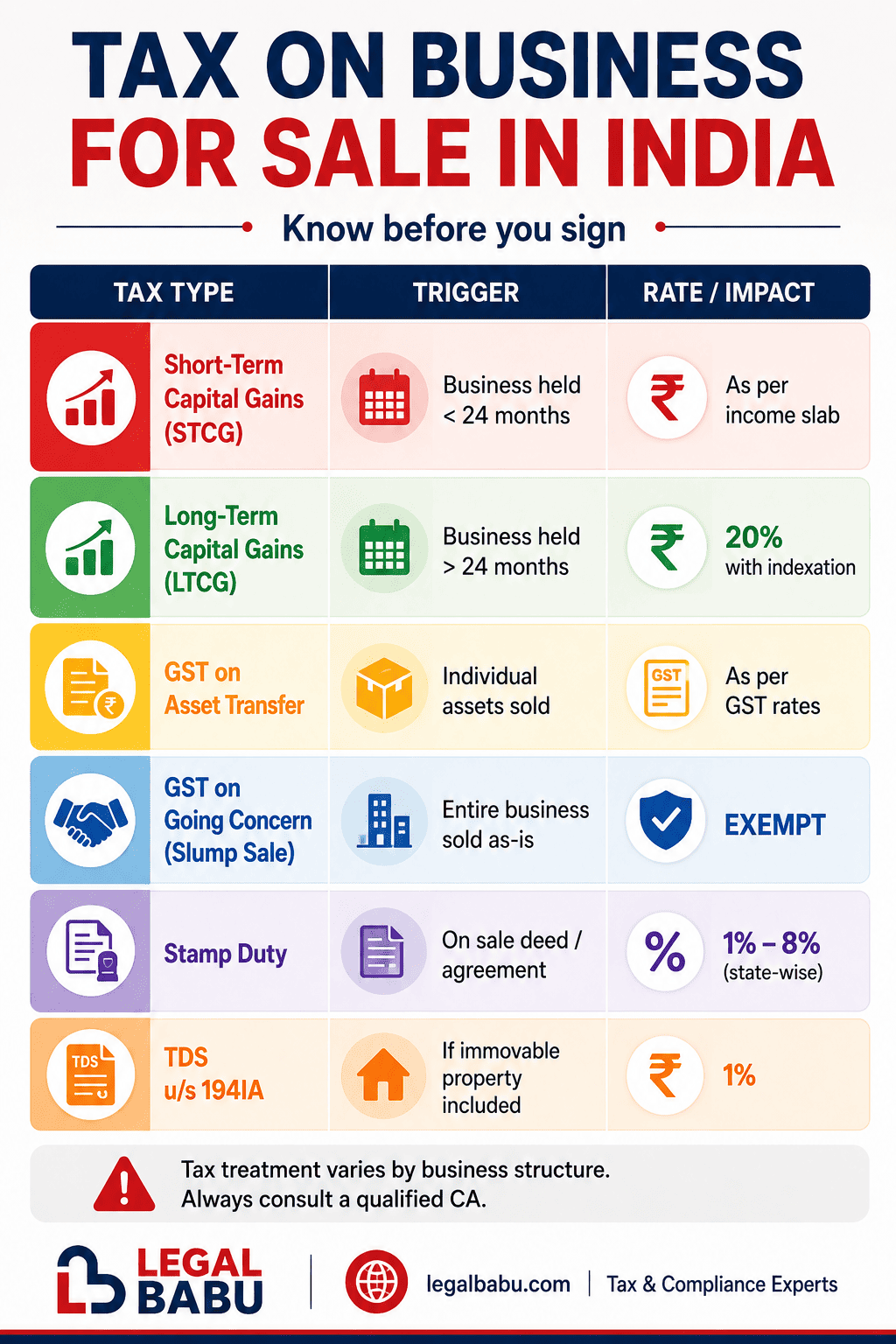
Tax Implications of a Business for Sale in India
|
Tax Type |
When It Applies |
Rate / Notes |
|
Short-Term Capital Gains (STCG) |
Business held < 24> |
As per the income tax slab |
|
Long-Term Capital Gains (LTCG) |
Business held > 24 months |
20% with indexation benefit |
|
GST on Asset Transfer |
Individual assets sold |
As per applicable GST rates |
|
GST on Slump Sale (Going Concern) |
The entire business is sold as a going concern |
Exempt from GST |
|
Stamp Duty on Sale Deed |
On agreements and title transfer |
1%–8% - varies by state |
|
TDS under Section 194IA |
If immovable property is included |
1% of transaction value |
For a detailed understanding of your tax position, refer to Income Tax Filing Services by LegalBabu or consult Income Tax India's official portal.
How to Protect Yourself Legally During a Business Sale
Both sides of a business for sale deal face real risks. These legal safeguards are non-negotiable.
-
Non-Disclosure Agreement (NDA): Must be signed by the buyer before any financial data is shared
-
Representations & Warranties in SPA: Seller declares the true condition of the business - pending liabilities, litigation, compliance status
-
Indemnity Clauses: Protect the buyer if hidden liabilities surface after the sale closes
-
Escrow Arrangements: Payment is held by a neutral third party until all conditions are satisfied
-
Non-Compete Agreement: Seller agrees not to operate a competing business for a defined period (typically 2–5 years) in the same geography
Without these protections, a business for sale deal can unravel post-closure - leaving either party with significant financial and legal exposure.
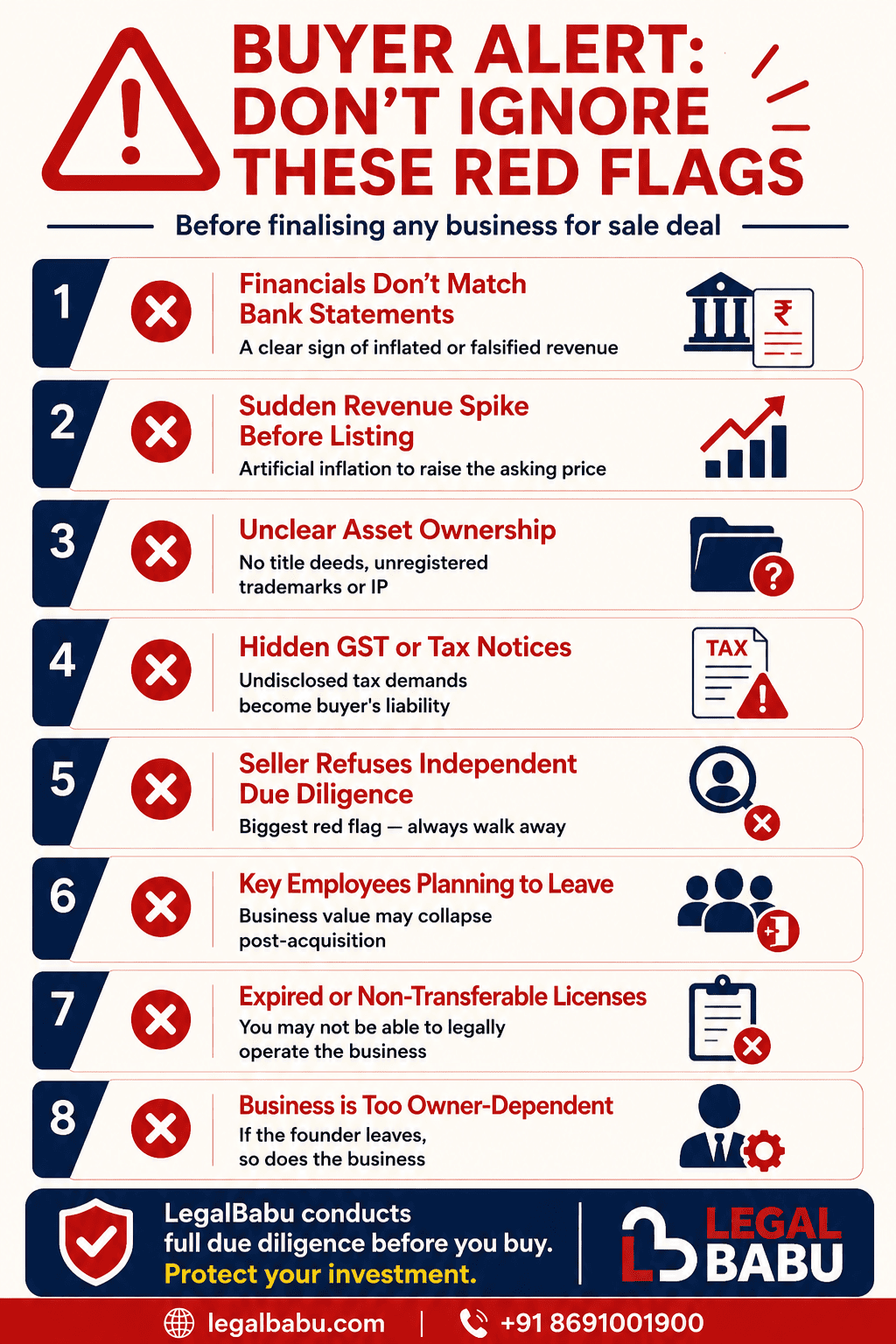
Red Flags to Watch for When Buying a Business for Sale
Before committing to any business for sale, watch for these warning signs:
-
Financial statements that don't match bank account deposits
-
Sudden revenue spike in the 1–2 years immediately before the listing
-
Unclear ownership of assets - no title deeds, unregistered IP or trademarks
-
Undisclosed GST notices, income tax demands, or pending court cases
-
Seller refusing to allow independent due diligence or third-party verification
-
Key employees or clients confirmed to be leaving post-acquisition
-
Non-transferable licenses, expired, or conditionally issued
-
Overreliance on the owner personally - the business may not survive the transition
Post-Sale Compliance: What Happens After the Deal Closes
Most guides stop at "sign the agreement." But a business for sale transaction is not complete until all registrations and licenses are updated. Skipping this step creates compliance gaps that attract penalties.
|
Task |
Responsible Party |
Timeline |
|
Amend the GST Registration to the new owner |
Buyer |
Within 15 days of transfer |
|
File MCA / ROC intimation for share transfer |
Company / CS |
Within 30 days |
|
Update bank account, signatories |
Both parties |
Immediately post-closure |
|
Transfer or reapply for trade licenses |
Buyer |
As per state rules |
|
Re-register FSSAI License (food business) |
Buyer |
Mandatory new application |
|
Update the IEC Code for export businesses |
Buyer |
DGFT portal update required |
|
Final PF/ESIC settlement for employees |
Seller |
Before the handover date |
LegalBabu handles all post-sale MCA filings, GST registration updates, and license re-registration, so nothing falls through the cracks.
Common Mistakes to Avoid in a Business for Sale Deal
Below are some common mistakes to keep in mind during a sale deal:
Sellers must avoid:
-
Pricing based on emotional attachment, not verified data
-
Sharing financials without a signed NDA
-
Ignoring pending GST, MCA, or labour compliance before listing
-
Agreeing to verbal terms without written contracts
Buyers must avoid:
-
Trusting only the seller's financials without independent verification
-
Skipping legal due diligence to speed up the deal
-
Ignoring employee liabilities, tax dues, or undisclosed court cases
-
Paying the full amount before ownership transfer is legally complete
How LegalBabu Can Help With a Business for Sale
LegalBabu provides comprehensive support for every stage of a business sale transaction, serving both buyers and sellers across India.
-
Business Valuation Reports prepared by CA / Registered Valuers
-
Due Diligence Support - financial, legal, and operational review
-
NDA, LOI, SPA / BPA Drafting and legal review
-
Transaction Advisory Services - deal structuring, negotiation, and closing
-
Post-Sale Compliance - MCA filings, GST transfer, license re-registration
-
Company Registration if the buyer needs a new legal entity to hold the acquired business
-
TDS Filing and Capital Gains Tax Planning
📞 Ready to buy or sell a business in India? Get a free 30-minute expert consultation from LegalBabu. Call +91 8691001900 or WhatsApp us now.
Conclusion
A business for sale in India is one of the most significant financial events of an entrepreneur's life, whether you are on the buying side or the selling side. The process demands the right valuation, a sound legal structure, complete documentation, and full post-sale compliance. Cutting corners at any stage can cost you far more than the fees of professional guidance.
LegalBabu's team of CA, CS, and legal experts has helped hundreds of business owners and buyers navigate transactions with clarity, speed, and full legal compliance. From the first valuation report to the final MCA filing - we are with you every step of the way.
FAQS
FAQs about Business for Sale
-
What is the legal process to sell a business in India?
The legal process to put a business for sale involves obtaining a professional valuation, preparing 3 years of financial and compliance documents, signing an NDA, conducting due diligence, executing a Business Sale Agreement or Share Purchase Agreement, and completing all post-sale registration transfers with MCA, GST, and state licensing authorities.
- How is a business for sale valued in India?
- Is GST applicable on a business for sale in India?
- What documents are required to sell a business in India?
- What is a slump sale in India?
- What taxes apply when selling a business in India?
- What is a Letter of Intent (LOI) in a business for sale deal?
- How long does it take to complete a business for sale in India?
- Can a foreign national or NRI buy a business for sale in India?
- What are the red flags to avoid when buying a business for sale?
- What post-sale compliance is required after buying a business for sale?
- How do I find a genuine buyer for my business for sale in India?


