
Table of Content
- What is NABL and its Key Objectives?
- What is ISO/IEC 17025 Certification?
- Why ISO/IEC 17025 Certification Necessary for Testing and Calibration Laboratories?
- Instruments Covered under ISO/IEC 17025 NABL Certification
- Scope of ISO/IEC 17025 NABL Certification
- Industries Benefiting from ISO/IEC 17025 NABL Certification
- Key NABL ISO/IEC 17025 Requirements for Testing
- Key NABL ISO/IEC 17025 Requirements for Calibration
- Key Benefits of NABL ISO/IEC 17025 Certification
- Process for Obtaining NABL ISO/IEC 17025 Certification
- Documents Required for NABL ISO/IEC 17025 Certification
- Key Challenges in Obtaining NABL ISO/IEC 17025 Certification
- How Legal Babu Can Help?
What is NABL and its Key Objectives?
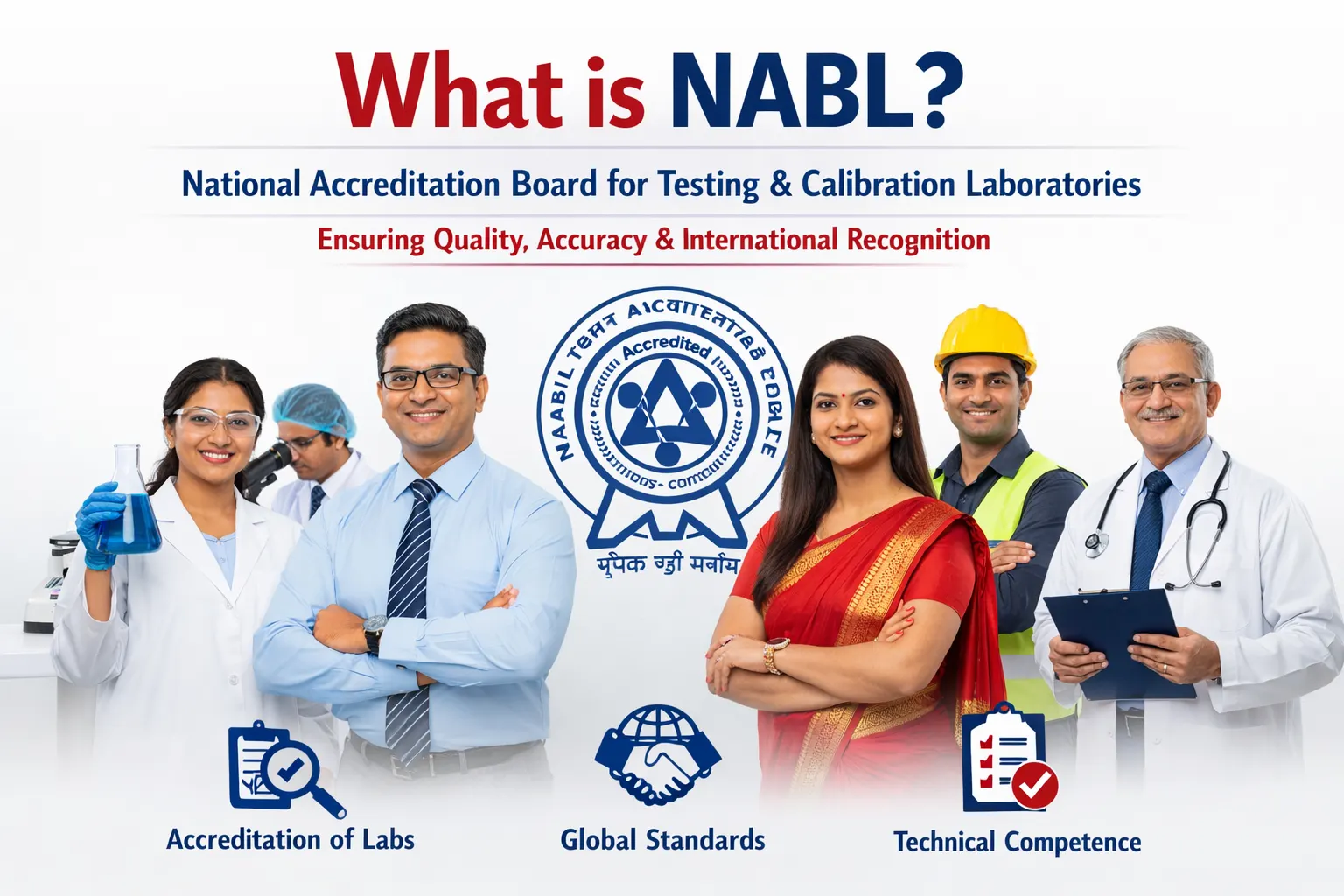
NABL (National Accreditation Board for Testing and Calibration Laboratories) is an autonomous body under the Department for Promotion of Industry & Internal Trade (DPIIT). It is responsible for providing accreditation to testing, calibration, and medical laboratories in India as per international standards such as ISO 17025. NABL accreditation ensures that laboratories operate with high levels of accuracy, reliability, and technical competence, thereby increasing confidence among customers, regulators, and global partners. It also helps Indian laboratories gain international recognition and improves the overall quality infrastructure of the country.
The main objectives of NABL include the following:
- Ensuring quality and reliability in testing and calibration results across accredited laboratories.
- Promoting international acceptance of test results through mutual recognition arrangements.
- Assessing and certifying the technical competence of laboratories through a rigorous evaluation process.
- Supporting industries and businesses by enhancing trust in laboratory reports for trade and exports.
- Encouraging continuous improvement and adherence to updated quality standards and best practices.
- Providing a transparent, impartial, and consistent accreditation system.
What is ISO/IEC 17025 Certification?

ISO/IEC 17025 certification is an international standard that specifies the requirements for the competence, impartiality, and consistent operation of testing and calibration laboratories. It is developed by the International Organization for Standardisation in collaboration with the International Electrotechnical Commission. This certification ensures that laboratories produce accurate, reliable, and technically valid results.
ISO/IEC 17025 covers key aspects such as laboratory management systems, technical procedures, equipment calibration, staff competence, and quality assurance. Laboratories accredited under this standard demonstrate their ability to generate precise and internationally accepted test and calibration results.
In India, accreditation for ISO/IEC 17025 is typically provided by the National Accreditation Board for Testing and Calibration Laboratories, which enhances the credibility of laboratories and facilitates global recognition.
Why ISO/IEC 17025 Certification Necessary for Testing and Calibration Laboratories?
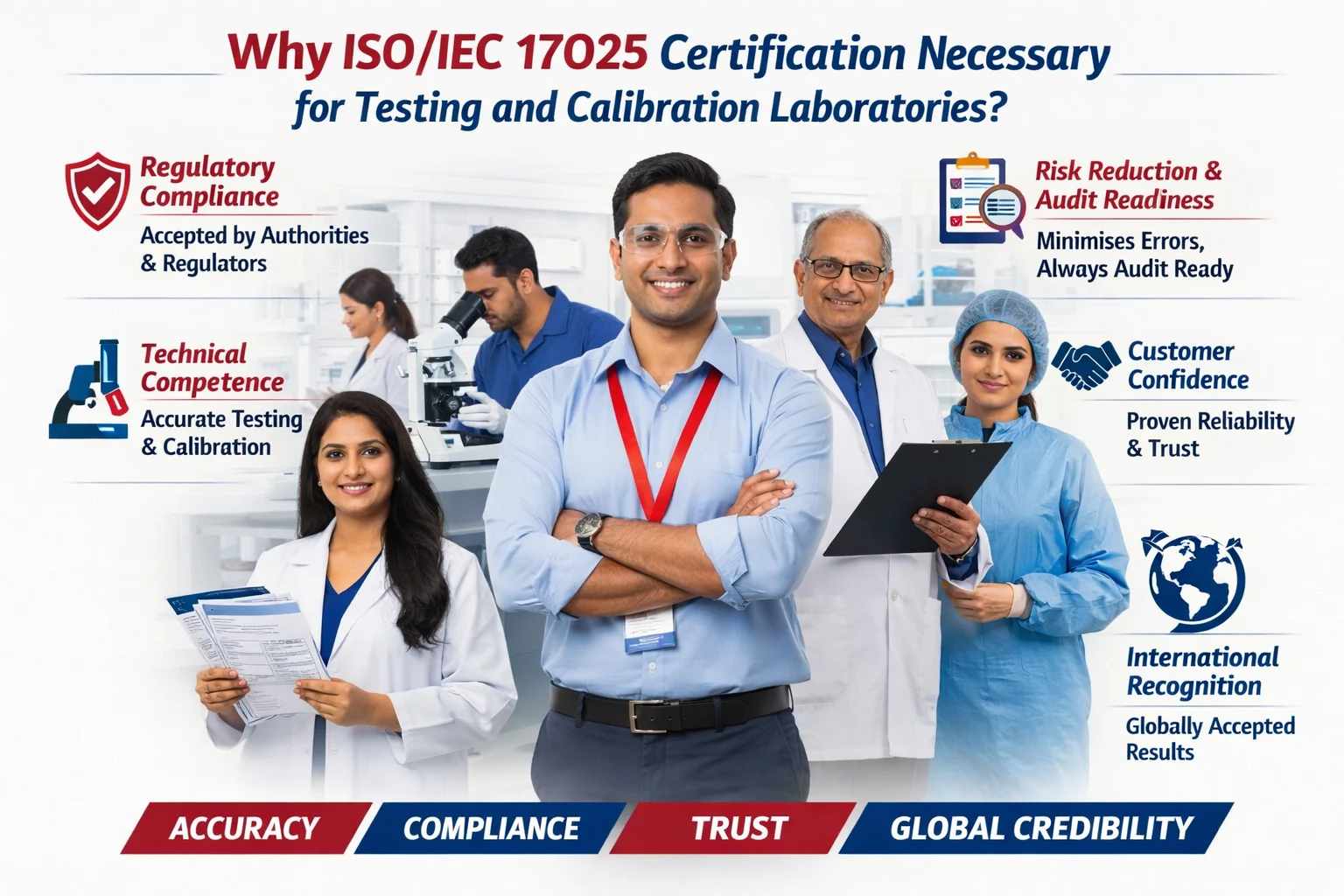
ISO/IEC 17025 certification is essential for testing and calibration laboratories, as it ensures technical competence, reliable results, and global credibility. It provides a structured framework that enhances accuracy, regulatory compliance, and trust, making laboratory data widely accepted and reducing risks in critical decision-making processes.
- Regulatory Compliance: Certification ensures laboratory reports are accepted by regulators and authorities, as results are generated under controlled conditions with proper traceability and validated methods.
- Technical Competence: It verifies the laboratory’s capability to perform accurate testing and calibration through assessment of staff skills, equipment calibration, and validated procedures.
- Risk Reduction & Audit Readiness: A structured quality system minimises errors and ensures laboratories are always prepared for audits, reducing non-conformities and operational disruptions.
- Customer Confidence: Certification builds trust among clients by proving consistency, impartiality, and reliability, which is crucial for long-term business relationships.
- International Recognition: Results from accredited labs are globally accepted, eliminating duplicate testing and supporting international trade and cross-border compliance.
What are the Instruments Covered under ISO/IEC 17025 NABL Certification?
|
Category |
Instruments Covered |
Description |
|
Dimensional Instruments |
Vernier calipers, micrometers, height gauges, dial indicators |
Used for precise measurement of length, thickness, and dimensions in manufacturing and engineering applications. |
|
Electrical Instruments |
Multimeters, clamp meters, insulation testers, power analyzers |
Ensure accuracy in measuring electrical parameters like voltage, current, resistance, and power. |
|
Thermal / Temperature Instruments |
Thermocouples, RTDs, digital thermometers, dry block calibrators |
Used for temperature measurement and calibration in industrial and laboratory environments. |
|
Pressure Instruments |
Pressure gauges, vacuum gauges, differential manometers |
Help measure and calibrate pressure levels in mechanical and process industries. |
|
Mass & Volumetric Instruments |
Weighing scales, analytical balances, pipettes, standard weights |
Ensure accurate measurement of mass and volume, critical for laboratories and production units. |
|
Specialized & Industrial Equipment |
Torque meters, flow meters, biomedical devices, RF equipment |
Covers advanced and industry-specific instruments requiring specialised calibration and validation. |
| BIS Laboratory Recognition Scheme | Testing laboratories (Government & Private) | Recognition for labs to test products as per Indian Standards |
| Management System Certification | Organizations seeking ISO certification | Certification for management systems such as ISO 9001, ISO 14001, etc., issued by BIS |
What is the Scope of ISO/IEC 17025 NABL Certification?
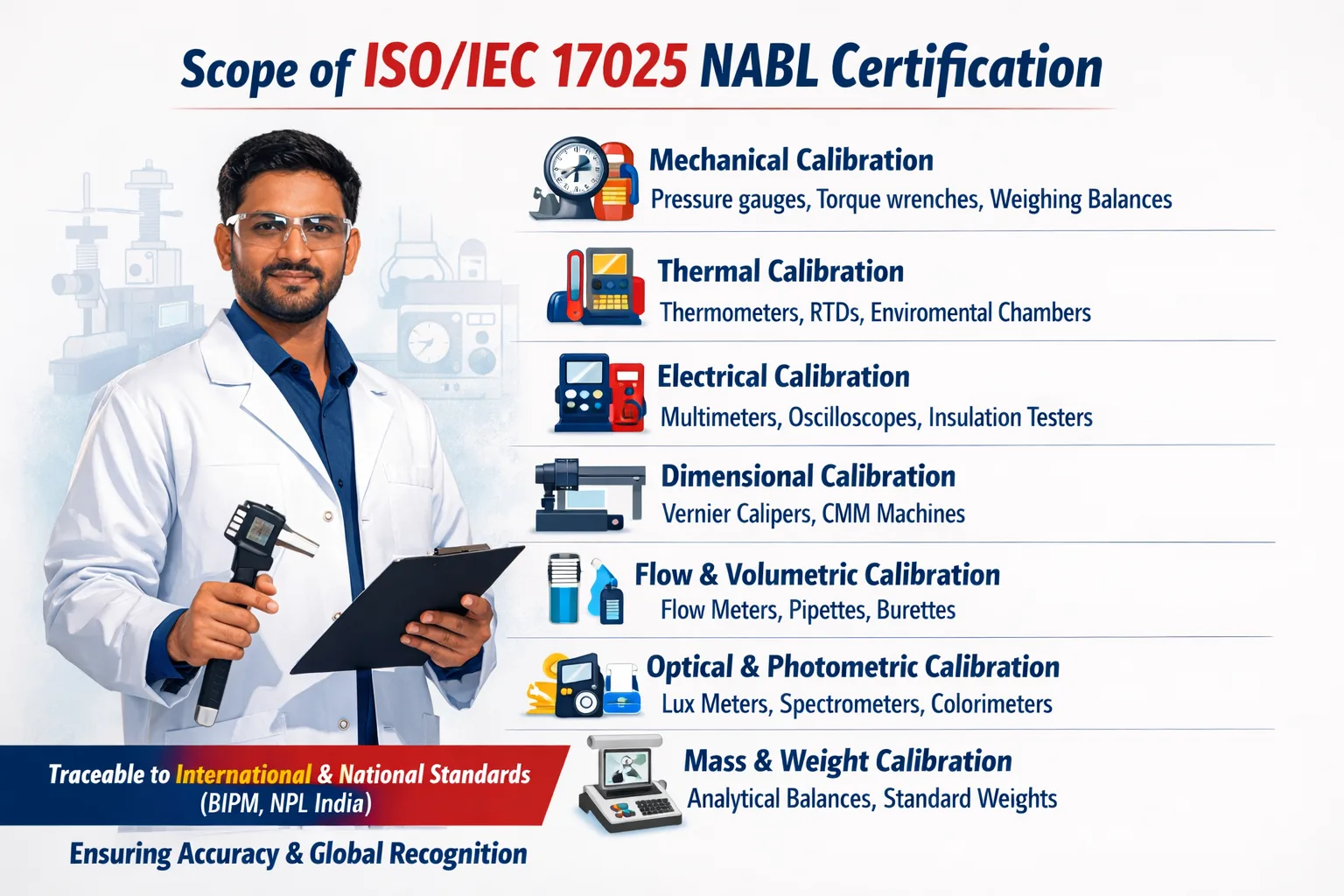
Accredited laboratories under National Accreditation Board for Testing and Calibration Laboratories cover a broad range of calibration and measurement disciplines, including:
- Mechanical Calibration: Pressure gauges, torque wrenches, weighing balances, force measurement devices used in industrial and manufacturing applications.
- Thermal Calibration: Thermometers, RTDs, thermocouples, ovens, furnaces, and environmental chambers to ensure accurate temperature measurement and control.
- Electrical Calibration: Multimeters, oscilloscopes, insulation testers, current and voltage-measuring instruments for precise electrical parameter evaluation.
- Dimensional Calibration: Vernier callipers, micrometres, height gauges, Coordinate Measuring Machines (CMMs) for high-precision dimensional measurements.
- Flow & Volumetric Calibration: Flow meters, pipettes, burettes, liquid dispensers used in laboratories and process industries for accurate volume and flow measurement.
- Optical & Photometric Calibration: Lux meters, spectrometers, colorimeters, and light-measurement instruments for optical accuracy and intensity validation.
- Mass & Weight Calibration: Analytical balances, standard weights, and weighing systems to ensure precise mass measurements in laboratories and production units.
All calibrations are performed using traceable reference standards aligned with international benchmarks set by the Bureau International des Poids et Mesures and national standards such as National Physical Laboratory India, ensuring global reliability and acceptance of results.
What are the Industries Benefiting from ISO/IEC 17025 NABL Certification?
The key industries benefiting from ISO/IEC 17025 NABL certification include the following:
- Pharmaceuticals & Healthcare
- Food & Beverage Industry
- Automotive & Engineering
- Aerospace & Defense
- Electronics & Electrical Manufacturing
- Power and Energy
- Chemical & Petrochemical Industry
- Construction & Infrastructure
What are the Key NABL ISO/IEC 17025 Requirements for Testing?
ISO/IEC 17025 specifies requirements for testing laboratories to ensure competence, accuracy, and reliability. NABL accreditation ensures laboratories follow standardised procedures, maintain quality systems, and deliver technically valid results. Here are the key requirements for testing:
1. Quality Management System: Establish and maintain a documented quality management system with defined policies, procedures, and objectives to ensure consistent laboratory operations, compliance with ISO/IEC 17025, and continual improvement in overall performance.
2. Document Control: Implement proper control over all documents, including approval, review, updating, and distribution, ensuring only current versions are used while preventing errors caused by outdated or unauthorised documentation.
3. Internal Audits: Conduct regular internal audits to evaluate compliance with ISO standards, identify non-conformities, and verify that quality systems are effectively implemented and maintained within the laboratory.
4. Corrective Actions: Identify root causes of errors or non-conformities and implement appropriate corrective actions to eliminate issues, prevent recurrence, and improve the reliability and efficiency of laboratory processes.
5. Management Review: Top management periodically reviews the quality management system to assess its effectiveness, ensure alignment with objectives, and make necessary decisions for improvement and resource allocation.
6. Personnel Competence: Ensure all laboratory personnel are adequately qualified, trained, and experienced, with defined roles and responsibilities, to perform testing activities accurately and maintain the credibility of results.
7. Equipment Calibration: Regularly calibrate and maintain laboratory equipment using traceable standards to ensure accuracy, reliability, and consistency of measurements, minimising errors and ensuring valid testing results.
8. Test Methods: Use validated, standardised, and appropriate test methods, ensuring they are properly documented and consistently applied to achieve accurate, reliable, and reproducible testing outcomes.
9. Measurement Traceability: Ensure all measurement results are traceable to national or international standards through a documented chain of calibrations, providing confidence in the accuracy and comparability of results.
10. Sampling: Follow well-defined sampling procedures to collect representative samples, ensuring that testing results accurately reflect the characteristics of the material or product being analysed.
11. Environmental Conditions: Maintain controlled environmental conditions, such as temperature, humidity, and cleanliness, to prevent any adverse impact on testing processes and ensure the validity and consistency of results.
12. Handling of Test Items: Implement proper procedures for the handling, storage, transportation, and identification of test samples to prevent contamination, damage, or loss, ensuring integrity throughout the testing process.
13. Reporting Results: Provide clear, accurate, and unbiased test reports, including all relevant details such as methods used, results obtained, and uncertainties, ensuring transparency and reliability for clients.
14. Control of Data: Ensure proper recording, storage, protection, and retrieval of data, maintaining confidentiality, integrity, and traceability while preventing unauthorised access or data loss.
15. Risk-Based Thinking: Identify potential risks and opportunities within laboratory processes and implement proactive measures to minimise errors, enhance performance, and ensure continuous compliance with quality standards.
16. Continuous Improvement: Promote ongoing improvement through feedback, audits, corrective actions, and performance monitoring to enhance laboratory efficiency, effectiveness, and the quality of testing services.
What are the Key NABL ISO/IEC 17025 Requirements for Calibration?
ISO/IEC 17025 calibration requirements ensure laboratories produce accurate, traceable, and reliable measurement results. NABL accreditation confirms adherence to technical competence, standardised procedures, and robust quality systems for calibration activities.
1. Calibration Method Validation: Calibration laboratories must use validated and standardised methods, ensuring procedures are appropriate, accurate, and consistently applied to produce reliable and reproducible calibration results across different measurement conditions.
2. Measurement Traceability: All calibration results must be traceable to national or international standards through an unbroken chain of comparisons, ensuring accuracy, consistency, and global acceptance of measurement results.
3. Measurement Uncertainty Evaluation: Laboratories must identify, calculate, and report measurement uncertainty using appropriate methods, ensuring transparency and reliability of calibration results for informed decision-making by customers and regulatory bodies.
4. Equipment Calibration and Maintenance: Regular calibration and maintenance of instruments are required to ensure accuracy and reliability, preventing measurement errors and ensuring consistent performance of equipment used in calibration processes.
5. Reference Standards Management: Maintain and use certified reference standards with known accuracy, ensuring they are properly calibrated, stored, and handled to preserve their integrity and reliability in calibration activities.
6. Environmental Conditions Control: Calibration must be performed under controlled environmental conditions, such as temperature and humidity, ensuring that external factors do not affect measurement accuracy and the reliability of calibration results.
7. Handling of Calibration Items: Proper handling, storage, and transportation of instruments under calibration must be ensured to prevent damage or alteration, maintaining their condition and ensuring accurate calibration outcomes.
8. Calibration Certificates and Reporting: Provide detailed calibration certificates, including results, uncertainties, traceability information, and conditions, ensuring clarity, transparency, and compliance with ISO/IEC 17025 reporting requirements.
9. Quality Assurance and Control: Implement quality control procedures such as proficiency testing and inter-laboratory comparisons to verify the accuracy and consistency of calibration results and maintain confidence in laboratory performance.
10. Data Recording and Integrity: Ensure accurate recording, storage, and protection of calibration data, maintaining traceability, confidentiality, and integrity while preventing unauthorised access or data manipulation.
What are the Key Benefits of NABL ISO/IEC 17025 Certification?
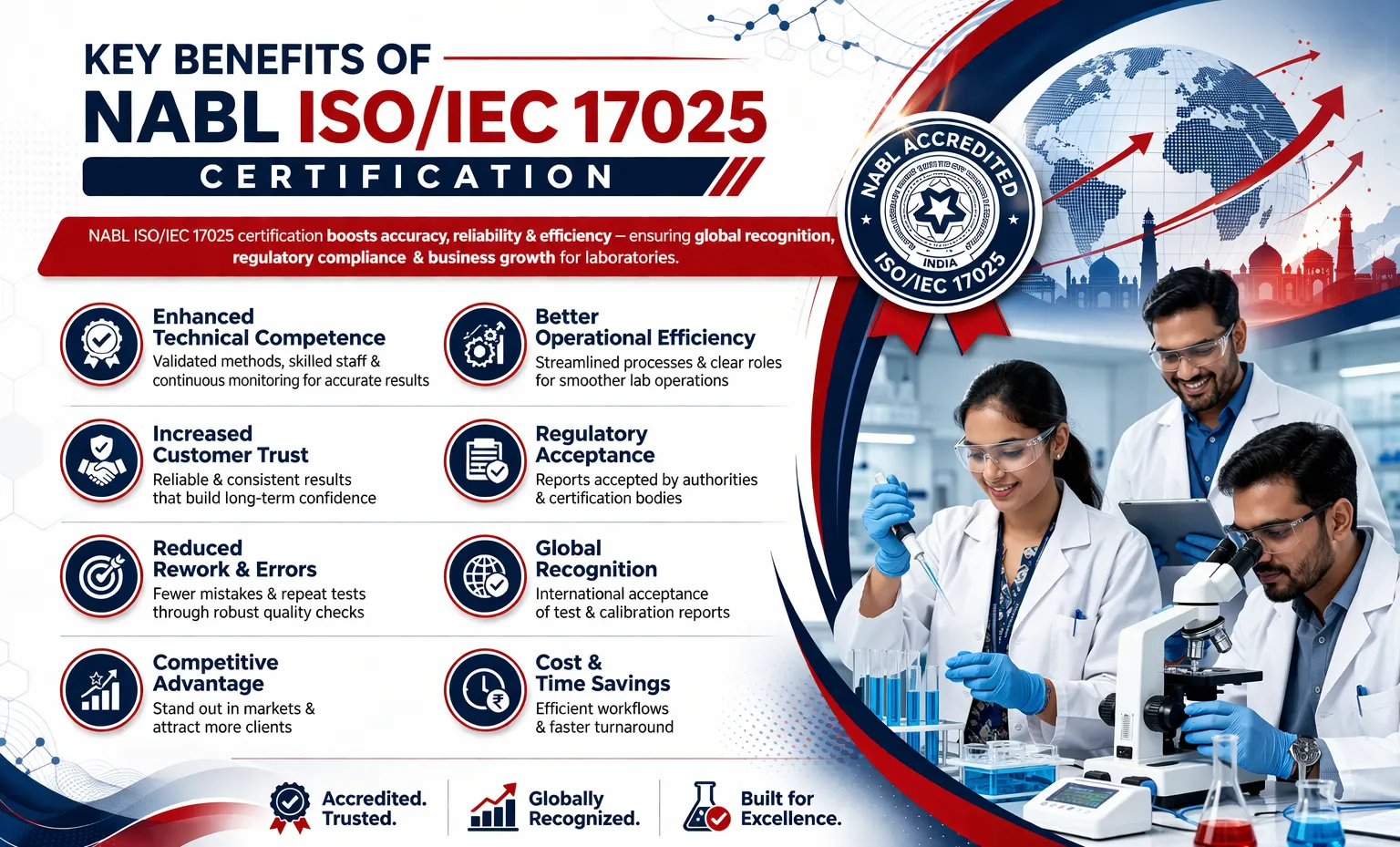
NABL ISO/IEC 17025 certification offers significant benefits to laboratories by improving accuracy, reliability, and operational efficiency. It enhances credibility, ensures regulatory compliance, and strengthens business performance, helping laboratories achieve global recognition and sustained growth in competitive markets. Additionally, it offers the following benefits:
- Enhanced Technical Competence: Certification strengthens laboratory capabilities through method validation, staff training, and continuous monitoring, ensuring technically sound, repeatable, and internationally acceptable testing and calibration results.
- Better Operational Efficiency: Clearly defined roles, structured processes, and systematic controls improve coordination, reduce operational delays, and enhance overall efficiency in day-to-day laboratory activities and management systems.
- Increased Customer Trust: Demonstrating compliance with international standards builds confidence among customers by ensuring impartiality, consistency, and reliability, thereby supporting long-term relationships and improving customer satisfaction.
- Regulatory Acceptance: Accredited laboratories gain wider acceptance from regulatory authorities, as their reports meet required standards, ensuring compliance and reducing the risk of rejection or additional verification requirements.
- Reduced Rework and Errors: Implementation of quality controls and validation processes minimises errors and repeat testing, saving time, reducing costs, and improving overall productivity and efficiency in laboratory operations.
- Global Recognition: Accreditation enables international acceptance of test and calibration results, eliminating duplication of testing and facilitating smoother participation in global trade and cross-border regulatory compliance processes.
- Competitive Advantage: Laboratories with accreditation stand out in competitive markets by demonstrating superior technical competence, quality assurance, and compliance, helping attract more clients and business opportunities.
- Cost and Time Savings: Efficient systems, reduced errors, and minimised duplication of work lead to significant cost savings and improved turnaround times, enhancing profitability and sustainable laboratory operations.
What is the Process for Obtaining NABL ISO/IEC 17025 Certification?
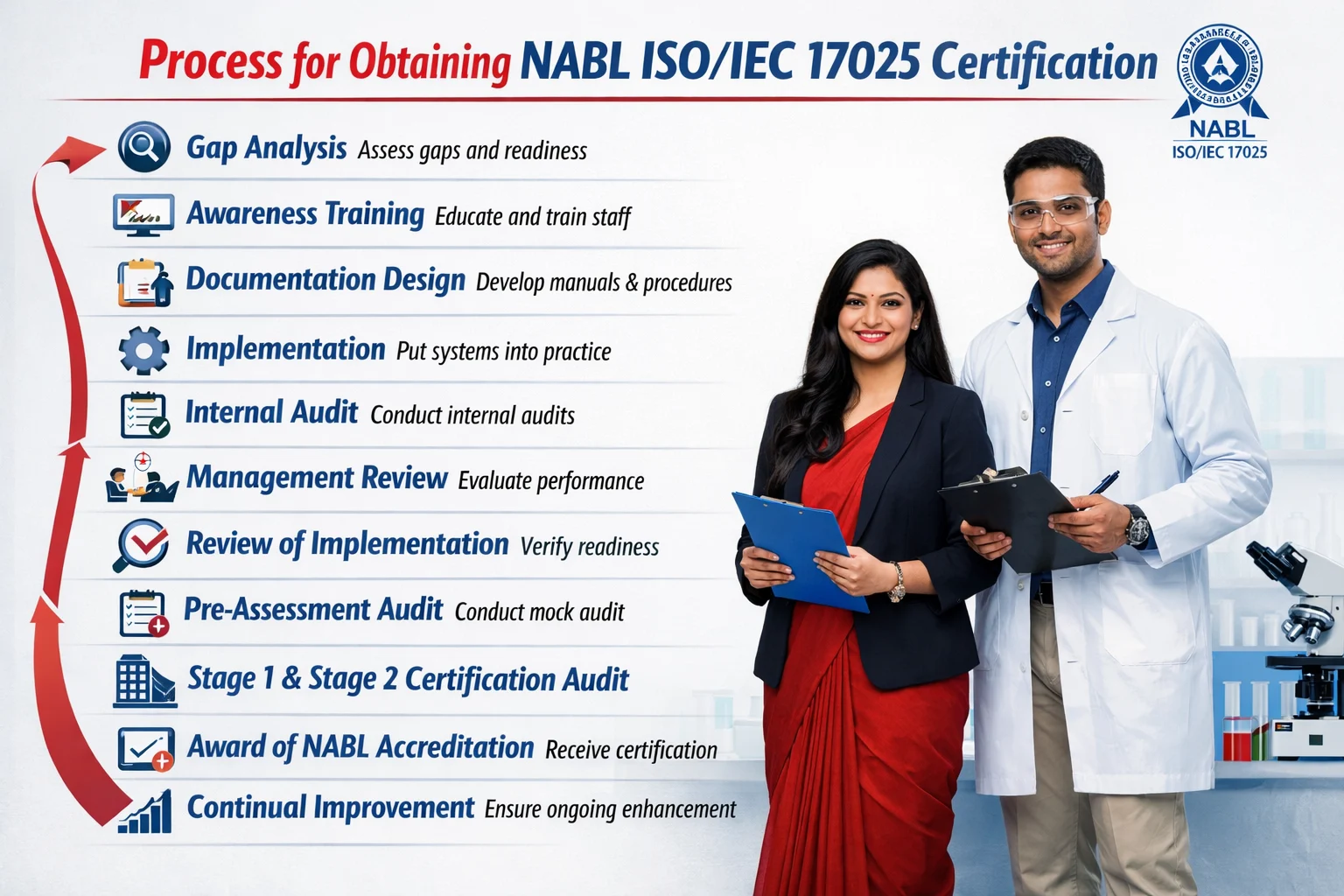
Here is the step-by-step process to obtain NABL ISO/IEC 17025 certification:
1. Gap Analysis
Initial assessment identifies gaps between existing laboratory practices and ISO/IEC 17025 requirements, helping define the scope, readiness level, and areas needing improvement.
2. Awareness Training
Training programs are conducted to educate staff about ISO/IEC 17025 requirements, quality systems, and their roles in maintaining compliance and achieving accreditation.
3. Documentation Design and Finalization
Development of quality manuals, procedures, policies, and records aligned with ISO/IEC 17025 standards to ensure structured and compliant laboratory operations.
4. Implementation
All documented procedures and systems are practically implemented across laboratory functions to ensure compliance with defined standards and operational consistency.
5. Internal Auditor Training and Internal Audit
Internal auditors are trained to conduct audits, identify non-conformities, and evaluate system effectiveness, ensuring readiness for external accreditation assessments.
6. Management Review Meeting
Top management reviews system performance, audit findings, and improvement opportunities to ensure the suitability, adequacy, and effectiveness of implemented processes.
7. Review of Implementation
A detailed evaluation is conducted to verify proper implementation of all requirements and to address any remaining gaps before the accreditation audit.
8. Pre-Assessment Audit
A mock audit is conducted to assess preparedness, identify weaknesses, and implement corrective actions before the final certification audit stages.
9. Stage 1 – Certification Audit
The accreditation body reviews documentation, scope, and system readiness to ensure compliance with ISO/IEC 17025 requirements before the main audit.
10. Stage 2 – Certification Audit
A detailed on-site assessment evaluates implementation, technical competence, and operational effectiveness to confirm compliance with accreditation requirements.
11. Award of NABL Accreditation
Upon successful audit completion, the laboratory is granted ISO/IEC 17025 NABL accreditation, confirming its technical competence and quality compliance.
12. Continual Improvement
Ongoing monitoring, audits, and training ensure continuous improvement, system effectiveness, and sustained compliance with evolving standards and industry requirements.
What are the Documents Required for NABL ISO/IEC 17025 Certification?
NABL ISO/IEC 17025 certification requires specific technical and traceability-focused laboratory documents, including but not limited to:
- Method validation reports
- Measurement uncertainty records
- Calibration traceability certificates
- Proficiency testing results
- Inter-laboratory comparison records
- Equipment calibration schedules
- Reference standard certificates
- Sampling procedures records
- Test method SOPs
- Environmental monitoring logs
- Test/calibration reports format
- Equipment maintenance logs
What are the Key Challenges in Obtaining NABL ISO/IEC 17025 Certification?
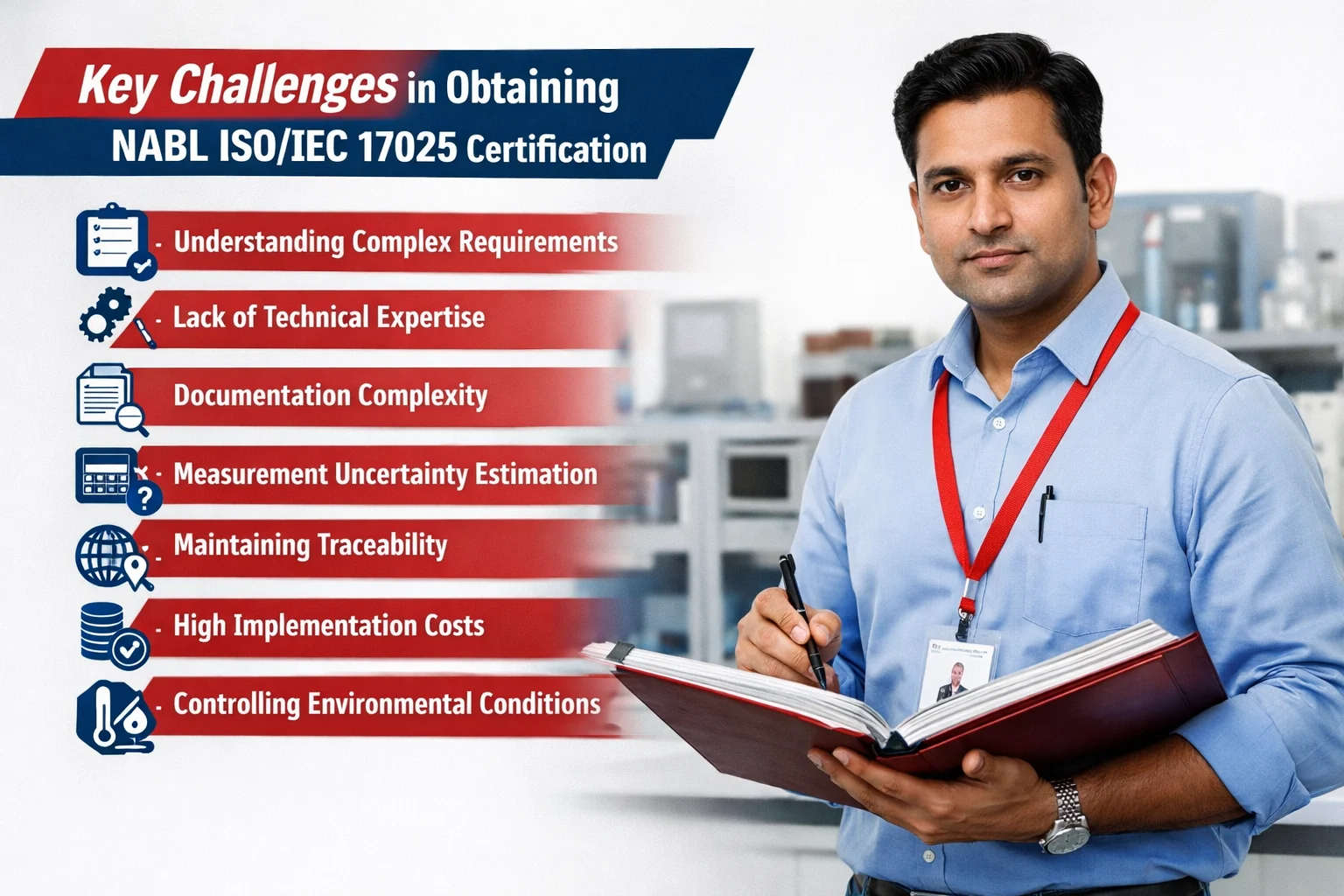
The key challenges businesses or organisations may face while obtaining NABL ISO/IEC 17025 certification includes:
- Understanding Complex Requirements: Laboratories often struggle to interpret detailed ISO/IEC 17025 clauses, making implementation difficult without proper guidance, expertise, and technical understanding of requirements.
- Lack of Technical Expertise: Shortage of skilled personnel with knowledge of calibration, validation, and uncertainty estimation can affect proper implementation and compliance with technical standards.
- Documentation Complexity: Preparing detailed, accurate, and compliant documentation, such as procedures, records, and validation reports, requires significant time, effort, and expertise.
- Measurement Uncertainty Estimation: Calculating and documenting measurement uncertainty is technically challenging and requires a deep understanding of statistical methods and laboratory processes.
- Maintaining Traceability: Ensuring all measurements are traceable to national or international standards involves proper calibration, documentation, and coordination with accredited bodies.
- Cost of Implementation: High costs associated with equipment calibration, training, infrastructure upgrades, and audits can be major barriers for small and medium-sized laboratories.
- Controlling Environmental Conditions: Maintaining required laboratory conditions such as temperature and humidity is challenging but essential for ensuring accurate and reliable results.
How Legal Babu Can Help?
Legal Babu simplifies the entire NABL ISO/IEC 17025 certification process by providing end-to-end support, from gap analysis and documentation to implementation and audit preparation. Our expert team ensures compliance with technical requirements, minimises errors, and accelerates certification, helping laboratories achieve accreditation smoothly while maintaining long-term quality and regulatory standards.
FAQS
Have some questions about ISO/IEC 17025 Certification?
We have got you covered:
-
What is the validity period of ISO/IEC 17025 certification?
National Accreditation Board for Testing and Calibration Laboratories' ISO/IEC 17025 certification generally remains valid for two years, subject to successful surveillance audits and continued compliance.
- Is ISO/IEC 17025 certification mandatory in India?
- Who can apply for ISO/IEC 17025 certification?
- How long does it take to obtain ISO/IEC 17025 certification?
- What is included in an ISO/IEC 17025 scope certificate?
- Why is proficiency testing important in ISO/IEC 17025 certification?
- Can small laboratories apply for ISO/IEC 17025 certification?
- Is consultancy required for ISO/IEC 17025 certification?
- What happens if a laboratory fails the certification audit?
- What is measurement uncertainty in ISO/IEC 17025?
- What is the role of internal audits in certification?
- Can a laboratory expand its certification scope later?
- What is traceability in ISO/IEC 17025 certification?
- Are electronic records acceptable for ISO/IEC 17025 certification?
- What is a surveillance audit in ISO/IEC 17025 certification?
- Why is impartiality important in ISO/IEC 17025 certification?
- Which organisations cannot apply for ISO/IEC 17025 certification?
- Can a laboratory hold multiple ISO certifications?
- What are quality control samples in laboratory testing?
- Can ISO/IEC 17025 certification be suspended or cancelled?


