
Table of Content
- What is MOA?
- What are the Main Clauses of the MOA?
- What is the Difference Between MOA and AOA of a Company?
- How Can You Change the MOA of Your Company?
- When Should You Change the MOA of Your Company?
- What Changes Can You Make in Your Company’s MOA?
- What Documents are Required to Change the MOA of Your Company?
- What is the Procedure to Change the MOA of Your Company?
- What are the Key Considerations while Changing the MOA of Your Company?
What is MOA?

The Memorandum of Association (MOA) is a fundamental legal document that defines the constitution and scope of a company under the Companies Act, 2013. It outlines essential details such as the company’s name, registered office, objectives, liability of members, and capital structure. The MOA acts as a charter that governs the relationship between the company and external stakeholders, specifying the boundaries within which the company can operate. Any activity beyond the stated objectives is considered ultra vires and legally invalid. Therefore, the MOA not only establishes the company’s identity but also ensures transparency, legal compliance, and protection of stakeholders’ interests throughout its operations.
What are the Main Clauses of the MOA?
The Memorandum of Association outlines essential clauses defining a company’s structure, objectives, and scope of operations under the Companies Act, 2013, ensuring legal identity, compliance, and operational clarity. The key clauses included under the MOA (Memorandum of Association) include the following:
- Name Clause
- Registered Office Clause
- Object Clause
- Liability Clause
- Capital Clause
- Association Clause
What is the Difference Between MOA and AOA of a Company?
The Memorandum of Association (MOA) and Articles of Association (AOA) are fundamental documents governing a company. While MOA defines the company’s scope and objectives, AOA outlines internal management rules. Understanding their differences is essential for ensuring proper corporate compliance and governance.
|
Basis of Difference |
Memorandum of Association (MOA) |
Articles of Association (AOA) |
|
Purpose |
Specifies objectives and powers of the company |
Regulates day-to-day operations and procedures |
|
Scope |
External document governing relationship with outsiders |
Internal document governing relationship among members |
|
Legal Status |
Supreme document; overrides AOA |
Subordinate to MOA |
|
Contents |
Name, registered office, object, liability, capital clauses |
Rules for directors, meetings, voting, dividends |
|
Binding Effect |
Binding on company and external stakeholders |
Binding on company and its members only |
How Can You Change the MOA of Your Company?
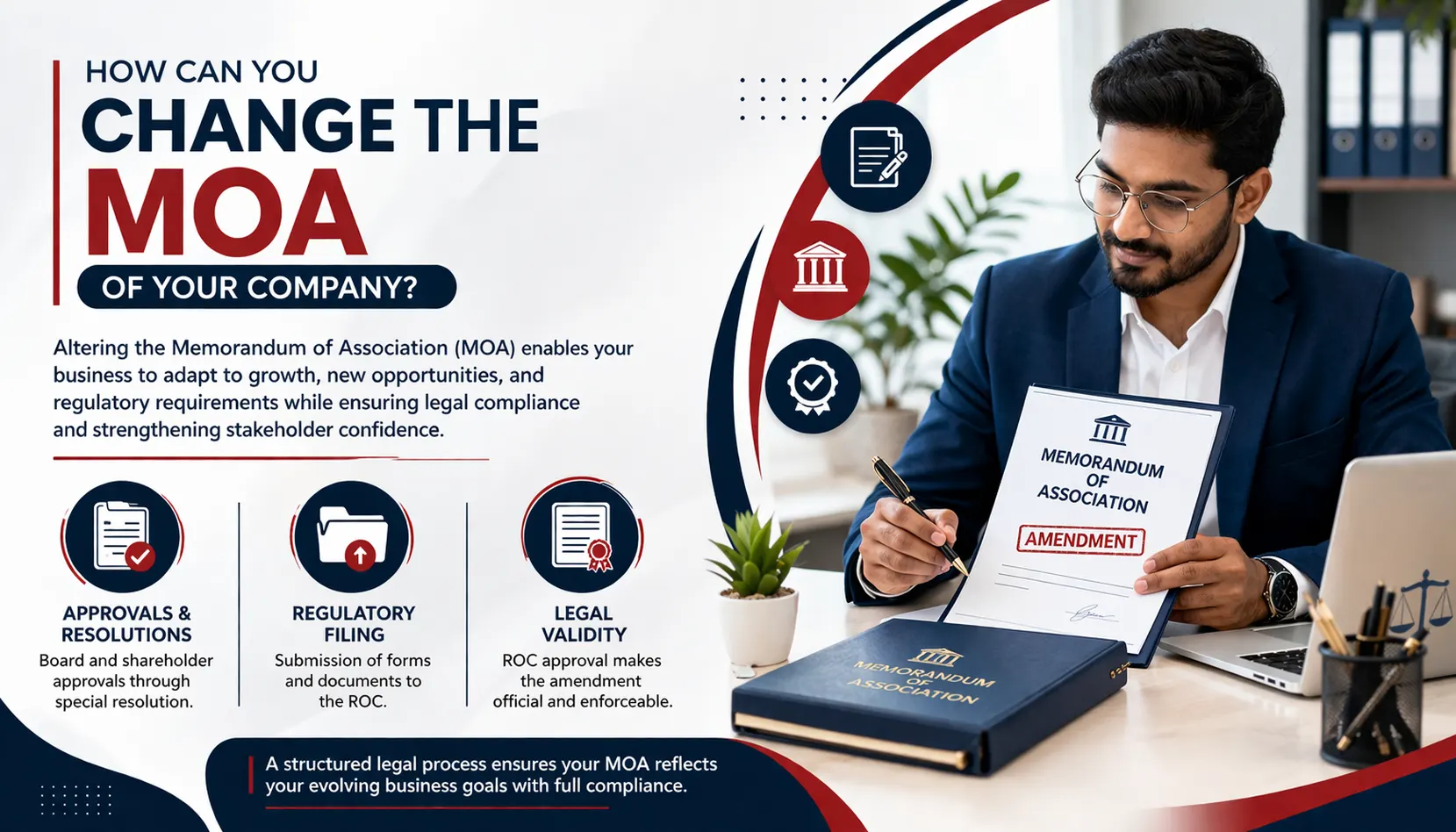
The Memorandum of Association (MOA) serves as the constitutional foundation of a company, defining its objectives, scope of activities, and relationship with stakeholders. As businesses grow and adapt to changing market conditions, it often becomes necessary to revise the MOA to reflect new strategies, expansion plans, or regulatory requirements. Such changes enable a company to legally align its operations with evolving commercial goals while ensuring compliance with the Companies Act, 2013.
Whether it involves modifying the object clause, shifting the registered office, or restructuring liability provisions, altering the MOA is a significant corporate action that must be handled with precision. A thoughtfully executed amendment not only facilitates business growth but also reinforces transparency, legal compliance, and stakeholder confidence in the organisation's long-term vision.
The process of modifying the MOA involves adherence to specific legal formalities under the Companies Act, 2013. It generally begins with the approval of the proposed changes by the board of directors, followed by obtaining shareholders’ consent through a special resolution. Depending on the nature of the alteration, approval from regulatory authorities such as the Registrar of Companies (ROC) may also be required. Once approved, the company must ensure that the changes are accurately reflected in all statutory records and relevant documents.
When Should You Change the MOA of Your Company?
The Memorandum of Association (MOA) defines a company’s scope, objectives, and legal identity under the Companies Act, 2013. As business needs evolve, companies may need to amend their MOA to stay compliant and aligned with strategic goals. Timely changes ensure smooth operations, legal validity, and support for long-term growth and expansion plans. Businesses should change their MOA when:
- Expanding business activities beyond existing object clause scope
- Entering new industries or diversifying core business operations
- Changing company name due to rebranding, merger, or acquisition
- Shifting registered office to another state for operational efficiency
- Increasing or restructuring authorised share capital for funding requirements
- Altering liability structure during company conversion or restructuring process
- Complying with new legal or regulatory requirements introduced by authorities
- Aligning company objectives with updated business strategy or market conditions
- Undertaking mergers, demergers, or corporate restructuring activities
- Rectifying inconsistencies or outdated clauses in the existing MOA document
What Changes Can You Make in Your Company’s MOA?

To change the Memorandum of Association (MOA) of your company in India, you must follow the procedures outlined in Section 13 of the Companies Act, 2013. Under the Companies Act, 2013, companies are permitted to modify specific clauses of the MOA, including:
1. Change in Name Clause: A company can change its name for rebranding, merger, or strategic reasons, subject to approval from authorities and compliance with naming guidelines.
2. Change in Registered Office Clause: The registered office can be shifted within the same city or state or to another state, depending on business requirements and regulatory approvals.
3. Change in Object Clause: The company can modify or expand its business objectives to include new activities or ventures, aligning with growth and diversification strategies.
4. Change in Liability Clause: Alterations may be made to define or modify the liability of members, especially in cases of restructuring or conversion of company type.
5. Change in Capital Clause: The authorised share capital of the company can be increased, reduced, or reorganised as per financial and operational needs.
6. Change in Association Clause: Amendments may be required in the subscription clause in specific cases like restructuring, though generally it remains unchanged after incorporation.
What Documents are Required to Change the MOA of Your Company?
The specific documents required to change the MOA of your company include the following:
Core Mandatory Documents
Regardless of the specific change, these primary documents must be prepared and filed:
- Revised (Altered) MOA: A complete, clean printed copy of the Memorandum of Association incorporating all the proposed changes.
- Certified Copy of Special Resolution: A formal extract from the company's minutes book confirming that at least 75% of shareholders approved the amendment.
- Notice of General Meeting (EGM/AGM): A copy of the formal notice sent to members (usually at least 21 clear days in advance) to announce the meeting where the resolution was passed.
- Explanatory Statement: A detailed statement required under Section 102, explaining the reasons, implications, and justification for the proposed amendments.
- Board Resolution: A certified copy of the resolution passed by the Board of Directors initiating the amendment process and calling for the shareholder meeting.
Clause-Specific Requirements
Depending on which clause you are changing, additional documents or specific forms may be required:
- Name Clause: Requires Form INC-24 and a copy of the name approval letter from the MCA.
- Registered Office (State-to-State Change): Requires Form INC-23 (application to Regional Director), Form INC-26 (advertisement in newspapers), and eventually Form INC-28 (notice of the order).
- Object Clause: If changing objects for which public money was raised, you must provide proof of newspaper publication and details regarding unutilised funds.
- Capital Clause: If increasing authorised capital, you typically file Form SH-7 along with the resolution.
What is the Procedure to Change the MOA of Your Company?
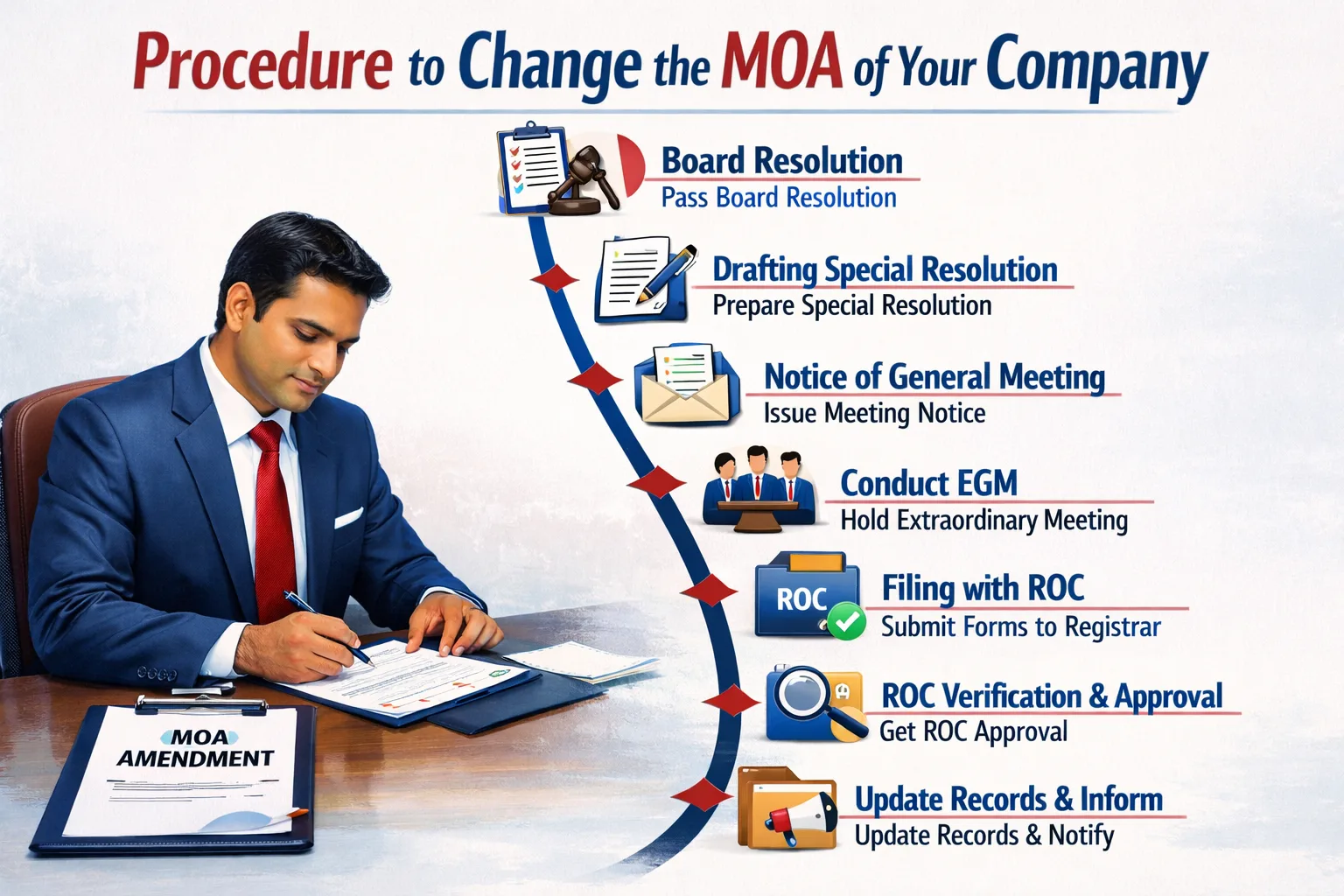
Altering the Memorandum of Association requires a structured legal process under the Companies Act, 2013. Companies must follow defined steps, including approvals, filings, and compliance procedures, to ensure the amendment is valid and legally enforceable. Here is the step-by-step procedure:
1. Board Resolution
The process begins with convening a board meeting where directors evaluate the need for alteration and pass a resolution approving the proposed changes. The board also authorises calling a general meeting and designates officials responsible for carrying out necessary compliance procedures.
2. Drafting Special Resolution
A special resolution is carefully drafted outlining the exact nature of the proposed amendments in the MOA clauses. It must clearly specify the changes to be made and ensure alignment with legal provisions and the company’s strategic objectives.
3. Notice of General Meeting
The company issues a formal notice to all shareholders, directors, and auditors, informing them about the general meeting. The notice must include details of the agenda, proposed MOA changes, and explanatory statements within the prescribed statutory time period.
4. Conduct Extraordinary General Meeting (EGM)
An extraordinary general meeting is conducted where shareholders discuss the proposed amendments. The changes are approved by passing a special resolution with the required majority, ensuring that members consent to the alteration in accordance with legal requirements.
5. Filing with Registrar of Companies
After shareholder approval, the company files necessary forms along with supporting documents with the registrar of companies. This step ensures that the alteration is officially recorded and complies with statutory filing requirements within the prescribed time limit.
6. ROC Verification and Approval
The Registrar of Companies examines the submitted documents and verifies compliance with applicable laws and regulations. Upon satisfaction, the Registrar approves the alteration and registers the amended MOA, making the changes legally effective and enforceable.
7. Update Records and Inform Stakeholders
Once approval is received, the company updates all statutory records, official documents, and copies of the MOA. It also informs relevant stakeholders, authorities, and regulatory bodies to ensure transparency and proper implementation of the approved changes.
What are the Key Considerations while Changing the MOA of Your Company?
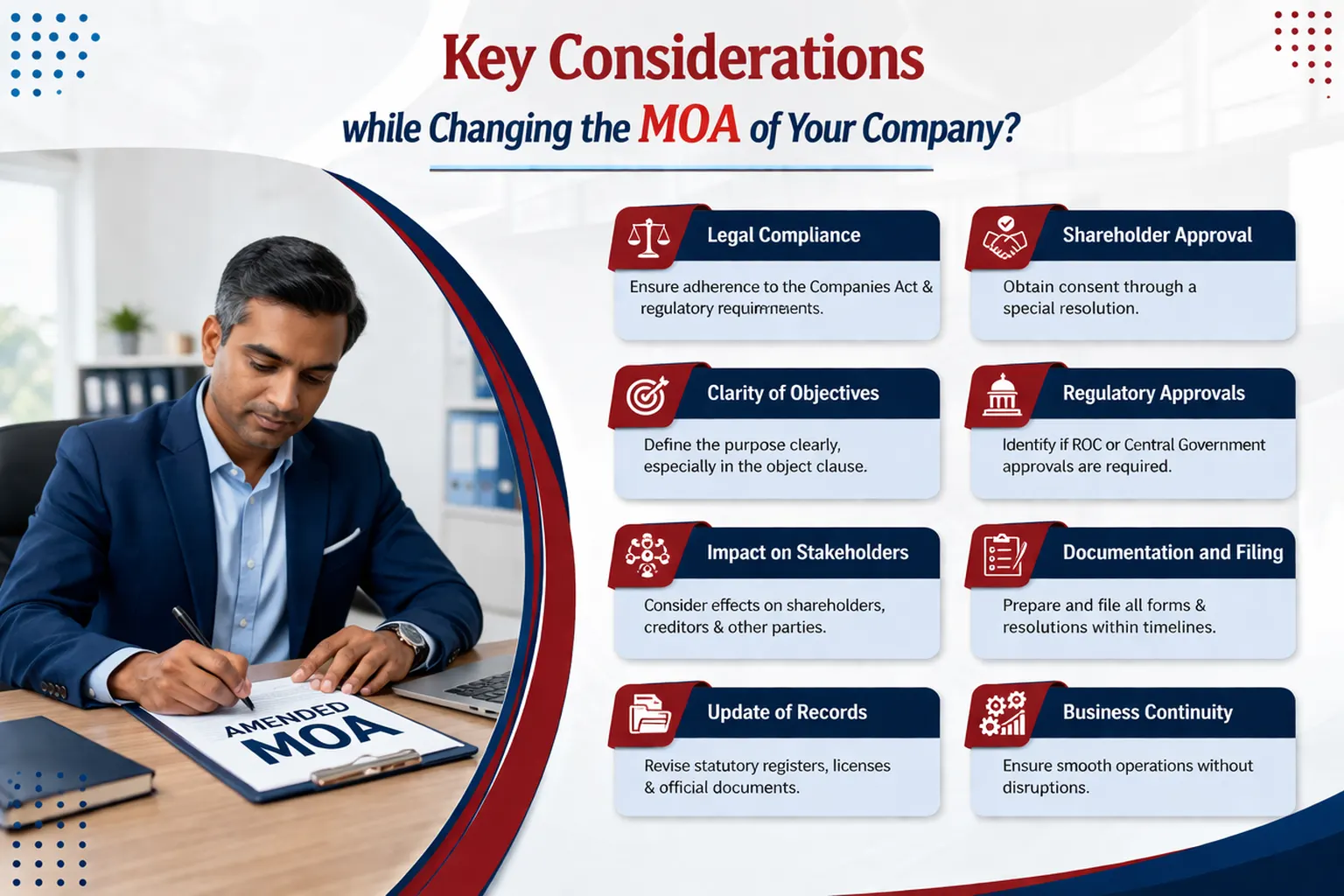
Altering the Memorandum of Association requires careful evaluation to ensure compliance with the Companies Act, 2013. Companies must consider legal, operational, and strategic factors to avoid complications and ensure a smooth and valid amendment process.
- Legal Compliance: Ensure that all proposed changes strictly comply with the provisions of applicable laws and regulatory requirements to avoid rejection, penalties, or future legal disputes.
- Shareholder Approval: Obtain proper consent from shareholders through a special resolution, as their approval is mandatory for validating any alteration in the MOA.
- Clarity of Objectives: Clearly define the purpose of alteration, especially in the object clause, to avoid ambiguity and ensure alignment with the company’s long-term business strategy.
- Regulatory Approvals: Determine whether approvals from authorities such as the Registrar of Companies or central government are required, depending on the nature of the change.
- Impact on Stakeholders: Evaluate how the proposed changes will affect shareholders, creditors, and other stakeholders to maintain transparency and avoid conflicts or objections.
- Documentation and Filing: Ensure all required documents, resolutions, and forms are properly prepared and filed within prescribed timelines to maintain legal validity of the alteration.
- Update of Records: After approval, update all statutory registers, agreements, licenses, and official documents to reflect the amended MOA and maintain consistency across records.
- Business Continuity: Assess the impact of changes on ongoing operations and ensure that business activities continue smoothly without disruption during and after the alteration process.
FAQS
Have some questions about MOA?
We have got you covered:
-
Can a private company change its MOA anytime?
Yes, a private company can alter its MOA anytime, subject to compliance with legal procedures, shareholder approval, and necessary filings with the Registrar of Companies.
- Can MOA changes affect existing contracts of the company?
- How long does it take to change the MOA?
- Is it mandatory to update MOA changes on the MCA portal?
- Can a company change multiple clauses of MOA simultaneously?
- Do MOA changes require updating other registrations?
- Can MOA be changed without shareholder approval?
- Is newspaper publication required for MOA changes?
- Does MOA alteration affect company incorporation details?
- Can MOA be altered multiple times in a year?


