
Will Drafting Services to Secure Your Family's Future

Most people spend a lifetime building something - a home, savings, a business, a family. Then they leave everything that matters most completely unaddressed. No will. No instructions. Just grief and a legal system that doesn't care about your intentions.
Will drafting isn't a task for "someday." It's a legal necessity for anyone who owns property and loves someone. And yet, fewer than 5% of Indians have a registered will. The result? Families torn apart by disputes that could have been prevented in an afternoon. Courts deciding who gets what - often over years, often unfairly.
Legal Babu helps you prevent exactly this. This guide covers everything you need to know about will drafting in India - the law, the process, the mistakes, and why getting it done right the first time is the most important legal decision you'll ever make for your family.
What Is a Will and Why Is It Not Optional
A will - formally called a testamentary document - is a written legal declaration by a person (called the testator) specifying how their assets, property, and possessions should be distributed after death. It comes into legal effect only upon the testator's death and can be modified or revoked at any point while they are alive.
In India, testamentary succession is governed by the Indian Succession Act, 1925. This law applies to Hindus, Christians, Sikhs, Jains, Buddhists, and Parsis. Muslims are governed by Muslim Personal Law for intestate inheritance but may still use a will to distribute up to one-third of their estate to non-heirs.
What happens if you die without a will? Your estate enters intestate succession - your assets get divided based on codified personal laws, not your wishes. Distant relatives may have equal legal claim. Minor children may be left without a designated guardian. Banks freeze accounts. Courts decide who gets what. And that process can take three to ten years.
A professionally executed will drafting service prevents all of it. It doesn't just distribute property - it names guardians for children, appoints an executor to manage the process, resolves nomination conflicts across financial instruments, and ensures your exact intentions are legally enforceable.
Key Statistics
|
Fact |
Data |
|
Indians with a registered will |
Less than 5% |
|
Estate disputes arising from no will |
Over 70% |
|
Average court timeline for intestate disputes |
3–10 years |
|
Year of the governing law |
Indian Succession Act, 1925 |
Did You Know? If a property is not mentioned in a will, it falls outside testamentary succession entirely and gets divided under the applicable personal law - regardless of what the rest of your will says. A complete asset inventory isn't optional. It's mandatory.
Who Can Legally Make a Will in India?
Under Section 59 of the Indian Succession Act, 1925, the following conditions must be satisfied for a will to be legally valid at the time of execution:
-
Age: The testator must be at least 18 years old. If under court-appointed guardianship, the age requirement is 21 years.
-
Sound mind: The testator must understand the nature of the document they are signing, what property they own, and who they are giving it to.
-
Free will: The will must reflect the testator's independent decision, not the result of coercion, fraud, or undue influence by a third party.
-
Not intoxicated or mentally incapacitated at the time of signing.
This is precisely why professional will drafting with a qualified lawyer matters. Legal Babu ensures that the right declarations, certificates, and witness protocols are in place so the will cannot be challenged on these grounds later.
Types of Wills Recognised Under Indian Law
Not every will works the same way. Understanding which type fits your situation is the first step in drafting a will that actually holds up.
Types of Wills at a Glance
|
Type of Will |
Who It Applies To |
Key Feature |
|
Unprivileged Will |
All civilians |
Must follow Section 63 - signed by testator, attested by two witnesses |
|
Privileged Will |
Soldiers, airmen, mariners in active service |
Can be oral or written; fewer formalities required |
|
Conditional/ Contingent Will |
Anyone |
Comes into effect only when a specified condition is met |
|
Joint Will |
Two or more persons |
Single document; each testator's portion governed separately |
|
Mutual Will |
Usually married couples |
Reciprocal provisions; legally binding once one party dies |
|
Living Will |
Anyone |
Governs medical decisions, not asset succession; validated by the Supreme Court in 2018 |
Unprivileged Will is the most common form in India. Every civilian will drafting scenario falls under this category. It requires the testator's signature on every page and attestation by two qualified adult witnesses.
Privileged Will exists for military personnel in active expedition or war scenarios. The legal formalities are reduced significantly - the will can even be oral in some cases.
A Conditional Will is powerful but dangerous if drafted loosely. If the triggering condition is ambiguous, courts interpret it - often not in your favor.
A joint will is frequently used by couples for jointly held property. After one spouse dies, the surviving spouse is generally bound by the terms.
Mutual Will creates a binding compact. Once one party to the mutual will dies and the survivor has accepted benefits under it, courts have held that the survivor cannot freely revoke their own will.
A Living Will does not distribute assets at all - it directs medical treatment decisions when the person cannot communicate. The Supreme Court's Common Cause v. Union of India (2018) judgment gave it legal standing in India.
If you are uncertain which type suits your family and assets, contact Legal Babu for a consultation. The right type of will is not a detail - it is the foundation everything else rests on.
8 Essential Components of a Legally Valid Will
A will that is missing even one critical component can be successfully contested - or declared void entirely. Every will drafting service worth using will ensure all of the following are correctly included.
-
Testator's Personal Details: Full legal name, age, address, PAN/Aadhaar number, and religion. Establishes identity beyond dispute. Vague identification is one of the first things opposing lawyers attack.
-
Declaration of Intent + Revocation Clause: A clear statement that this is the testator's last and final will, and that all prior wills and codicils are revoked. Without this clause, an older will can be presented in court and create conflicting claims.
-
Executor Appointment: Names the person responsible for carrying out the will's instructions. Should be a trustworthy, financially capable adult who is willing to take on the responsibility. Always name an alternate executor in case the primary predeceases the testator. For families with complex assets, consider trust registration as a supplementary mechanism for structured wealth management.
-
Beneficiary Details: Full legal names, relationships, dates of birth, and contact details of every person or organisation receiving something under the will. Generic references like "my children" without naming them create ambiguity courts are forced to resolve.
-
Complete Asset Description: Every asset - movable and immovable. Real estate must include survey numbers, registration details, and municipal property numbers. Bank accounts, investment folios, insurance policy numbers, vehicle registration details, and digital assets (including cryptocurrency) must all be listed. An incomplete asset list is the single most common source of post-death disputes.
-
Distribution Plan (Bequests): Precise allocation of each asset to each beneficiary. "My son should get the house" is legally weaker than a clause naming the son by full name, listing the property with its full registered address, survey number, and document reference. Specificity is protection.
-
Sound Mind Declaration: A clause affirming the testator is of sound mind, acting voluntarily, and free from any coercion or undue influence. For testators above 70 or with health conditions, attaching a doctor's certificate at the time of execution significantly strengthens this clause against future challenge.
-
Signatures and Two Qualified Witnesses: The testator must sign every page in the presence of two witnesses. Both witnesses must sign each page in each other's presence and in the testator's presence. Critically, a witness cannot be a beneficiary under the will. If they are, their bequest is voided, though the will itself may remain valid. It would be advisable to have the will witnessed and signed by both a doctor and a lawyer, as this would enhance its credibility in a court of law. This is one of the most common and costly errors in self-drafted wills.
How to Draft a Will in India - Step by Step
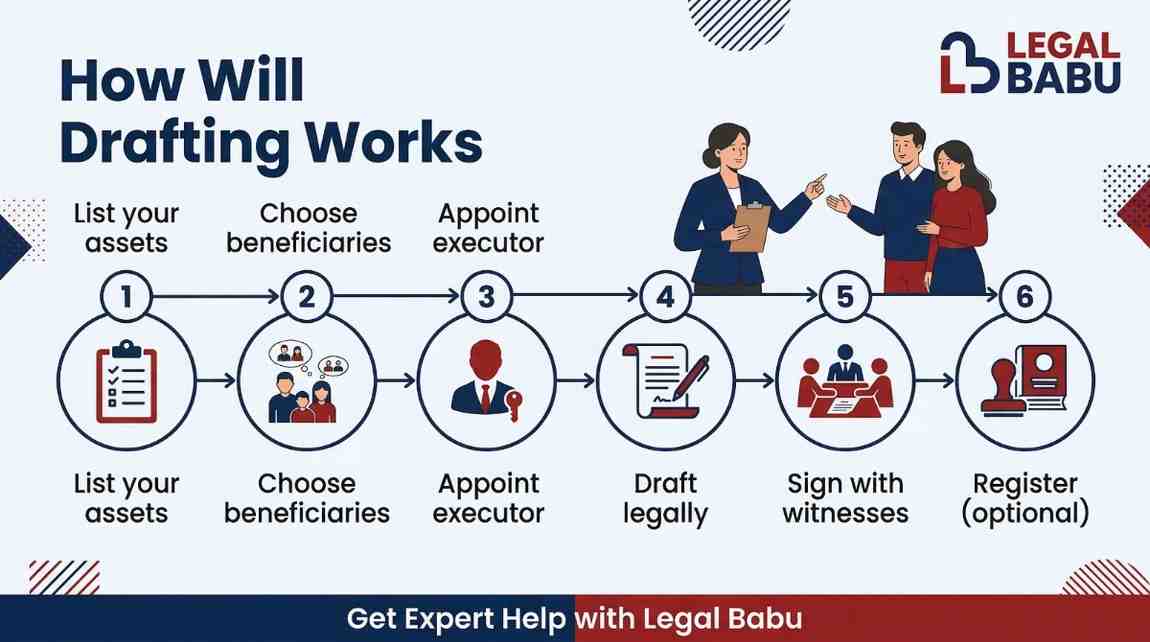
Will drafting is a structured legal process. Cutting corners at any step creates vulnerabilities that opposing parties - and courts - will exploit. Here is exactly how it should be done.
Step 1 - Compile a Complete Asset Inventory
List every asset you own. Movable and immovable. Domestic and foreign. This includes residential and commercial property (with registration numbers), all bank and investment accounts, life insurance policies, PF and PPF balances, mutual fund folios, vehicle registrations, jewellery, and digital assets, including cryptocurrency wallets and domain names.
Incomplete asset lists are the most common trigger for disputes because unmentioned assets default to intestate succession - regardless of what the will says elsewhere.
Step 2 - Define Your Beneficiaries With Precision
Be specific. Every beneficiary should be identified by full legal name, date of birth, relationship to the testator, and current address. Each asset or portion of an asset should be unambiguously tied to a named beneficiary. Vague allocations - "divide equally among my children" - are legally weaker and practically harder to execute.
Step 3 - Appoint an Executor (and an Alternate)
Choose someone trustworthy, organizationally capable, and stable enough to manage an estate during a period of family grief. The executor deals with banks, courts, beneficiaries, and tax authorities. Naming an alternate executor is essential - if the primary executor dies before the testator, the will is not automatically void, but the execution process becomes significantly more complicated.
For families managing substantial or complex assets, a trust registration alongside the will provides an additional layer of structured, legally recognised asset management that a simple will cannot replicate.
Step 4 - Audit Nominations Across All Financial Instruments
This is the step most will drafting services skip entirely. Insurance policies, EPF/PPF accounts, bank accounts, and mutual fund folios all carry separate nomination fields - and in several cases, the nominee receives the asset directly, regardless of what the will states. A comprehensive will drafting process audits these nominations for conflicts and alignment before the document is finalised.
Step 5 - Draft the Will With a Legal Professional
Generic online templates miss jurisdiction-specific requirements, fail to include the right protective clauses, and leave interpretive gaps that courts fill unfavourably. The language in a will must be legally unambiguous. Every clause should anticipate challenge and be written to withstand it.
Legal Babu's legal professionals draft fully customised wills - not templates - tailored to your asset structure, family dynamics, and succession goals.
Step 6 - Execute the Will Correctly
The testator must sign every page of the will in the presence of two witnesses simultaneously. The witnesses must then sign every page in the testator's presence and in each other's presence. For elderly testators or those with health concerns, a doctor's certificate confirming mental capacity at the time of signing is strongly recommended. This single piece of documentation can defeat most legal challenges before they begin.
Step 7 - Register the Will at the Sub-Registrar's Office
Registration is not mandatory under Indian law. But it creates a permanent government record, dramatically reduces the risk of forgery or suppression, and makes the will significantly harder to challenge in court.
Registration is done under the Registration Act, 1908 at the Sub-Registrar's office in the jurisdiction where the testator resides.
Step 8 - Store, Communicate, and Update
The original will should be stored in a fireproof location - ideally a bank's safe deposit locker. The executor must know exactly where it is. The will must be reviewed and updated after every major life event: marriage, divorce, birth of a child, death of a beneficiary or executor, or a significant change in assets. As a rule, revisiting the document every three to five years is advisable even without triggering events.
Read more: Check how income tax is filled.
Registered vs. Unregistered Will - What's the Real Difference?
Both are legally valid in India. But one is significantly more defensible than the other - especially when contested.
|
Factor |
Registered Will |
Unregistered Will |
|
Legal Validity |
Valid - backed by government record |
Valid - if properly executed |
|
Contestability |
Harder to challenge or suppress |
Easier to question; relies on witnesses |
|
Forgery Risk |
Extremely low - government copy retained |
Higher - no independent third-party record |
|
Evidence of Execution |
Permanent Sub-Registrar record |
Witness testimony alone |
|
Probate Requirement |
May still be needed in some states |
Mandatory in Mumbai, Kolkata, Chennai |
|
Risk of Suppression |
Near zero - government retains copy |
Real - original can be hidden or destroyed |
|
Recommended? |
Strongly yes |
Only where registration is genuinely impractical |
What is probate?
Probate is a court-issued certificate confirming the legal validity of a will and authorising the executor to administer the estate. In India, probate is mandatory in the High Court jurisdictions of Mumbai, Kolkata, and Chennai for immovable property. For other states, it is not compulsory but is frequently required by banks and other institutions before releasing or transferring assets.
Learn more about legal documentation and compliance processes at Legal Babu's Learn section.
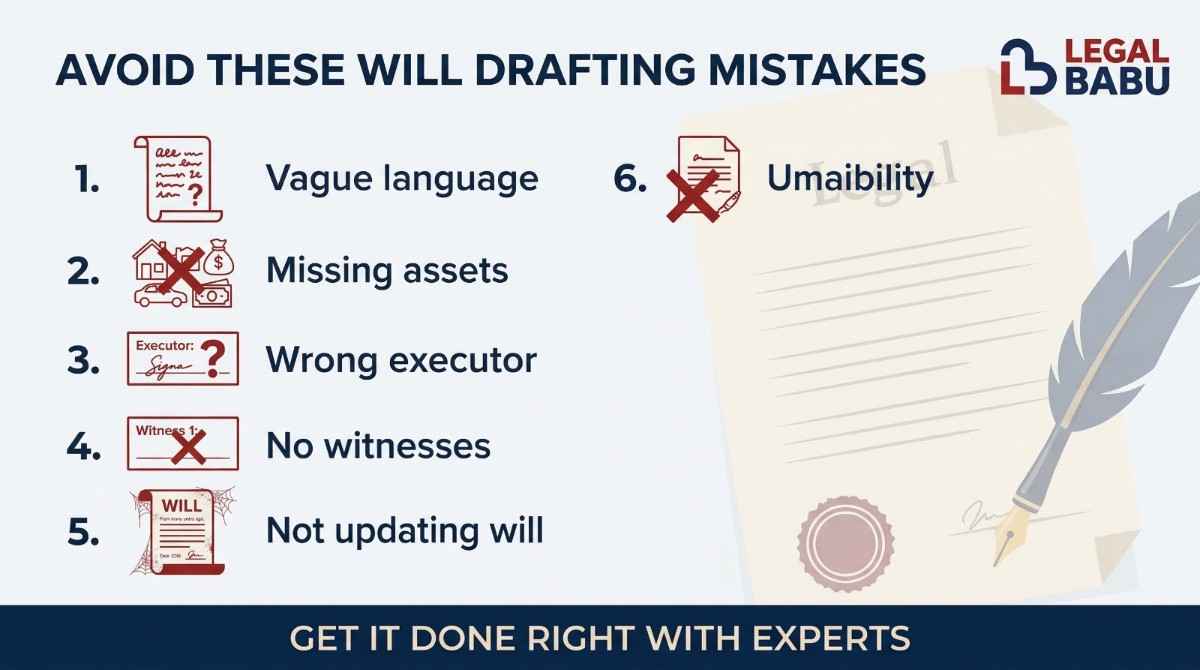
8 Critical Mistakes That Can Render Your Will Legally Worthless
These are not theoretical risks. They are the exact errors that opposing lawyers look for when a will is challenged - and they appear far more often than most people expect.
Common Will Drafting Mistakes to Avoid
-
A Beneficiary Serves as a Witness: Under Section 67 of the Indian Succession Act, 1925, if a beneficiary witnesses the will, their bequest under that will becomes void. The will itself may remain valid - but that person loses their inheritance entirely. This single mistake can devastate a family member's share with no remedy.
-
Vague or Ambiguous Language: "Divide equally among my children" without naming them. "My house" without an address or survey number. "My savings" without specifying accounts. Courts interpret ambiguity - and interpretation rarely matches what the testator intended.
-
No Revocation Clause: Without explicitly revoking prior wills, an old will remains legally operative. Two conflicting wills create a court battle over which one governs - and the most recently dated will doesn't automatically win.
-
Nomination Conflicts Unaddressed: A nominee on a bank account or insurance policy receives the asset first - this is a contractual right. The legal heir entitled under the will must then seek restitution from the nominee. Without auditing nominations before will drafting, you may inadvertently create a situation where the nominee and the beneficiary are different people, leading to prolonged legal disputes.
-
Not Signing Every Page: Each page of the will must carry the testator's signature. A will with even one unsigned page can be challenged on grounds of incompleteness. Witnesses must also sign every page.
-
Using Generic Online Templates: Templates sourced from the internet are not customised to Indian jurisdiction, your state's specific requirements, or your individual asset situation. They skip critical protective clauses, use outdated language, and leave interpretive gaps. A template-based will often create more legal problems than it solves. Legal Babu drafts fully customised, lawyer-reviewed wills.
-
Failing to Update After Life Events: Marriage, divorce, birth of a child, death of a named beneficiary or executor, sale of a major property - any of these can make existing provisions obsolete, contradictory, or unenforceable. A will is not a one-time document; it is a living legal instrument that must evolve with your circumstances.
-
Neglecting Digital Assets: Cryptocurrency, domain names, digital investment accounts, and online business assets are real, often significant, and frequently forgotten in will drafting. Without clear instructions and access details (stored securely and separately from the will), digital assets may be permanently inaccessible to beneficiaries.
Ready to Protect Your Family With a Legally Sound Will?
A professionally drafted will is not a luxury. It is the legal document that decides whether your family inherits your life's work - or spends the next decade in court fighting for it. Legal Babu drafts fully customised, lawyer-reviewed, dispute-resistant wills tailored to your specific assets, family structure, and succession goals. Don't delay a decision this important.
FAQS
Frequently Asked Questions on Will Drafting
-
1. Is it mandatory to register a will in India?
No. Registration is not compulsory under Indian law - an unregistered will is legally valid if properly executed. That said, registration creates a permanent government record, makes the will far harder to challenge, and eliminates the risk of suppression or forgery. It is strongly recommended.
- 2. Can a will be handwritten in India?
- 3. Can a will be changed or revoked after it is made?
- 4. What is probate, and when is it required in India?
- 5. Can a person with an illness or old age make a valid will?
- 6. Who cannot be a witness to a will?
- 7. Does a will override a nominee in a bank account or insurance policy?
- 8. Can I draft my will online in India?
- 9. What is an executor, and why is one needed?
- 10. Can a Muslim draft a will in India?
- 11. How often should I update my will?
- 12. What happens to assets not mentioned in the will?


