
How Will Budget 2026 Tax Changes Affect Your Wallet?
- by kapil
- Updated Feb 25, 2026
- 8 mins read

I. What is the Overview of the Budget 2026 Tax Changes?
Welcome to your complete breakdown of the Budget 2026 Tax Changes. Whether you are a salaried employee, a seasoned investor, or a business owner, this year’s budget brings sweeping changes to both direct and indirect taxation that will directly impact your finances.
A major highlight of these updates is a much-welcomed shift in the default tax regime, featuring a brand-new tax slab structure aimed at reducing the burden on everyday taxpayers. Additionally, the government has placed a strong emphasis on “procedural ease,” introducing key compliance changes to simplify how we file and pay taxes. Add in some crucial corporate tax adjustments, and we are looking at a budget designed to modernize compliance and offer targeted relief. Let’s dive into what this means for you.
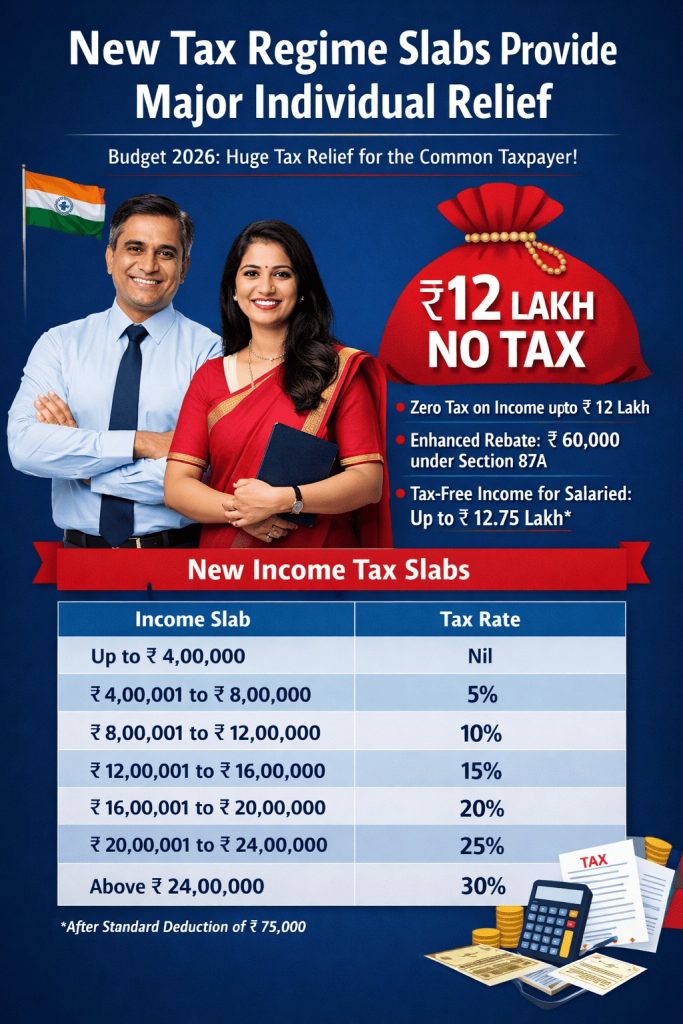
II. How Do the New Tax Regime Slabs Provide Major Individual Relief?
The Budget 2026 Tax Changes bring massive news for the common taxpayer, primarily through the new default tax regime.
The Big Win: Resident individuals earning a taxable income up to ₹ 12 lakh will effectively pay zero tax. When choosing between the new and old tax regimes, this massive relief is driven by an enhanced rebate of ₹ 60,000 provided under Section 87A. For salaried taxpayers, the benefits are even sweeter—the tax-free limit extends to ₹ 12.75 lakh after applying the standard deduction of ₹ 75,000.
Here is a quick look at the new slab rates:
| Income Slab | Tax Rate |
| Up to ₹ 4,00,000 | Nil |
| ₹ 4,00,001 to ₹ 8,00,000 | 5% |
| ₹ 8,00,001 to ₹ 12,00,000 | 10% |
| ₹ 12,00,001 to ₹ 16,00,000 | 15%9 |
| ₹ 16,00,001 to ₹ 20,00,000 | 20% |
| ₹ 20,00,001 to ₹ 24,00,000 | 25% |
| Above ₹ 24,00,000 | 30% |
III. What Are the Key Procedural and Compliance Shifts?
Filing your taxes just got a bit more flexible. A core part of the Budget 2026 Tax Changes involves easing the administrative headache for taxpayers.
- Extended ITR Revision Window: Made a mistake? The deadline for filing revised or belated returns on the e-filing portal has been extended from December 31 to March 31 of the subsequent tax year. Note: This comes with a nominal fee of ₹ 1,000 (if income is under ₹ 5L) or ₹ 5,000 (if income is over ₹ 5L).
- Staggered Filing Deadlines: The deadline for salaried individuals (ITR-1/2) remains July 31. However, the due date for non-audit business cases and trusts has been pushed to August 31.
- TCS Rationalization: Planning a trip abroad or sending money for education/medical needs? Tax Collected at Source (TCS) on overseas tour packages and LRS remittances for education/medical purposes has been slashed to a flat 2% rate, regardless of the transaction amount.
IV. How Will the Budget 2026 Tax Changes Affect Investments and Capital Markets?
If you invest in the markets, pay close attention. The Budget 2026 Tax Changes are shifting the landscape for capital market taxation:
- Share Buybacks: Proceeds will now be taxed as Capital Gains for all shareholders, rather than as dividends.
- Securities Transaction Tax (STT) Hike: Trading costs are going up. STT on Futures rises to 0.05% (from 0.02%), and on Options, it jumps to 0.15% (from 0.1%).
- Sovereign Gold Bonds (SGBs): The capital gains exemption upon maturity is now restricted only to original subscribers. If you buy SGBs from the secondary market, they will attract capital gains tax.
- Dividend & Mutual Fund Income: The 20% interest deduction against dividend income has been scrapped. Going forward, this income is fully taxable under “Income from Other Sources”.
V. What Are the Major Overhauls to TDS and TCS Rates?
To keep more working capital in your hands, the government has introduced major rate overhauls through the Budget 2026 Tax Changes for Tax Deducted at Source (TDS) and TCS. For a complete breakdown of limits and guidelines, you can check the updated TDS rate chart.
Key Reductions Include:
- E-commerce: TDS on operator payments is drastically reduced to 0.1%.
- Insurance: Rates for both life insurance payouts and insurance commissions have been slashed from 5% down to 2%.
- Manpower Supply: Now categorized under “Work,” moving to lower TDS rates of 1% or 2%, instead of higher professional rates.
VI. How Do the Budget 2026 Tax Changes Improve the Ease of Doing Business?
Buying property or doing business with non-residents? The compliance load is lightening thanks to the Budget 2026 Tax Changes.
- Property Purchases: Starting October 1, 2026, buyers purchasing property from non-resident sellers will no longer need a Tax Deduction and Collection Account Number (TAN). You can simply use a PAN-based challan.
- TDS Refunds on Belated Returns: You can now claim TDS refunds even if you file your returns after the due date, provided you file within the new March 31 extended window.
- Higher Thresholds: The limit for deducting TDS on commission/brokerage increases to ₹ 20,000, and for professional/technical fees, it jumps to ₹ 50,000.
VII. What Are the Corporate and Business Reforms in the Budget 2026 Tax Changes?
The corporate sector sees significant Budget 2026 Tax Changes aimed at streamlining operations and reducing the overall tax burden. If you are evaluating your entity type to maximize these benefits, a quick comparative analysis of various business structures is a smart move before moving forward.
- MAT Reset: The Minimum Alternate Tax (MAT) rate is reduced from 15% to 14%. For old-regime companies, MAT becomes a final tax—no fresh MAT credit will accrue after April 1, 2026.
- Safe Harbour Threshold: Good news for IT/ITeS companies: the turnover threshold to avail of “Safe Harbour” rules has been massively raised from ₹ 300 crore to ₹ 2,000 crore, with a shift to an automated approval system.
- IFSC Boost: The tax holiday for Offshore Banking Units in GIFT City is doubled from 10 years to 20 years.
Furthermore, these corporate shifts, combined with the recent startup recognition rules, create an incredibly favorable environment for tech innovation and investment in India.
VIII. How Have Indirect Taxes Been Adjusted Under the Budget 2026 Tax Changes?
The Budget 2026 Tax Changes also bring relief to everyday consumers and domestic manufacturers through indirect tax adjustments.
- Personal Imports: Basic customs duty (BCD) on goods imported for personal use is halved from 20% to 10%.
- Healthcare Relief: Customs duty is fully exempted on 17 essential cancer drugs and specialized medicines for 7 rare diseases.
- Manufacturing Boost: BCD is exempted on capital goods required for processing critical minerals (like Lithium/Cobalt) and manufacturing Lithium-ion cells.
- GST 2.0 Reforms: Following recent GST Council meetings, rates on many daily essentials (like hair oil and toothpaste) drop from 18% to 5%. With these lower rates making compliance more beneficial for small businesses, now is the perfect time to register for GST online. Additionally, individual health and life insurance is now completely exempt (0%) from GST.

IX. What Are the Special Compliance and Decriminalization Measures?
A central theme of the Budget 2026 Tax Changes is leniency and reducing the fear of prosecution for minor errors.
- FAST-DS Scheme: A one-time, six-month window allows small taxpayers (undisclosed overseas assets/income up to ₹ 1 crore) to come clean. By paying a 30% tax and a 30% penalty levy, you gain full immunity from prosecution.
- Decriminalization: Minor procedural lapses—like failing to produce books of accounts or certain TDS documentation errors—are no longer criminal offences. They will now only attract financial penalties.
X. What Are the Ultimate Goals of the Budget 2026 Tax Changes?
Ultimately, the Budget 2026 Tax Changes revolve around fostering economic growth through simplified compliance and targeted financial relief. From effectively zero-tax brackets for the middle class to strategic corporate reforms and essential GST cuts, the budget is highly comprehensive. These wide-ranging reforms aim to strip away administrative red tape, structuring a modernized, transparent framework that empowers everyday taxpayers and large corporations alike to thrive in the future.
If you want to dive deeper into other regulatory updates and compliance guides, explore our extensive business and tax learning resources to stay ahead of the curve.
Whether you need help optimizing your individual tax savings under the new slabs, filing your income tax returns securely, or ensuring your business stays 100% compliant with the latest regulations, the experts at Legal Babu have you covered.
FAQs
How do the Budget 2026 Tax Changes affect buying property from an NRI?
Starting October 1, 2026, the compliance burden for buying property from non-resident Indians is significantly lighter. Buyers will no longer need to apply for a Tax Deduction and Collection Account Number (TAN). Instead, you can process the one-time property purchase using a simple PAN-based challan.
With the GST 2.0 reforms reducing rates, should my small business register for GST?
If your turnover exceeds the mandatory threshold, or if you sell online, you must register. The 5% rate on daily essentials makes compliance easier than ever. You can quickly apply for GST registration online to ensure you stay compliant.
How can I calculate my exact tax liability under the Budget 2026 new slabs?
Comparing your tax outgo before and after the ₹75,000 standard deduction can be complex. You can use our online income tax calculator to instantly estimate your exact tax liability and potential savings.
Do these corporate tax reforms benefit a single-owner business?
Yes, reduced red tape and compliance decriminalization help smaller entities too. However, to formalize your operations and maximize growth, explore our sole proprietorship registration solutions to get started on the right foot.
Does the budget impact how multiple founders should structure their business?
With better compliance frameworks and higher TDS thresholds, structuring properly is vital for mutual success. Co-founders can leverage these benefits by choosing to register your partnership firm safely and legally.
Are there specific business licenses required after these Budget 2026 Tax Changes?
While the budget simplifies some property and TDS rules, operating legally still requires specific state, trade, and central permits based on your industry. Our team can help you navigate these seamlessly through our business registration & license services.
You may also like
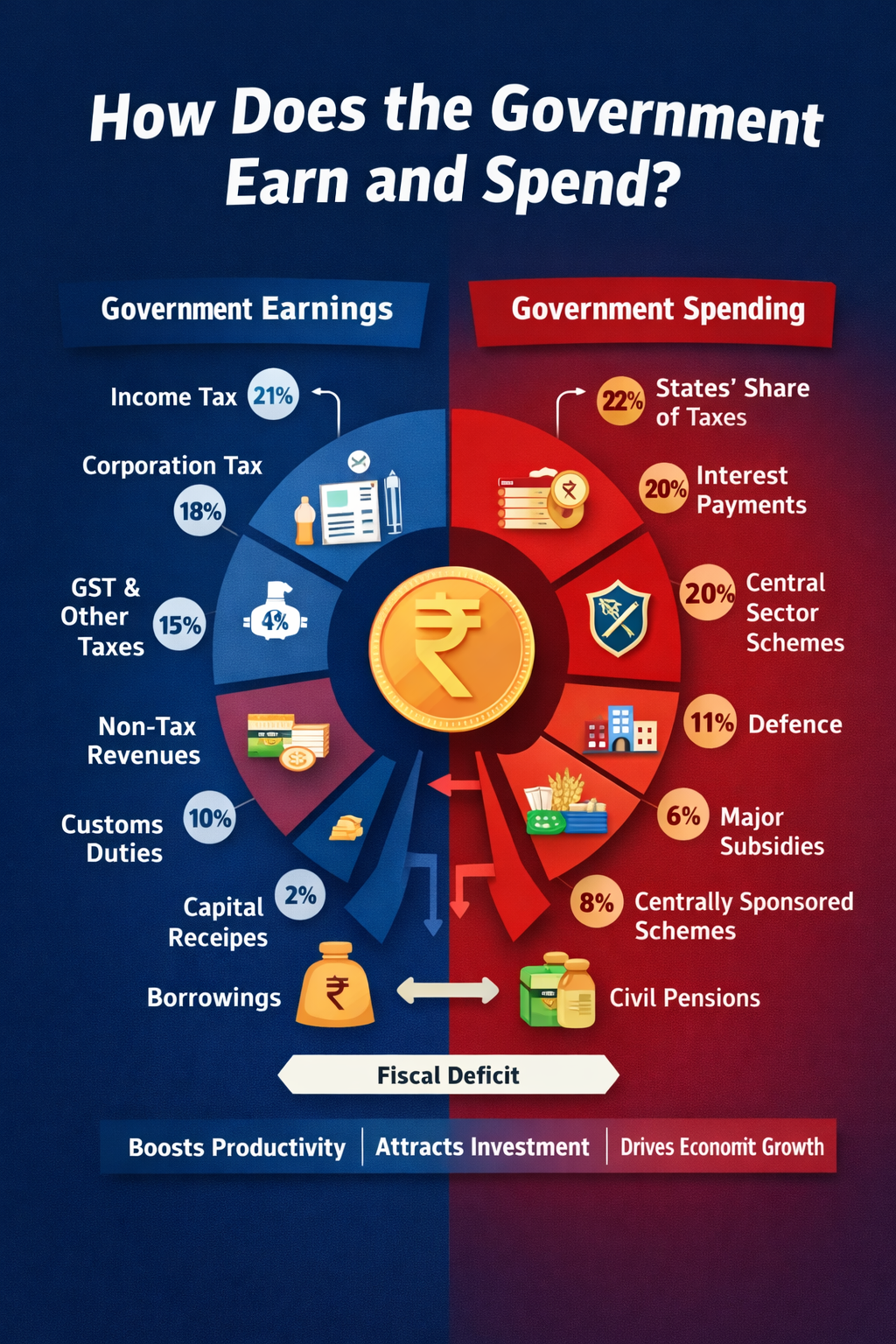
How Does the Government Earn and Spend?
Government Earn and Spend patterns define how an economy functions and how publ