
How Does the Government Earn and Spend?
- by kapil
- Updated Feb 25, 2026
- 8 mins read
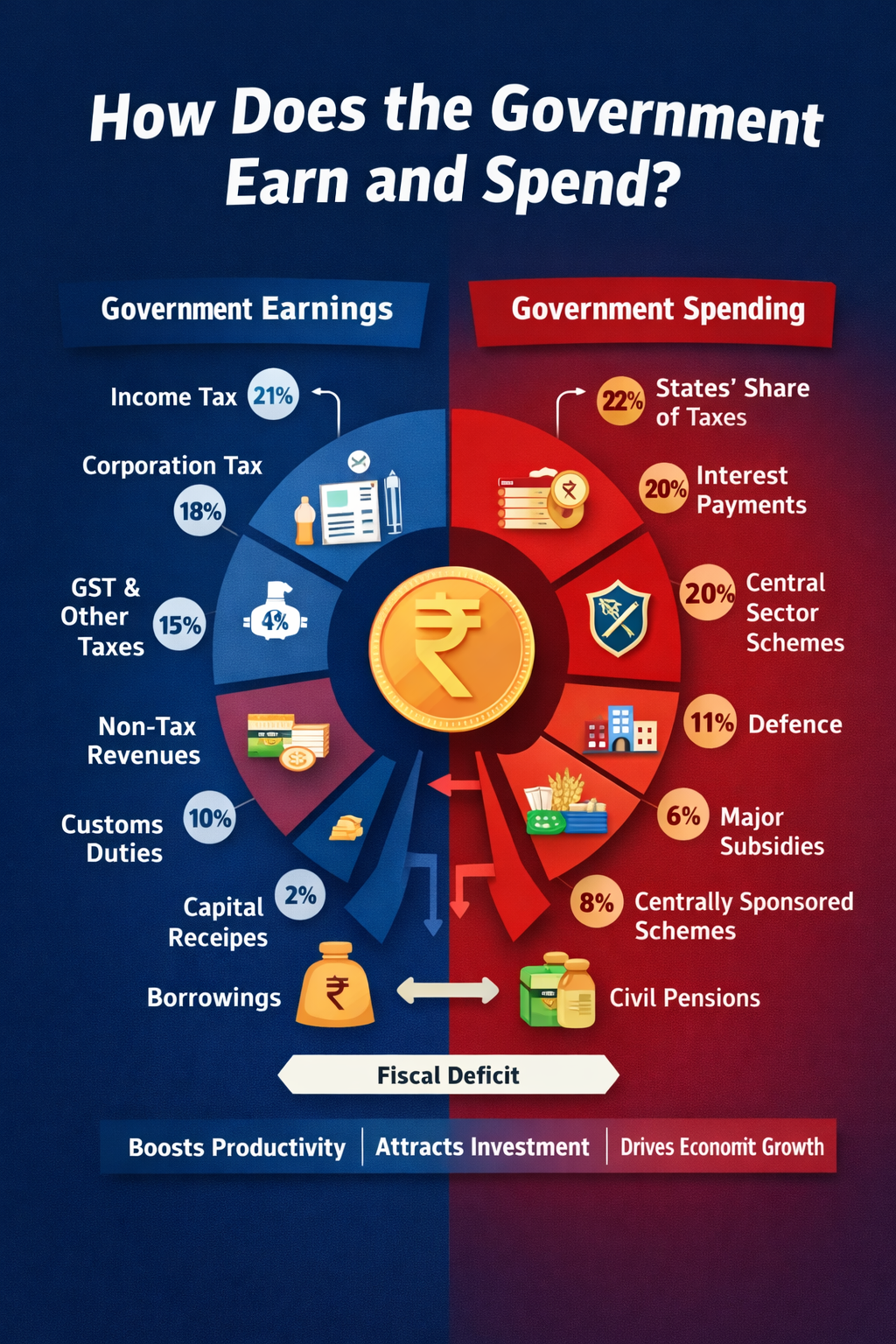
Government Earn and Spend patterns define how an economy functions and how public money is collected, allocated, and managed. The government requires structured revenue collection systems and disciplined expenditure planning methods to fund all road construction, subsidy distribution, defense asset acquisitions, and state grant transfers. The Union Budget 2026-27 demonstrates a clear path to support ongoing economic development while maintaining fiscal responsibility through public investments and community-focused growth.
The government operates differently from businesses. The government generates most of its revenue through tax collection, uses non-tax sources to supplement its income, and borrows to cover remaining financial shortfalls.
For official budget documents and detailed financial statements, refer directly to the Ministry of Finance on the India Budget portal.
Table of Contents
What Are the Main Sources of Government Revenue?
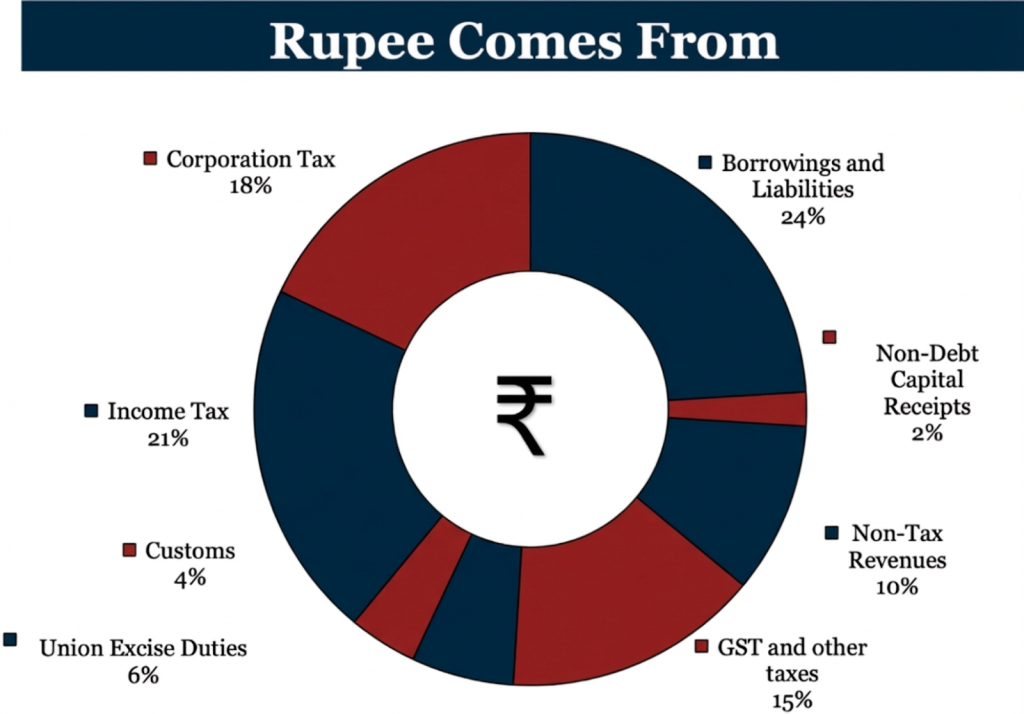
The government receives its revenue through three main categories: tax revenue and non-tax revenue, and capital receipts, which encompass borrowings.
For a broader context on how public revenue systems function in emerging economies, refer to the fiscal data framework explained by the World Bank Macroeconomics Division.
What Is Tax Revenue?
Tax revenue forms the backbone of government income. The revenue consists of both direct taxes and indirect taxes.
| Revenue Source | Share (%) | What It Means |
| Income Tax | 21% | Tax paid by individuals |
| Corporation Tax | 18% | Tax on company profits |
| GST & Other Taxes | 15% | Indirect tax on goods and services |
| Union Excise Duties | 6% | Tax on domestic production |
| Customs Duties | 4% | Tax on imports |
Income tax and corporation tax together account for nearly 40% of total revenue. The GST functions as a primary source of indirect taxation. Customs and excise duties support domestic manufacturing policy and trade regulation.
Read also: Complete Guide to Taxes in Indiafor insights on tax types and applicability.
What Is Non-Tax Revenue?
Non-tax revenue contributes around 10% of total receipts. The total includes:
- Dividends from public sector enterprises
- Interest receipts
- Spectrum auctions
- Fees, penalties, and service charges
Economic conditions and government asset monetization plans determine the revenue stream fluctuations.
How Does Government Borrowing Work?
The government obtains 24% of its total receipts through borrowings.
The government finances its budget shortfall through three methods, which include:
- Market borrowings
- Treasury Bills
- Small savings schemes
This gap is called the fiscal deficit. Borrowing is not inherently negative. It becomes a concern only when debt grows faster than GDP.
The fiscal deficit represents the financial gap. Borrowing exists as a neutral financial practice. The situation becomes problematic when the country experiences debt growth that exceeds its GDP.
How Does the Government Spend Its Money?
Government spending is divided into two types of expenditures: revenue and capital.
Some expenses are recurring. The other expenses result in permanent assets.
What are the Major Expenditure Heads?
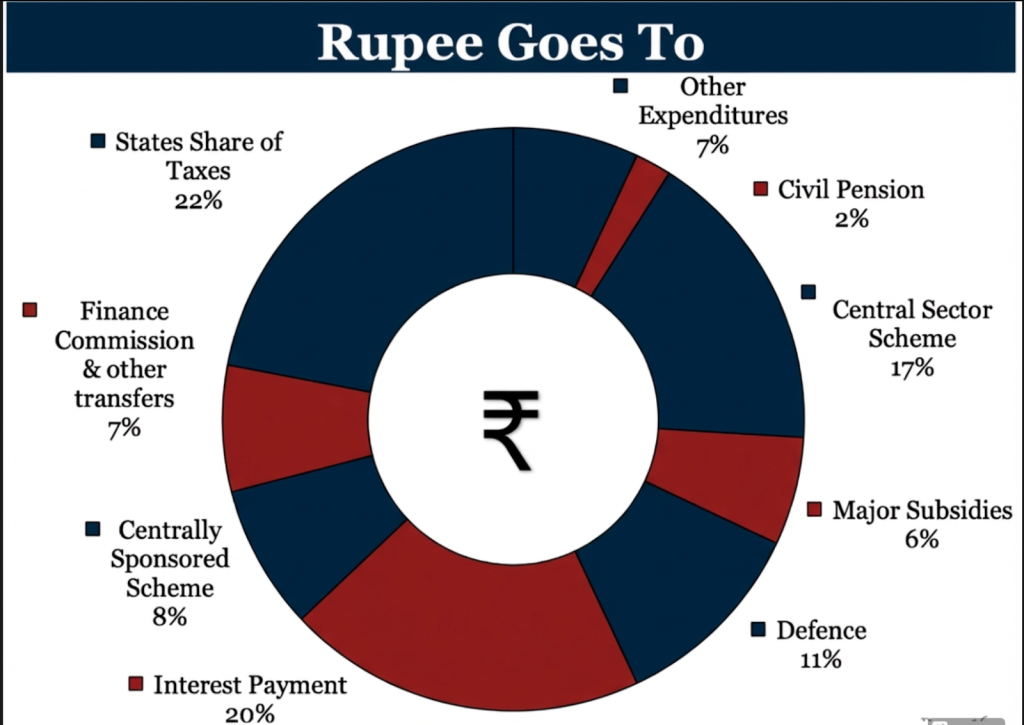
Budget 2026–27 shows a clear allocation pattern.
| Expenditure Head | Share (%) | Purpose |
| States’ Share of Taxes | 22% | Devolution to states |
| Interest Payments | 20% | Servicing past debt |
| Central Sector Schemes | 17% | Union government programs |
| Defence | 11% | National security |
| Major Subsidies | 6% | Food, fertilizer, fuel support |
| Other Expenditure | 7% | Administrative expenses |
A large share of funding goes to state governments. The government faces high interest costs because it must repay outstanding debt each year. The defense sector remains a key area of funding because it supports military strategy needs.
What Is Revenue Expenditure vs Capital Expenditure?
The future growth of an organization depends on how it spends its funds between revenue and capital expenses.
| Revenue Expenditure | Capital Expenditure |
| Salaries and wages | Infrastructure projects |
| Subsidies | Railways and highways |
| Interest payments | Defense assets |
| Pensions | Energy and logistics networks |
Revenue expenditure maintains operations. Capital expenditure builds assets.
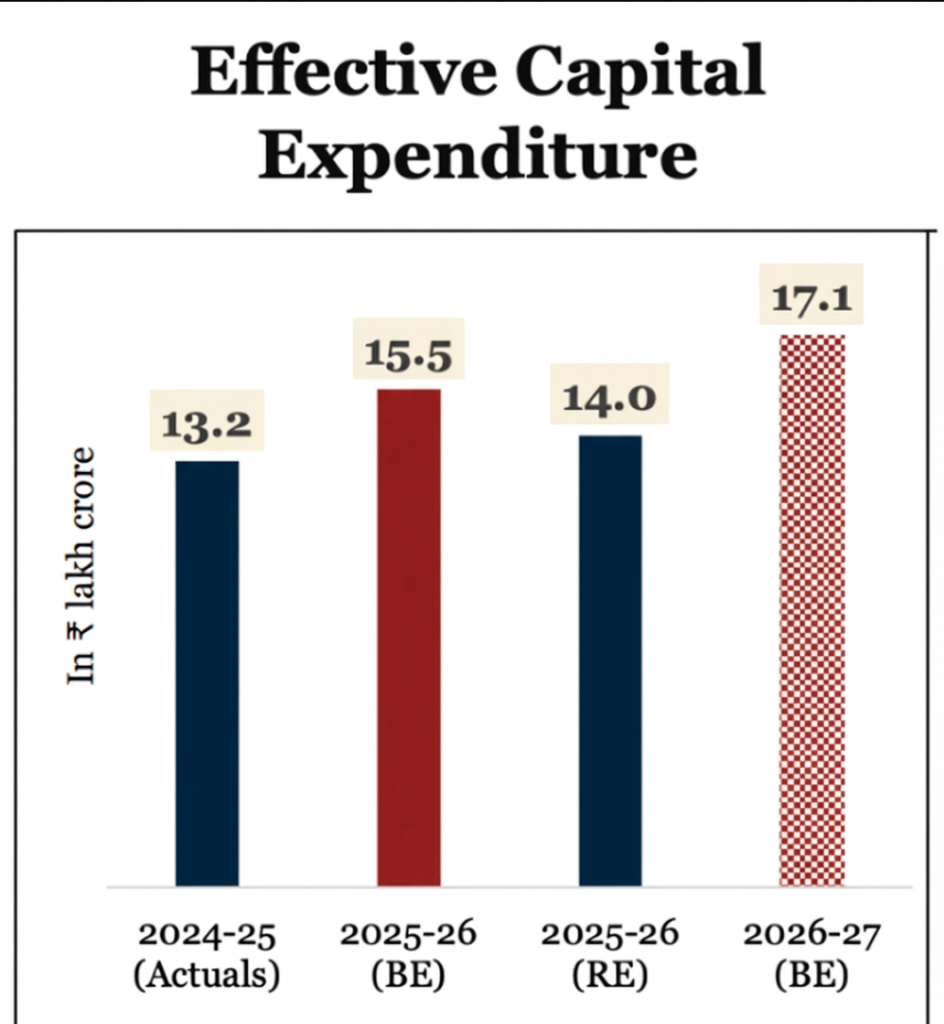
Public capital expenditure has increased significantly from FY15 to FY27, signaling a shift toward infrastructure-led growth. The effective capital expenditure for the year 2026 to 2027 is projected at ₹17.1 lakh crore, which is higher than the 2024 to 2025 actual amount of ₹13.2 lakh crore.
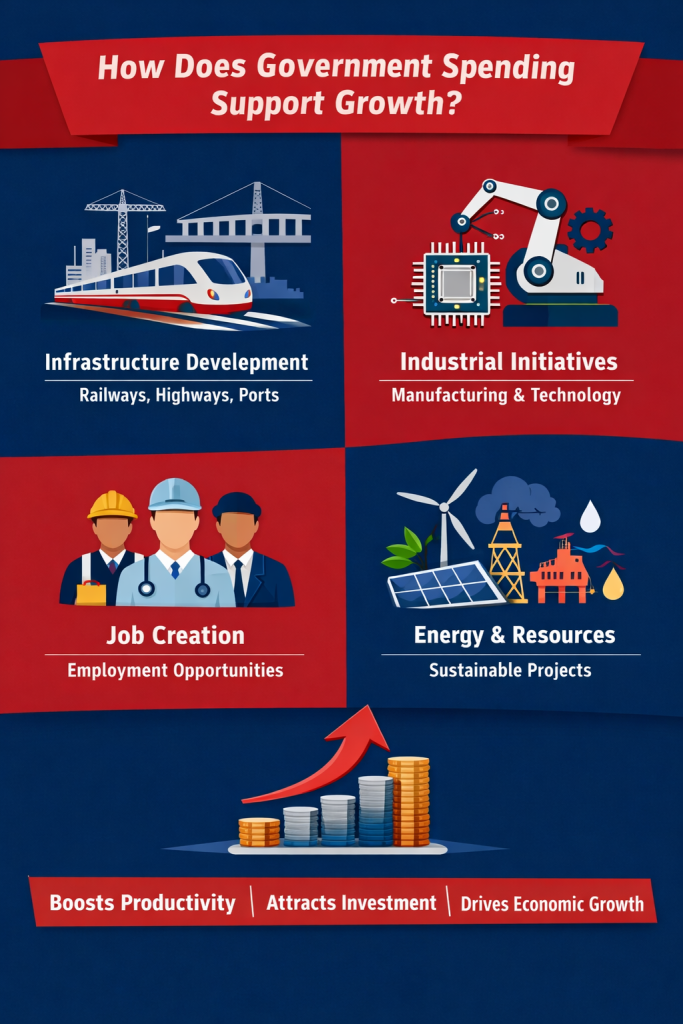
How Does Government Spending Support Growth?
The 2026-27 budget focuses on implementing structural reforms and boosting productivity rather than pursuing temporary solutions that appeal to voters.
To explore how structural reforms improve productivity, refer to policy research from the NITI Aayog.
Key focus areas include:
- Reviving 200 legacy industrial clusters
- Strengthening semiconductor manufacturing under ISM 2.0
- Biopharma and electronics component schemes
- Three dedicated chemical parks
- Rare earth and strategic mineral initiatives
Services sector reforms include:
- Five hubs for medical value tourism
- Expansion of allied health professional institutions
- Training 1.5 lakh multiskilled caregivers
- National Institute of Hospitality
- AVGC content creator labs in schools and colleges
Infrastructure remains central:
- New Dedicated Freight Corridors
- Operationalizing 20 National Waterways
- Coastal Cargo Promotion Scheme
- High-speed rail corridors between major cities
Energy security measures include:
- Support for lithium-ion battery manufacturing
- Exemptions on critical mineral processing equipment
- Expansion of nuclear project import exemptions
- Carbon Capture, Utilization, and Storage scheme
The allocations have specific purposes that focus on improving productivity, reducing import needs, and increasing local production capabilities.
How Are States Funded by the Central Government?
States receive a constitutionally mandated share of central taxes. The vertical devolution remains at 41%.
In FY 2026–27:
- ₹1.4 lakh crore is allocated as Finance Commission grants
- Transfers include rural and urban local body grants
- Disaster management support is included
Total transfer to states and union territories has steadily increased over the past five years, reaching ₹26.2 lakh crore in 2026–27 (Budget Estimate).
Detailed recommendations of fiscal transfers are available from the Finance Commission of India.
State funding ensures balanced regional development and supports federal fiscal stability.
What Do the Receipt and Expenditure Trends Show?
The revenue receipts for 2026-27 are estimated at ₹18.1 lakh crore, up from the actual revenue of ₹16.2 lakh crore in 2024-25.
The growth of capital receipts provides additional financial support to the organization.
The total expenditure amount for the project currently stands at ₹41.3 lakh crore because of increased capital expenditures and social sector financial commitments.
Major ministry allocations include:
- Transport: ₹5,98,520 crore
- Defence: ₹5,94,585 crore
- Rural Development: ₹2,73,108 crore
- Home Affairs: ₹2,55,234 crore
- Agriculture and Allied Activities: ₹1,62,671 crore
- Education: ₹1,39,289 crore
- Health: ₹1,04,599 crore
Spending patterns show a balance between security, infrastructure, rural development, and human capital.
Read also: GST Registration & Compliance in India to learn how GST works.
FAQs about Government Earn and Spend
What is the biggest source of government income?
The government generates its highest revenue through income tax and corporation tax, which is followed by GST collections.
Why does the government borrow if it earns taxes?
The government borrows money to cover the fiscal gap, which results when its spending surpasses its income. The government fiscal gap between its actual earnings and its planned budget spending is known as the fiscal deficit.
What is the difference between fiscal deficit and revenue deficit?
The total borrowing needs of the government are represented by the fiscal deficit. The revenue deficit occurs when revenue expenses surpass actual revenue income.
Why are interest payments so high?
The government must pay interest on its previous loans, which have grown into a substantial financial burden. The government must pay interest obligations, which constitute approximately 20 percent of its total expenses.
How does capital expenditure benefit citizens?
The government uses capital expenditures to construct highways and railways, energy systems, and logistics networks. These projects create infrastructure assets that deliver prolonged economic benefits and job opportunities.
How does government spending affect inflation?
The government maintains inflation at moderate levels by implementing disciplined fiscal policies, which work together with productive capital expenditures to achieve sustained economic growth.
How much of the government’s spending goes to the states?
The government allocates 22% of its total budget to provide States their tax revenue share. State finances receive additional support through Finance Commission grants along with other financial transfers, which help promote local development.
What is the difference between revenue expenditure and capital expenditure?
Revenue expenditure covers operational costs such as salaries, subsidies, pensions, and interest payments. Capital expenditure creates assets like highways, rail corridors, and energy infrastructure, which support long-term economic growth.
Why are interest payments such a large component of expenditure?
Interest payments account for about 20% of total spending because past borrowings must be serviced annually. This is why fiscal consolidation and debt control remain central to budget planning.
How does capital expenditure impact economic growth?
Capital expenditure helps the economy grow by boosting productivity through infrastructure development and reducing logistics costs. The development of freight corridors, waterways, and energy systems results in long-term progress for manufacturing and services.
What is the target debt-to-GDP ratio for the government?
The government has set a target debt-to-GDP ratio of 50+-1%, which it plans to achieve by 2030 through gradual reductions that start from the 55.6% debt level of 2026-27.
You may also like
How Does the Government Earn and Spend?
Government Earn and Spend patterns define how an economy functions and how publ