Step-by-Step EC Filing Guide for Recruiting Agents
- by kapil
- Updated January 28, 2026
- 8 mins read
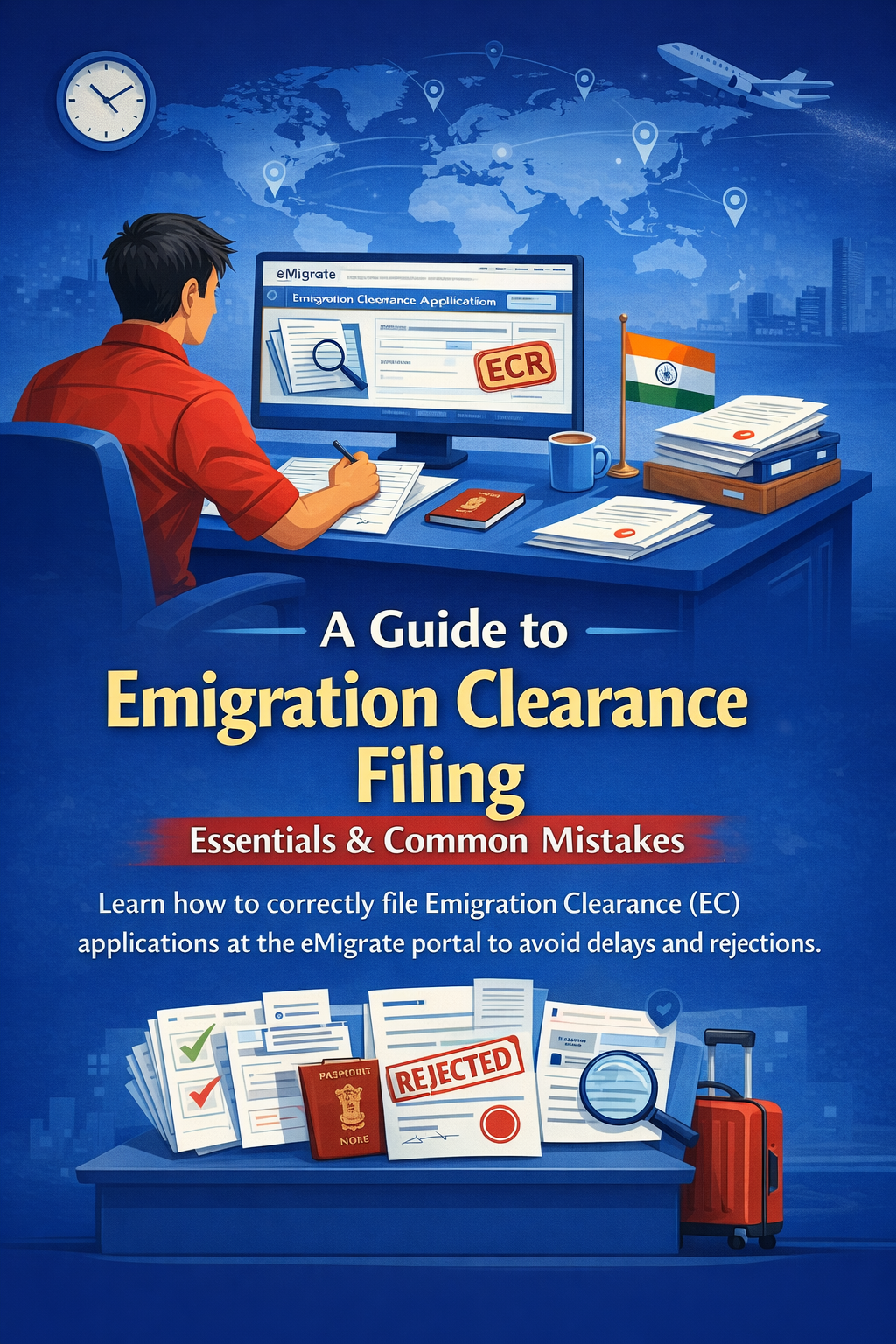
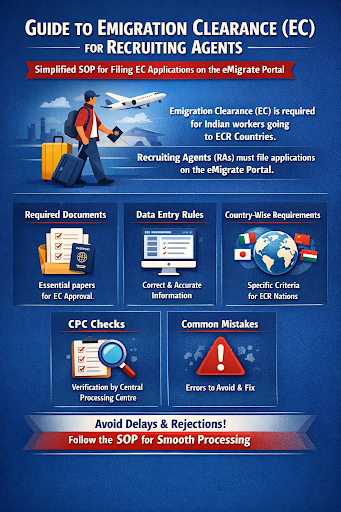
Emigration Clearance (EC) is a mandatory step for certain Indian workers who are going abroad for employment in Emigration Check Required (ECR) countries. Recruiting Agents (RAs) are responsible for filing EC applications correctly on the eMigrate portal.
This guide explains the official SOP in a simple and readable way. It covers EC filing essenrtils like documents, data entry rules, country-wise requirements, CPC checks, and common mistakes so that RAs can avoid delays and rejections.
Why This SOP Is Important
The current standard operating procedure has been issued to make sure that:
- EC applications are filed correctly the first time
- Document errors and mismatches are reduced
- Processing delays and rejections are avoided
- Workers are deployed safely and legally as per the acceptable global standards
Following the SOP saves time for both Recruiting Agents and government authorities.
Who This SOP Applies To
This SOP applies to:
- All Recruiting Agents registered on the eMigrate portal
- EC applications for ECR category workers
- Workers going to ECR countries through Recruiting Agents or Foreign Employers
Documents to Be Verified Before EC Filing
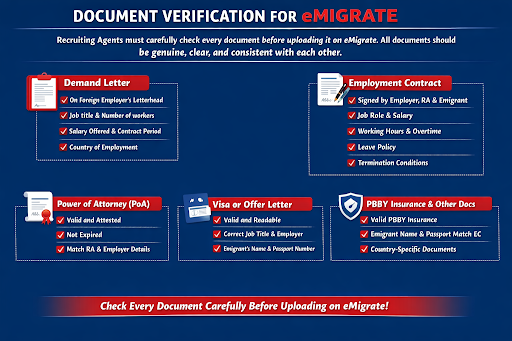
Recruiting Agents must carefully check every document before uploading it on eMigrate. All documents should be genuine, clear, and consistent with each other.
1. Demand Letter
The demand letter must:
- Be issued on the Foreign Employer’s letterhead or generated through eMigrate
- Clearly mention:
- Job title
- Number of workers required
- Salary offered
- Contract period
- Country of employment
2. Employment Contract
The employment contract must:
- Be signed by the Foreign Employer, Recruiting Agent, and Emigrant
- Match the demand letter and Job ID
- Clearly mention:
- Job role
- Salary
- Working hours
- Overtime details
- Leave policy
- Termination conditions
3. Power of Attorney (PoA)
The Power of Attorney must:
- Be valid and not expired
- Be properly attested as per destination country rules
- Match the RA and Foreign Employer details on eMigrate
4. Visa or Offer Letter
The visa or offer letter must:
- Be valid and clearly readable
- Match job title and employer details entered in eMigrate
- Have correct emigrant name and passport number
5. PBBY Insurance and Other Mandatory Documents
- Pravasi Bharatiya Bima Yojana (PBBY) insurance must be valid. One must have knowledge of terms and cons
- Emigrant name and passport number must match EC application details
- Any country-specific mandatory documents must be uploaded
Rules for Data Entry on eMigrate
Incorrect data entry is one of the main reasons for EC rejection. Recruiting Agents must ensure:
- All details entered exactly match the uploaded documents
- No spelling mistakes in:
- Emigrant name
- Passport number
- Employer name
- Job title
- Salary is entered in the correct currency and format
Even a small mismatch can lead to rejection.
Guidelines for Uploading Documents
While uploading documents on eMigrate, ensure that:
- Documents are clear and easy to read
- Pages are properly oriented
- File size is within prescribed limits
- Documents are uploaded in the correct category
Do not upload:
- Blurred or unclear scans
- Incomplete pages
- Combined or unrelated documents
Common Reasons for EC Rejection
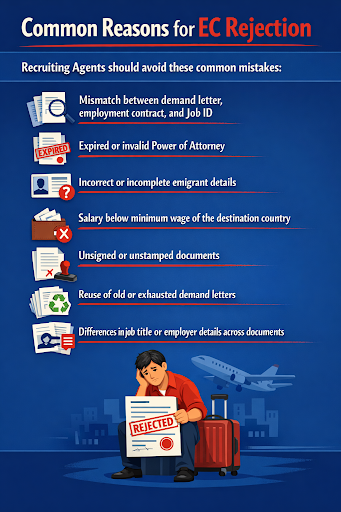
Recruiting Agents should avoid these common mistakes:
- Mismatch between demand letter, employment contract, and Job ID
- Expired or invalid Power of Attorney
- Incorrect or incomplete emigrant details
- Salary below minimum wage of the destination country
- Unsigned or unstamped documents
- Reuse of old or exhausted demand letters
- Differences in job title or employer details across documents
Country-Wise Document Requirements (Annex A and Annex B)
The SOP includes detailed annexures that list document requirements based on:
- Country of employment
- Whether the demand is raised by the Recruiting Agent or the Foreign Employer
| S. No. | Country |
| 1 | Saudi Arabia |
| 2 | Oman |
| 3 | Qatar |
| 4 | Kuwait |
| 5 | United Arab Emirates (UAE) |
| 6 | Malaysia |
| 7 | Jordan |
| 8 | Iraq |
| 9 | Lebanon |
| 10 | South Sudan |
| 11 | Thailand |
| 12 | Yemen |
| 13 | Libya |
| 14 | Syria |
| 15 | Afghanistan |
| 16 | Sudan |
| 17 | Bahrain |
| 18 | Indonesia |
Important Country-Specific Points
- UAE cases require a MOHRE contract, except for government or exempted employers
- For UAE Free Zone cases, a MOHRE undertaking may be required
- Documents not in English must have a translated copy attested by the Recruiting Agent
- Commercial employers must upload a valid CR copy
How EC Applications Are Checked by CPC
The Central Processing Cell (CPC) examines every EC application carefully.
CPC checks include:
- Whether documents are uploaded in the correct folders
- Whether contracts are signed by Employer, RA, and Emigrant
- Verification of MOHRE contracts for UAE cases
- Matching PBBY insurance details with EC form and passport
- Cross-checking details across:
- EC application form
- Visa copy
- Employment contract
Details verified include:
- Employer name and country
- Emigrant name
- Passport number
- Job designation
- Visa number
Direct Recruitment Cases
- CPC may contact emigrants directly on the mobile number provided
- Indian Missions may be contacted for document verification
If any discrepancy or missing document is found, the application may be rejected.
Send Correspondence Facility by PoE
To avoid direct rejection, the eMigrate system provides a Send Correspondence option.
- PoE can ask for missing or additional documents
- The application is returned to the Recruiting Agent
- RAs must respond and upload documents within 24 hours
If the RA does not respond within two days, PoE can process the application without waiting.
Best Practices for Recruiting Agents
- Check all documents carefully before uploading
- Ensure consistency across all documents and data fields
- Use only valid and unused demand letters
- Follow minimum wage rules of the destination country
- Respond quickly to PoE correspondence
Conclusion
Correct filing of Emigration Clearance applications is essential for smooth and timely overseas deployment of workers. By following this SOP and maintaining accuracy at every step, Recruiting Agents can significantly reduce EC rejections and delays.
A well-prepared EC application protects both the worker and the Recruiting Agent and ensures compliance with government regulations. Also, having the first hand knowledge of SOP’s and recruitment process by a foreign employer or Indian entity will help everyone in crew in hasslefree onboarding.
Frequently Asked Questions on Emigration Check
1. Who is required to apply for Emigration Clearance (EC)?
Emigration Clearance is required for Indian workers who fall under the Emigration Check Required (ECR) category and are travelling to notified ECR countries for employment. EC is mandatory before departure and must be approved through the eMigrate system.
2. Can a Recruiting Agent file an EC application without complete documents?
No. EC applications should only be filed after all required documents are complete and verified. Incomplete or incorrect documents usually lead to rejection or delays during CPC scrutiny.
3. What is the most common reason for EC application rejection?
The most common reasons include mismatch of details between the demand letter, employment contract, visa, and EC form, expired Power of Attorney, and incorrect emigrant details such as name or passport number.
4. Is PBBY insurance mandatory for EC approval?
Yes. Pravasi Bharatiya Bima Yojana (PBBY) insurance is mandatory for EC approval. The policy must be valid and the emigrant’s name and passport number must match the EC application details.
5. What should a Recruiting Agent do if PoE sends the application back for correction?
If PoE uses the Send Correspondence option, the Recruiting Agent must upload the requested or corrected documents within 24 hours. Delays beyond two days may result in PoE processing the application without waiting for the RA’s response.
6. Are translated documents accepted for EC filing?
Yes. Documents issued in languages other than English must be accompanied by a translated copy attested by the Recruiting Agent. Unattested or untranslated documents may lead to rejection.
7. Is Emigration Clearance required for all countries?
No. Emigration Clearance is required only for ECR category workers travelling to notified ECR countries. Workers travelling to non-ECR countries or those in the ECNR category do not require EC.
8. Can one demand letter be reused for multiple EC applications?
No. Demand letters cannot be reused once exhausted. Using old or already exhausted demand letters is a common reason for EC rejection.
9. What happens if the salary mentioned is below the minimum wage?
If the salary offered is below the minimum wage prescribed by the destination country, the EC application is likely to be rejected. Recruiting Agents must ensure salary compliance before filing EC.
10. Is it mandatory for all parties to sign the employment contract?
Yes. The employment contract must be signed by the Foreign Employer, Recruiting Agent, and the Emigrant. Missing signatures can result in rejection during CPC scrutiny.
11. How important is matching data across documents?
Data consistency is critical. Details such as emigrant name, passport number, job title, employer name, and salary must match across the EC form, visa, demand letter, and employment contract.
12. Can EC applications be rejected even after document upload?
Yes. EC applications may still be rejected if discrepancies, incorrect uploads, or missing information are found during CPC or PoE verification, even if documents were uploaded earlier.
You may also like

LMPC Certificate for Importers, Packers & Manufacturers
Businesses dealing with pre-packaged goods in India must comply with various leg