LMPC Certificate for Importers, Packers & Manufacturers
- by admin
- Updated March 10, 2026
- 9 mins read
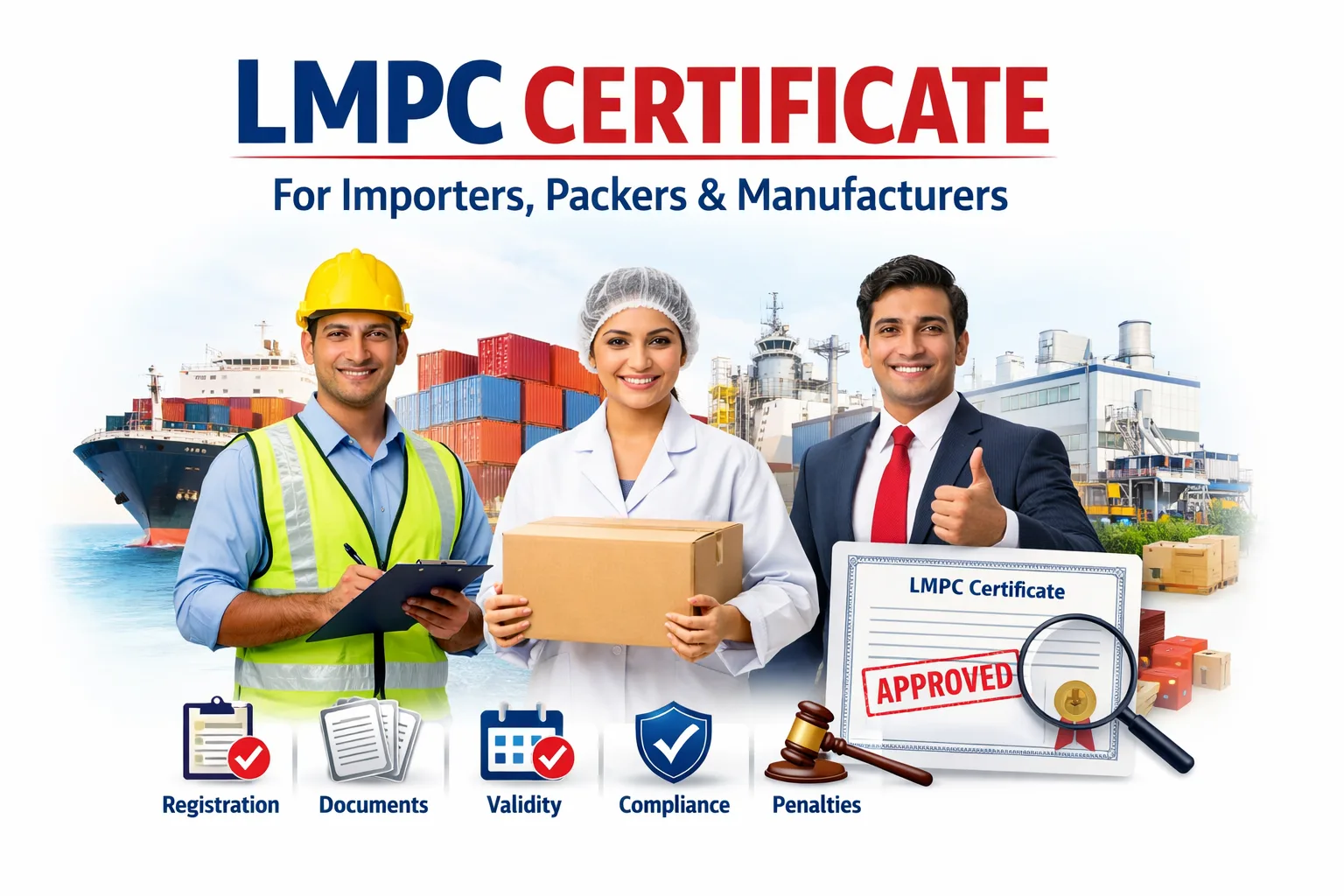
Businesses dealing with pre-packaged goods in India must comply with various legal metrology regulations before their products reach the market. One of the key requirements is obtaining the LMPC (Legal Metrology Packaged Commodities) certificate, which applies to importers, manufacturers, and packers. Understanding its applicability, exemptions, documentation, registration process, validity, fees, and penalties is essential for businesses to ensure smooth operations and avoid regulatory issues in the packaged commodities sector.
Table of Contents
- What is an LMPC Certificate?
- What are Pre-Packed Commodities for an LMPC Certificate?
- Different Types of LMPC Certificate
- Benefits of LMPC Certificate
- Exemptions under LMPC Certificate
- Documents Required for LMPC Certificate Registration
- Process for Obtaining LMPC Certificate
- Validity Period of LMPC Certificate
- Penalties for Non-Compliance
- Industries Requiring LMPC Certificate
- Fees for LMPC Certificate Registration
- Timeline for Obtaining LMPC Certificate
What is an LMPC Certificate?
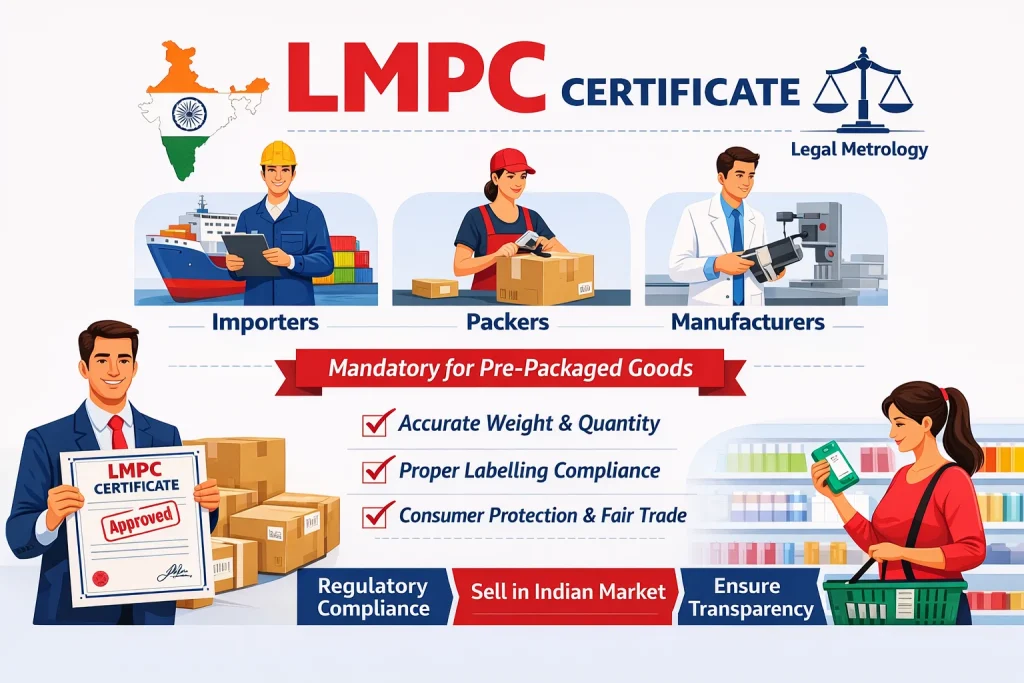
The Legal Metrology Packaged Commodities (LMPC) Certificate is a mandatory registration for importers, packers, and manufacturers dealing with pre-packaged goods in India. Issued under the Legal Metrology Act, 2009, it ensures that packaged commodities comply with government regulations regarding accurate weight, quantity, labelling, and consumer transparency.
Businesses involved in importing, packaging, or manufacturing products must obtain this certificate before selling goods in the Indian market. It helps maintain fair trade practices and protects consumer rights by ensuring proper product information on packaging.
What are Pre-Packed Commodities for an LMPC Certificate?
Pre-packed commodities under an LMPC certificate refer to goods that are packaged before being offered for sale and where the quantity is predetermined without the buyer being present. It include:
| Category | Examples of Pre-Packed Commodities |
| Food Products | Snacks, biscuits, rice, wheat flour, packaged beverages, edible oil, pulses, sugar, spices |
| Personal Care Products | Shampoo, soap, toothpaste, face wash, body lotion, hair oil, cosmetics, deodorant |
| Household Products | Detergent powder, dishwashing liquid, floor cleaner, air freshener, cleaning sprays |
| Consumer Goods | Batteries, light bulbs, stationery items, adhesive products, small utility items |
| Pharmaceutical Products | Tablets, capsules, syrups, medical ointments, health supplements |
| Electronic Accessories | Mobile chargers, earphones, USB cables, power adapters, portable accessories |
What are the Different Types of LMPC Certificates?
The LMPC certificate is issued to different types of businesses involved in the supply of pre-packaged commodities in India. Depending on the role of the business in the supply chain, LMPC registration is mainly categorised as the following:
- LMPC Certificate for Importers: LMPC registration for importers is required for businesses importing pre-packaged goods into India. It ensures that imported products comply with legal metrology labelling, quantity, and packaging regulations before being sold in the market.
- LMPC Certificate for Manufacturers/Packers: Manufacturers or packers must obtain LMPC registration to ensure that packaging, weight declarations, and product labelling comply with legal metrology rules.
What are the Benefits of LMPC Certificate for Importers and Manufacturers?
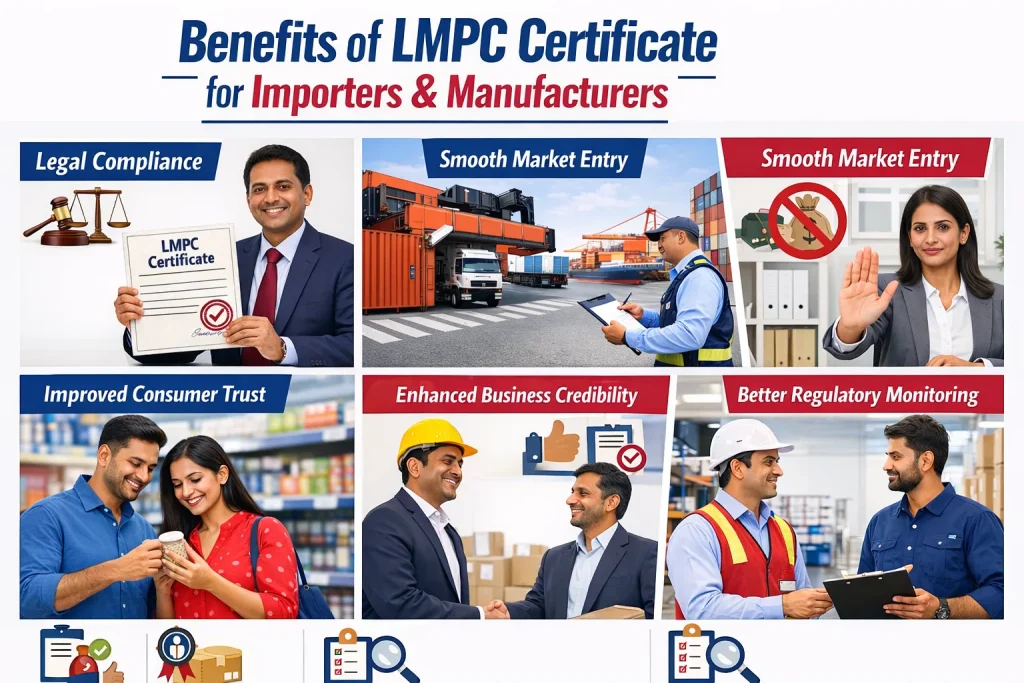
The LMPC certificate provides several advantages for businesses involved in importing, manufacturing, or packing pre-packaged commodities in India. Some of them are:
- Legal Compliance: Obtaining an LMPC certificate ensures that businesses comply with the Legal Metrology Act and packaged commodity rules, reducing the risk of penalties, legal disputes, or regulatory action.
- Smooth Market Entry: The certificate allows importers and manufacturers to legally sell pre-packaged commodities in India, ensuring that products pass customs checks and enter the market without regulatory obstacles.
- Improved Consumer Trust: Proper labelling and accurate quantity declarations help consumers make informed purchasing decisions, increasing transparency and strengthening trust in the brand and its packaged products.
- Avoidance of Penalties: LMPC registration helps businesses avoid fines, product seizures, and legal complications that may arise from non-compliance with packaging, labelling, and quantity declaration regulations.
- Enhanced Business Credibility: Having LMPC certification demonstrates that a business follows government standards, which improves brand credibility and builds stronger relationships with customers, distributors, and regulatory authorities.
- Better Regulatory Monitoring: The certification ensures that businesses maintain proper records and follow standard packaging practices, helping authorities monitor compliance and maintain fairness in trade practices.
What are the Exemptions under LMPC Certificate?
Certain packaged commodities are exempt from LMPC certification requirements based on their quantity and usage purpose. The key exemptions include the following:
| Condition | Exemption Detail |
| Small Quantity Exemption | Products weighing 10 ml or 10 g or less do not require LMPC certification. |
| Bulk Agricultural Products | Agricultural commodities packed in quantities exceeding 50 kg are exempt from LMPC requirements. |
| Fast Food Packaging | Fast food packages prepared and sold by restaurants, hotels, or food outlets are exempt. |
| Authorized Drug Formulations | Drug packages regulated under the Drugs (Price Control) Order, 1995 are exempt. |
| Bulk Goods Exception | Goods above 25 litres or 25 kg are exempt, except fertilisers and cement up to 50 kg. |
| Institutional Consumers | Packaged goods supplied to railways, airlines, hospitals, hotels, and similar institutions are exempt. |
What are the Documents Required for LMPC Certificate Registration?
The following documents are required to obtain an LMPC certificate:
- Import Export Code (IEC) certificate for importers
- PAN card of the applicant or business entity
- GST registration certificate
- Business registration proof (Company, LLP, Partnership, or Proprietorship)
- Identity proof of the applicant (Aadhaar card, PAN card, or passport)
- Address proof of the business premises
- Copy of shop and establishment license or trade license (if applicable)
- Product or commodity details intended for import, manufacture, or packing
- Packaging or product label details showing mandatory declarations
- Passport-size photographs of the authorised signatory
- Authorisation letter or board resolution (for companies or LLPs)
- Rent agreement or property ownership proof of the business premises
- Affidavit to state that the applicant would abide by the Legal provisions
- Authorised Agent of Medical Devices
- Affidavit to state that the applicant has neither been punished by any court nor is any anytycriminal proceeding pending in any court.
What is the Process for Obtaining the LMPC Certificate?
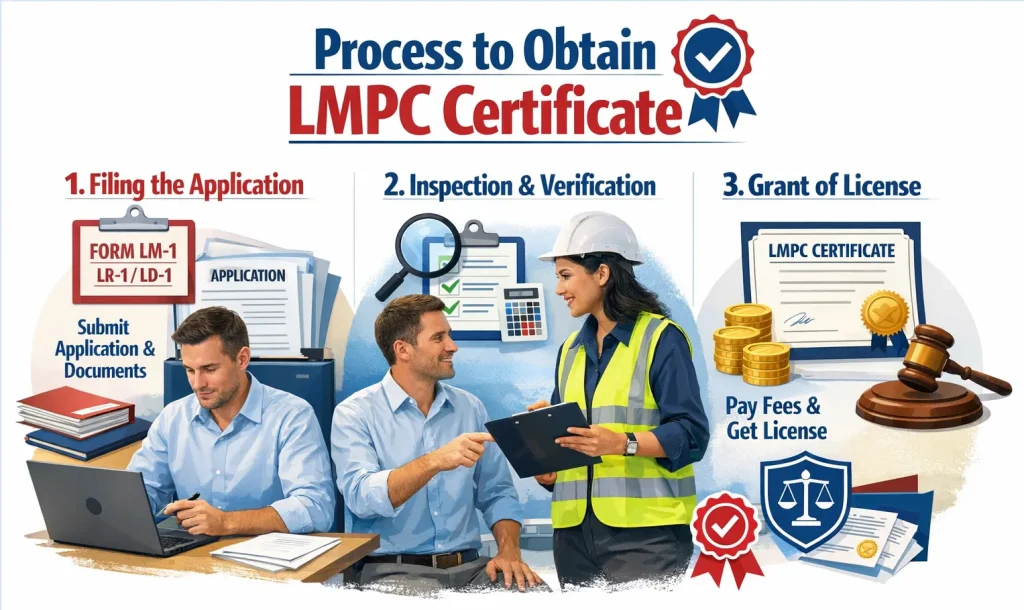
The procedure for obtaining an LMPC certificate in India is defined under Rule 15 of the Legal Metrology (Packaged Commodities) Rules, 2011, as follows:
- Filing the Application: The first step is submitting the prescribed application form to the Legal Metrology Department. This includes Form LM-1 for manufacturer licence, Form LR-1 for repairer licence, and Form LD-1 for dealer licence, along with the required documents.
- Inspection and Verification: After the application and documents are submitted, the Legal Metrology authority reviews the records and may conduct an inspection to verify business details, compliance requirements, and the accuracy of the submitted information.
- Grant of License: Once the verification and inspection process is completed successfully, the applicant must pay the prescribed government fees. After this, the authority grants the LMPC certificate.
What is the Validity Period of LMPC Certificate for Import?
The LMPC certificate for importers is generally valid for 5 years from the date of issuance. After the expiry of this period, the importer must apply for renewal of the certificate to continue importing and selling pre-packaged commodities in India. It is advisable to initiate the renewal process before the expiry date to avoid delays in customs clearance, penalties, or disruption to business operations.
What are the Penalties for Non-Compliance with LMPC Certificate Requirements?
Non-compliance with the Legal Metrology Act, 2009 and the Legal Metrology (Packaged Commodities) Rules, 2011 may result in fines, penalties, or legal action against manufacturers, importers, packers, or dealers dealing with pre-packaged commodities.
| Violation / Non-Compliance | Penalty / Consequence |
| Violation of Rules 27 to 31 of LMPC Rules | A fine of ₹4,000 may be imposed for violating provisions related to packaged commodity declarations and requirements. |
| Violation of Other Provisions | If any rule is violated where no specific punishment is prescribed, a general penalty of ₹2,000 may be imposed. |
| Late Application for LMPC Certificate | If the LMPC registration is applied after 90 days from the commencement of import, a late fee of ₹5,000 may be charged (commonly applicable in Delhi). |
| Non-Compliance with Weights and Measurements Standards | Manufacturers, importers, packers, or dealers violating weight and measurement standards may face a fine up to ₹10,000 or imprisonment up to one year. |
| Violation of Section 11 of the Legal Metrology Act | Importers, manufacturers, or packers violating Section 11 may face a penalty of ₹10,000 or imprisonment up to one year. |
| Import without LMPC Certificate (Section 19) | The import of any weight or measure without obtaining an LMPC certificate is prohibited and may attract penalties under the Legal Metrology Act, 2009. |
| Failure to Submit Annual Returns | If the importer or manufacturer fails to submit the required annual return, a penalty of ₹5,000 or imprisonment up to one year may be imposed. |
| Incorrect or Unverified Product Labelling | If the product label contains incorrect or unverified weight or measurement, the importer or manufacturer may be liable for penalties. |
For Which Industries LMPC Certificate is Required?
Various industries dealing with pre-packaged commodities required to obtain an LMPC Certificate to ensure compliance with legal metrology regulations. Some of them are:
- Food and Beverage Industry
- Pharmaceutical Industry
- Electronics Industry
- Automotive Industry
- FMCG Industry
- Cosmetics Industry
- Textiles Industry
- Agriculture Industry
- Other Industries
What is the Fees for LMPC Certificate Registration?
The government fee for LMPC (Legal Metrology Packaged Commodities) certificate registration in India is ₹500, as prescribed under the Legal Metrology (Packaged Commodities) Rules, 2011. This fee must be paid at the time of submitting the application to the Controller or Director of Legal Metrology.
What is the Timeline for Obtaining LMPC Certificate for Import?
The timeline for obtaining an LMPC certificate is usually 3 to 4 weeks, depending on the completeness of documents and verification by the Legal Metrology Department. The process includes application submission, document scrutiny, and authority verification. Any delay in documentation or additional inspection requirements may extend the approval timeline before the certificate is issued.
The Bottom Line
The LMPC certificate is an essential compliance requirement for businesses dealing with pre-packaged commodities in India. It ensures accurate labelling, transparency, and adherence to legal metrology regulations. By obtaining the certificate and following the prescribed rules, importers, manufacturers, and packers can avoid penalties, build consumer trust, and ensure smooth market operations in the packaged goods sector.
Frequently Asked Questions
1. Which authority issues the LMPC certificate in India?
The LMPC certificate is issued by the Controller or Director of the Legal Metrology Department of the respective state where the importer or business entity operates.
2. Is LMPC registration required before importing goods into India?
Yes, importers must obtain LMPC registration before importing pre-packaged commodities, as customs authorities may require the certificate during clearance of goods at Indian ports.
3. Can a single LMPC certificate cover multiple product categories?
Yes, a single LMPC certificate can cover multiple product categories if they are declared during registration and comply with the applicable packaging and labelling requirements.
4. Is an LMPC certificate required for online sellers or e-commerce businesses?
Yes, e-commerce sellers dealing in pre-packaged commodities must ensure LMPC compliance to display accurate product information, such as quantity, MRP, and manufacturer details.4
5. Can the LMPC certificate be cancelled or suspended?
Yes, the Legal Metrology Department may suspend or cancel the certificate if the business repeatedly violates packaging, labelling, or measurement regulations.
You may also like
LMPC Certificate for Importers, Packers & Manufacturers
Businesses dealing with pre-packaged goods in India must comply with various leg