
How is the Government Improving Ease of Doing Business in India?
- by kapil
- Updated February 25, 2026
- 11 mins read

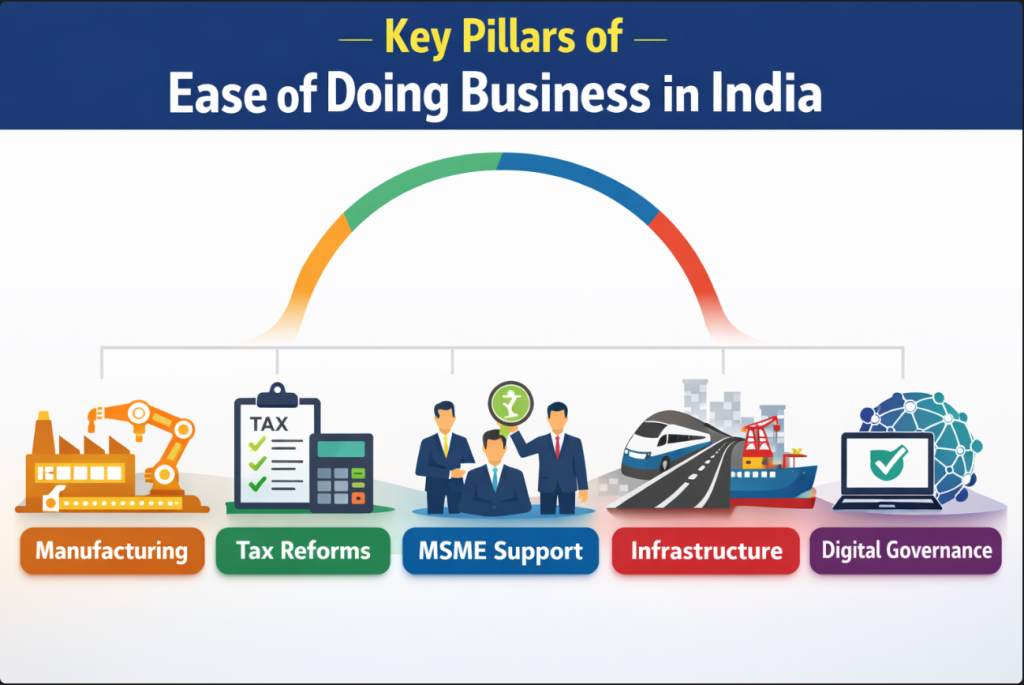
The Government of India uses business accessibility improvements in India to create economic development policies. The Government of India is not relying on rhetoric. The Government drives business improvements through structural reforms and fiscal discipline, along with digital governance and sector-specific financial support, to deliver better results that both predictably and competitively improve business operations.
The Budget 2026–27 will maintain this direction through specific actions that target manufacturing, services, MSMEs, infrastructure, and compliance simplification.
The objective is clear: reduce friction, increase investment, strengthen domestic capacity, and improve trust between the state and enterprises.
Why Does Ease of Doing Business in India Matter for Growth?
India aims for sustained economic growth while controlling government spending. That balance requires:
- The system needs to provide businesses with predictable tax rates that will remain stable over time.
- The system needs to deliver quicker approval processes to businesses while decreasing their compliance obligations.
- The system needs to provide strong logistical services together with essential infrastructural facilities.
- The system requires access to credit that people can afford.
- The system needs to establish clear rules that all businesses can understand.
Read Also: Understanding GST registration is crucial for new businesses. Learn more about the GST Registration Process and Requirements.
What Structural Reforms Have Been Introduced?
The government has implemented more than 350 reforms to increase productivity and create additional job opportunities.
The main structural changes that took place during this period include:
- The government has established simpler GST processes and registration procedures, which enable businesses to achieve compliance more easily.
- The government has published Labour Codes, which allow businesses to meet their compliance requirements through a unified system.
- The government has established new standards that businesses must fulfill to meet Quality Control Orders.
- The two parties will work together to reduce situations where their regulations create conflicts.
- The government will establish high-level committees that will work to speed up the process of implementing reforms.
The reform strategy operates as an ongoing process that changes according to current requirements. The system develops domestic capacity while it protects against disruptions from international market instability.
How Are Tax Reforms Strengthening Ease of Doing Business in India?
Tax certainty is one of the most critical factors for investors. The recent policy changes reflect that understanding.
Manufacturing-Focused Tax Support
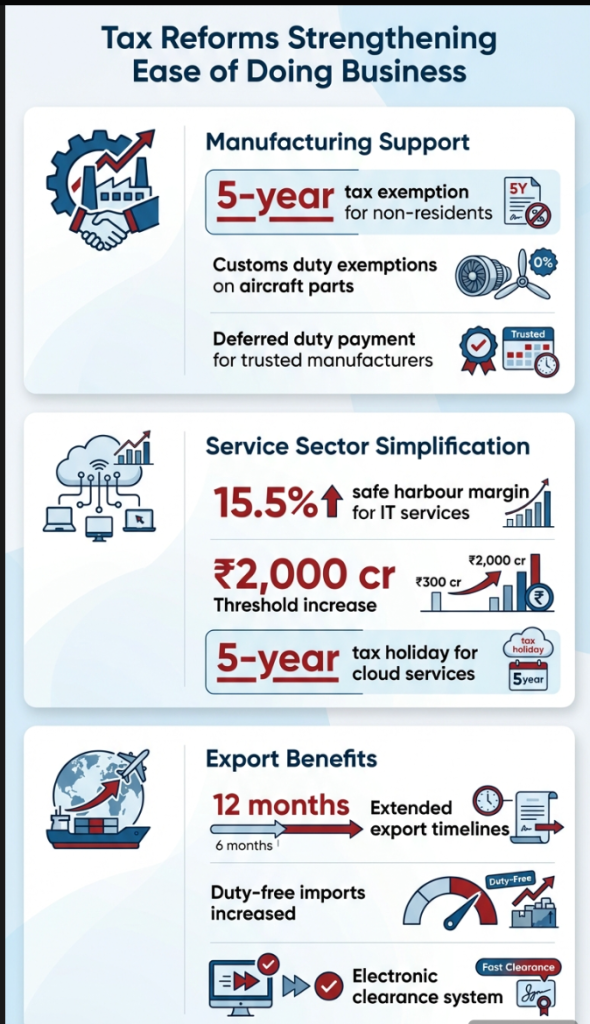
The following customs and duty reforms result in direct reductions of production expenses:
- Non-residents who provide capital goods to bonded zone toll manufacturers can use the five-year income tax exemption.
- The safe harbour provisions allow non-residents to store their operational materials.
- The system provides trusted manufacturers with a delayed duty payment option.
- Exemptions from basic customs duty on parts for aircraft manufacturing and microwave ovens
- Eligible SEZ units can access the concessional domestic tariff sale measure.
Related Read: Explore detailed guides on business taxation, deductions, and compliance to maximise your benefits.
Exporters have also received procedural relief:
- The export timeline for leather and textile garments has been extended to one year from its previous six-month duration
- The system allows seafood processing operations to import their necessary materials without duty charges up to an expanded limit.
- The system establishes trusted importers who can access risk assessment facilities.
- The factory premises can use electronic sealing combined with factory exit clearance.
These measures reduce compliance delays and improve working capital cycles.
Service Sector Tax Simplification
The services sector, especially the IT and digital infrastructure sectors, has now received complete operational details.
- All IT services need to be grouped together under one category, which will use a standardised safe harbour margin of 15.5%.
- The safe harbour threshold has been increased from ₹300 crore to ₹2,000 crore.
- Automated rule-driven approval process
- Fast-tracked unilateral APA process targeted for a two-year resolution
- Foreign companies that provide cloud services from India-based data centers will receive five-year tax holidays.
Tax certainty reduces disputes. That alone improves the investment climate.
Key Tax Reforms at a Glance
| Reform Area | Policy Change | Business Impact |
| Manufacturing | Customs duty exemptions | Lower production cost |
| Exporters | Extended export timelines | Reduced compliance stress |
| IT Services | 15.5% safe harbour margin | Predictable tax liability |
| Non-residents | Tax holiday on cloud services | Attracts global investment |
How Are MSMEs Being Strengthened?
The business operations of India depend on MSMEs, which provide essential services.
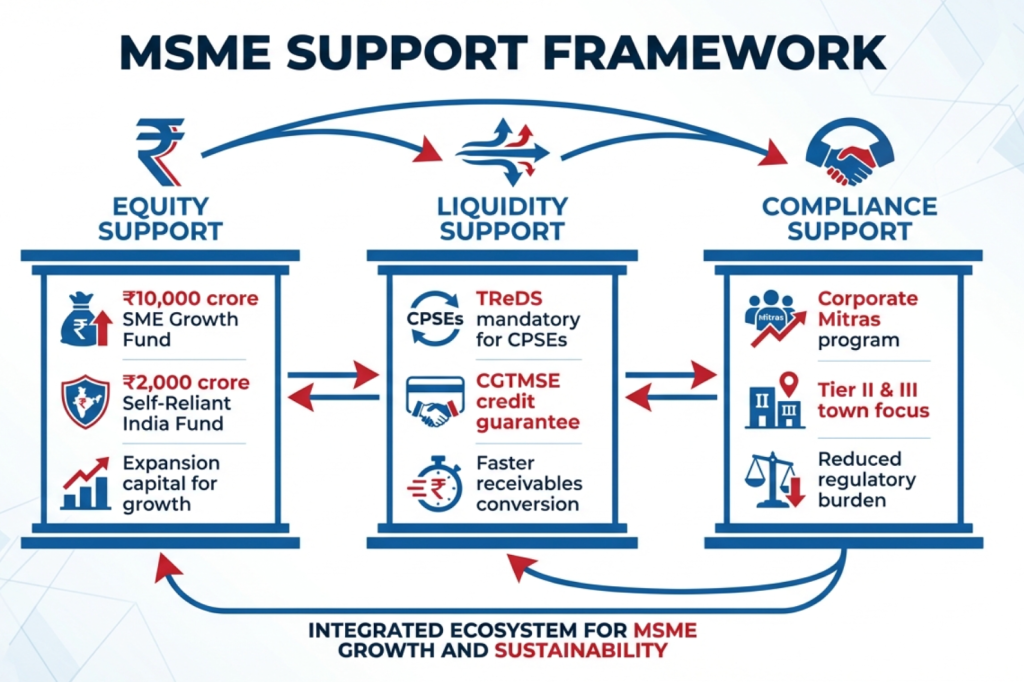
The method uses three elements, which include equity funding and liquidity enhancement, together with simplified compliance procedures. The Ministry of MSMEhas implemented complete support programs that deliver equity funding and liquidity solutions together with compliance support to businesses.
Equity and Liquidity Support
- The SME Growth Fund provides ₹10,000 crore in funding.
- The Self-Reliant India Fund receives a top-up of ₹2,000 crore.
- CPSE purchases require mandatory use of TReDS.
- The CGTMSE provides credit guarantee support for businesses that use invoice discounting.
- The GeM system connects with TReDS to enhance payment processing times.
Participants in the market can use TReDS receivables to issue asset-backed securities, thereby improving liquidity and creating a secondary market.
Compliance Support
Professional institutions will create “Corporate Mitras” which will provide services in Tier II and Tier III towns. Their practical function enables MSMEs to fulfil their compliance obligations through cost-effective solutions.
MSME Support Framework
| Support Type | Initiative | Outcome |
| Equity | SME Growth Fund | Expansion capital |
| Liquidity | TReDS + CGTMSE | Faster receivables |
| Compliance | Corporate Mitras | Reduced regulatory burden |
The implemented measures work to solve two problems, which involve working capital pressure and complex operational procedures.
How Is Infrastructure Driving Ease of Doing Business in India?
The ability to compete in business depends on the quality of the infrastructure present in an area.
The government has made substantial increases to public capital spending while introducing several programs to improve transportation links.
Key actions include:
- The SASCI program provides ₹2 lakh crore funding to Indian states
- The Dedicated Freight Corridors project establishes rail links from Dankuni to Surat
- The Coastal Cargo Promotion Scheme aims to boost inland shipping from its current level to 12% by the year 2047
- Seaplane VGF scheme to promote indigenous manufacturing
- The InVITs, REITs, NIIF, and NABFID organisations will use their resources to create new infrastructure projects
City Economic Regions and high-speed rail corridors link major growth hubs, creating an organised system of urban development.
Fiscal Indicators Supporting Infrastructure
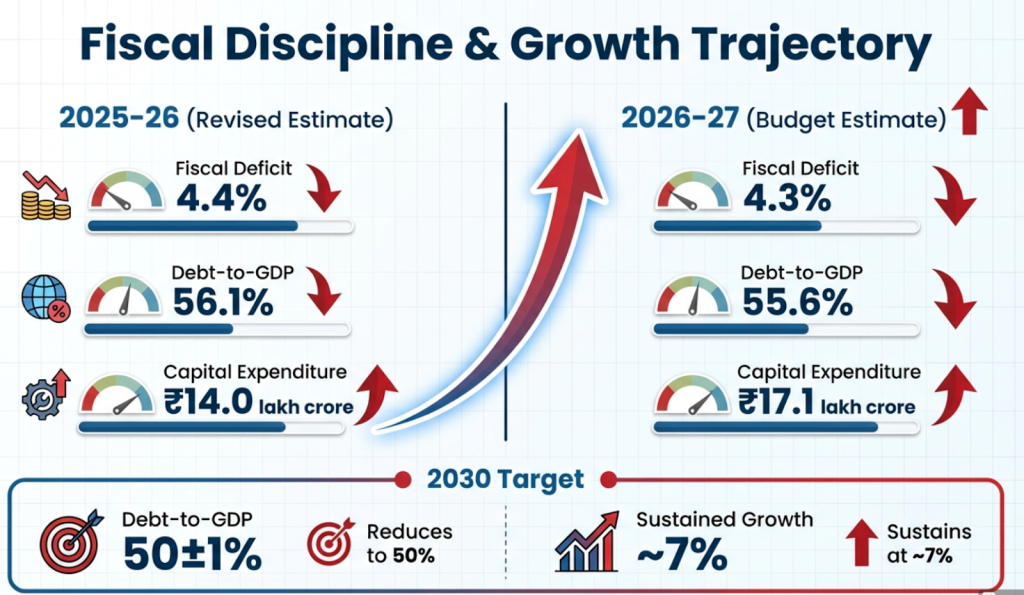
| Indicator | 2025-26 (RE) | 2026-27 (BE) |
| Fiscal Deficit | 4.4% | 4.3% |
| Debt-to-GDP | 56.1% | 55.6% |
| Effective Capital Expenditure | ₹14.0 lakh crore | ₹17.1 lakh crore |
How Is Digital Governance Reducing Compliance Friction?
The process of compliance reform extends beyond establishing new tax rates. The process needs to achieve higher productivity outcomes.
Recent improvements include:
- Single digital window for cargo clearance approvals
- Customs Integrated System development will be completed within a two-year period
- Automated lower or nil TDS certificate process
- The Advance Ruling validity period has been extended from its previous three-year duration to a new five-year period
- Decriminalisation of the non-production of certain documents
The shift from customs warehousing to a system that prioritizes warehouse operators reduces operational delays.
Digitalisation reduces the authority that people possess. This transformation builds more confidence.
How Is the Financial Sector Supporting Business Stability?
Capital allocation and risk management needs require a strong financial system.
Recent steps include:
- The program provides financial incentives to municipalities that issue large municipal bonds.
- Market-making framework and total return swaps on corporate bonds
- Comprehensive review of FEMA (Non-debt Instruments) Rules
- The High-Level Committee on Banking exists to create regulations that support business growth.
- The PFC and REC organisations will undergo a restructuring process
These initiatives make it easier for organisations to obtain long-term financing while strengthening capital markets.
How Is Manufacturing Being Strategically Expanded?
Ease of doing business in India also depends on domestic production capability.
The government is focusing on:
- India Semiconductor Mission 2.0
- Scheme for Rare Earth Permanent Magnets
- Biopharma SHAKTI
- Electronics Components Manufacturing Scheme
- Revival of 200 legacy industrial clusters
- Three dedicated chemical parks
- Container manufacturing scheme
The industrial sector gains competitive advantages through targeted customs exemptions, which apply to lithium-ion battery components, solar glass inputs, and nuclear project goods.
The approach combines industrial policy with tax incentives and supply chain security elements.
How Does Fiscal Discipline Improve Investor Confidence?
Investors assess macro stability before committing capital.
The government has:
- Targeted debt-to-GDP ratio of 50±1% by 2030
- Maintained fiscal deficit at 4.3% in Budget Estimates 2026–27
- Increased capital expenditure without widening the revenue deficit
- Retained 41% vertical devolution to states
Predictability in fiscal numbers lowers sovereign risk perception. That translates into lower borrowing costs and stronger investor confidence.
What Is the Overall Impact on Ease of Doing Business in India?
The reform approach is multi-layered:
- Lower compliance costs
- Faster approvals
- Clear tax frameworks
- Infrastructure expansion
- MSME liquidity
- Digital process automation
- Fiscal stability
The business environment in India has expanded beyond regulatory rankings, as it now reflects coordinated reforms across taxation, logistics, finance, manufacturing, and digital governance.
The organisation maintains a constant direction for its activities. The organisation increasingly relies on data-driven methods to execute its plans. The organisation intends to develop its competitive edge over an extended time period.
Want to Learn More? Visit our business learning centerfor in-depth articles on business setup, compliance, legal frameworks, and growth strategies.
FAQs about Ease of Doing Business in India
What is the ease of doing business in India?
The ease of doing business in India describes how the combination of regulations, tax standards, and operational conditions affects business operations from initial setup to full legal compliance. The framework includes systems for taxation and licensing, infrastructure development, credit accessibility, and digital governance.
How has Budget 2026–27 improved the ease of doing business in India?
The Budget 2026–27 implementation brought customs duty exemptions and TReDS financial support for MSMEs, tax simplification for IT services and infrastructure development, and automated compliance systems. These changes reduce transaction expenses while improving operational performance.
How are MSMEs benefiting from these reforms?
MSMEs receive equity support through the SME Growth Fund, liquidity through TReDS and CGTMSE guarantees, and compliance assistance via Corporate Mitras. Payment cycles are being formalised and accelerated.
Why are tax safe harbour rules important?
Safe harbour provisions create established tax boundaries, which decrease litigation chances while providing better tax forecasting. This encourages both domestic and foreign investment.
How does fiscal discipline support business growth?
Stable fiscal indicators work to reduce macroeconomic risk while they control inflationary pressures and improving sovereign credit perception. This results in reduced financing expenses, which then creates a more trustworthy environment for investors.
How do customs reforms improve ease of doing business in India?
Customs reforms reduce clearance time, lower import costs, and minimise repeated inspections. Trusted importers gain greater operational predictability through deferred duty payments, electronic export cargo sealing, and extended advance ruling validity. These steps reduce working capital blockage and simplify cross-border trade operations.
What role does digital governance play in the ease of doing business in India?
Digital governance creates two advantages by reducing human interface and eliminating discretionary delays. Single-window cargo clearance, automated TDS certification, and the upcoming Customs Integrated System create faster, more transparent compliance processes. Automation of work processes decreases procedural mistakes while it builds greater trust between businesses and regulators.
How does infrastructure investment support businesses in India?
Infrastructure systems create better logistics processes, which lead to decreased transportation expenses. Dedicated Freight Corridors and expanded National Waterways and high-speed rail corridors create better connections between industrial centres. Better infrastructure directly enhances supply chain reliability and export competitiveness.
Why is fiscal discipline important for improving the ease of doing business in India?
Fiscal stability protects the economy from macroeconomic dangers while establishing trust with investors. The government practices fiscal responsibility by maintaining a controlled deficit and achieving a declining debt-to-GDP ratio. The government maintains stable public finances, which results in moderate inflation and stable interest rates that support businesses that need to plan their long-term investments.
How are foreign investors benefiting from the ease of doing business reforms?
Foreign investors gain advantages from tax holidays, which apply to sectors such as cloud services, safe harbour provisions, customs duty exemptions, and streamlined FEMA regulations. These measures reduce compliance uncertainty and improve capital protection, which makes India a more attractive investment destination.
You may also like


What Does Project Logistics Alliance Membership Offer?
Project Logistics Alliance membership offers an Indian project cargo business a