
What are the DGS Swimming Pool Compliance Rules for MTIs 2026?
- by kapil
- Updated December 31, 2025
- 6 mins read

The DGS swimming pool compliance rules for MTIs in 2026 are based on Training Circular No. 59 of 2025, which serves as an addendum to Circular No. A notice was issued on February 5, 2025, as part of 6 of 2025. This circular addresses the lagging implementation that has been a concern since 2018, in accordance with mandates outlined in Training Circulars No. The 4th and 7th days of 2018. Maritime Training Institutes offering pre-sea courses, Basic Safety Training, Personal Survival Techniques, Refresher PST, or Proficiency in Survival Craft and Rescue Boats must have swimming pools and water bodies on their campuses that are compliant with the installation of water bodies.
The Merchant Shipping Act of 1958 and the STCW Convention of 1978 emphasize that swimming is a primary and essential survival skill. Ties, ups for external facilities that were allowed before are no longer allowed, except for a limited number of cases that have been approved by the DGS. The standards blend with other maritime regulations, such as those stated in the Crew Manual 2025 for the Indian Merchant Shipping Rules and MLC 2006 Certification requirements.
Why Do MTIs Need Strict Swimming Pool Compliance in 2026?
As the most basic necessity for those who operate, the ability to swim serves as the foundation for the seafarers’ survival skills. The deaf and general sign language communication ensures that Physical Education Instructors of the Armed Forces, while conducting the physical training and the realistic Pre-Service Training scenarios, do not require the presence of any external facilities. The postponement of the Implementation, which started in the year 2018, has made it necessary for the 2026 enforcement to be carried out so as to maintain the same level of standards in more than 300 Model Training Institutes across India.
The non-conformity to regulations may lead to the suspension of courses, thus adversely affecting the intake and placement of candidates in RPSL-licensed companies. It is also in harmony with the training infrastructure being brought up to the international standards, which is a good fit for the changes in the amendments to the Maritime Labour Convention 2006. Maritime Training Institutions, which are becoming increasingly less viable in such a way, are still going on with business as usual amidst the rising demand for Defence Goods Service, approved seafarers.
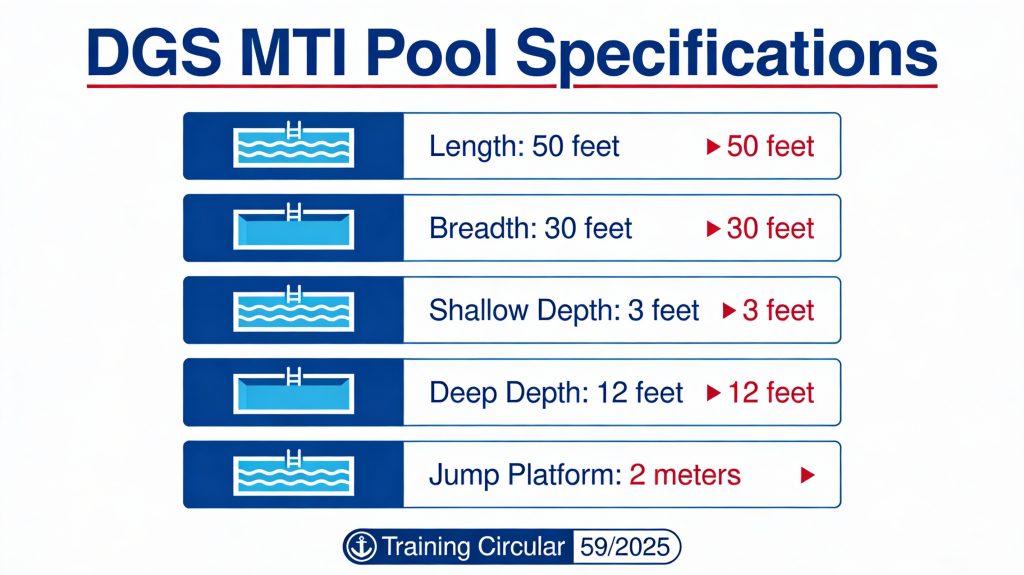
What Exact Dimensions Must MTI Swimming Pools Meet?
Regulation-conforming pools are 50 feet in length and 30 feet in width. Their depths gradually increase from 3 feet at the shallow end to 12 feet at the deepest point. During PST and Refresher PST in BST courses, a jumping platform should be at least 2 meters above the water surface. PSCRB courses require waterbodies of at least 5500 square meters in area for the following activities: lifeboats launching, maneuvering at 6 knots, survivor pickup, towing, and marshalling of life rafts.
Off-campus facilities that are owned by the same entity should not be more than 80 km away from the main campus. Any distances of 10 km or more must be disclosed to applicants at the admissions process. Newly appointed MTIs are not allowed to be approved for pool, based training courses unless these facilities have been established. For infrastructure planning in India, it is advisable to consult the licensing requirements of the RPSL Licence.
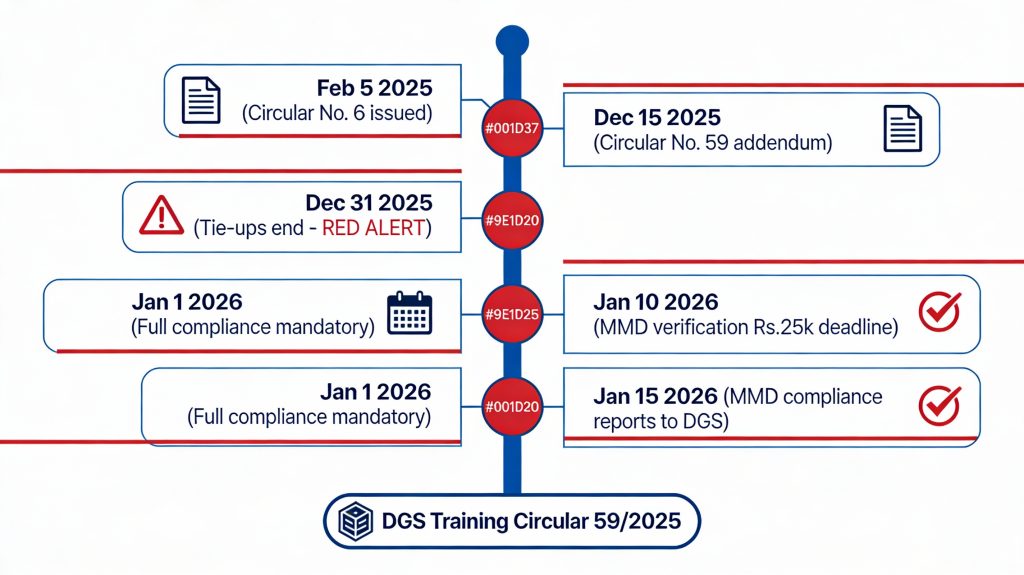
When Do DGS Swimming Pool Compliance Deadlines Take Effect?
The next round of enforcement will begin on January 1, 2026, and thus, it will supersede the timelines that were previously specified in Circular No. Six of 2025. The tie-up arrangements are going to end on December 31, 2025, if they are not explicitly approved by the DGS after a jurisdictional inspection by the Mercantile Marine Department (MMD) and a recommendation from the Principal Officer.
It is expected that all Principal Officers of the MMD will furnish their compliance reports to the DGS by January 15, 2026; those MTIs that fail to comply with the requirements will have their approvals for relevant courses revoked from that time onwards.
Those MTIs that are engaged in completing pools as per the provisions of Circular No. Applicants who need MMD verification are to deposit Rs. 25, 000 by January 10, 2026, and should they fail to do so, their course will be withdrawn. Pre- sea MTIs are allowed only to create tie-ups that have received the approval of the STCW Compliance Board, which is valid for a short duration only.
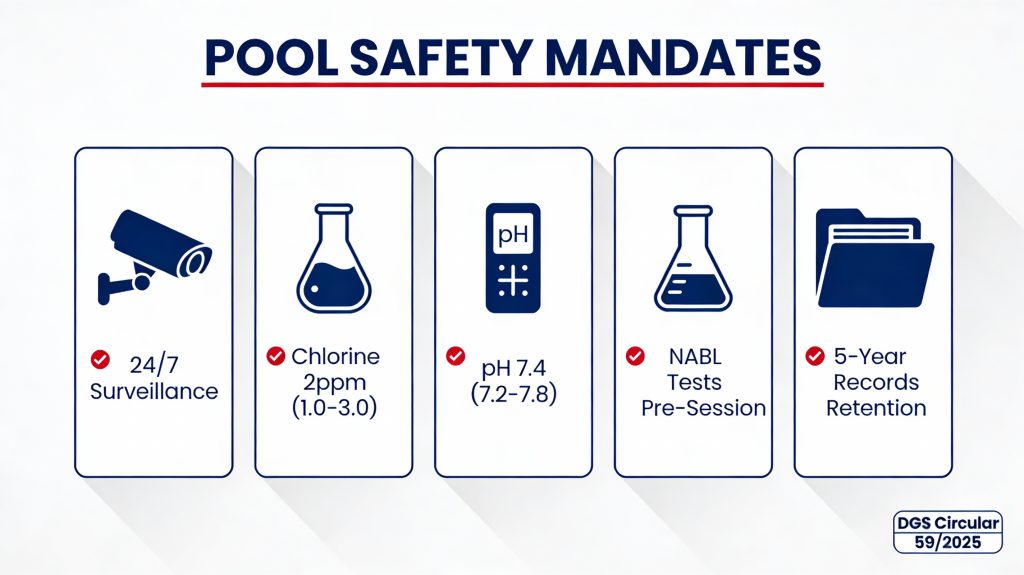
How Must MTIs Maintain Pool Hygiene and Safety Standards?
MTIs conform to the hygiene standards set by the local authorities, along with DGS standards. They also have 24-hour CCTV surveillance of pools and their surrounding areas to ensure safety and security. Full-volume filtration systems are kept in operation for at least 2 hours before and after training sessions. The water quality aims at a chlorine level of 2.0 ppm (within a 1.0- 3.0 ppm range), pH levels of 7.2, 7.8 (best pH 7.4), and is taken from several points 45 minutes before the session. The records are kept by the instructors who also verify the results obtained from the NABL, accredited laboratories.
The adjacent bathrooms are being disinfected regularly according to the set schedules, and all the relevant records (maintenance logs, CCTV footage, tests, and cleaning records) are kept for 5 years. Daily logs need confirmation from the instructor and the person in charge of the course. Integration of the DG Shipping approved doctor list needs medical supervision.
What Penalties Apply for Non-Compliance with Pool Rules?
The non-compliant Maritime Training Institutes (MTIs) will be banned from conducting pre-sea courses, BST, PST Refresher, or PSCRB training after January 15, 2026. A suspension or cancellation of approval can be initiated immediately if there are incomplete or inaccurate records, non, accessibility, or if there is a deliberate alteration of records. Without the necessary facilities, course approvals go nowhere; if the verification fee is unpaid on January 10, 2026, courses are deemed to have been withdrawn.
These sanctions result in a decrease in the enrolment figures and bad relations with the newly established RPSL companies. Maritime Consultancy is a good choice if you need help with RPSL startup compliance.
How Can MTIs Achieve Full Compliance by 2026?
Conduct a gap analysis against Circulars 7/2018, 6/2025, and 59/2025, focusing first on construction and MMD inspections. Recruit architects to produce drawings that fulfill the depth requirements and that clearly illustrate the off-campus supply chain operations. File your verification applications promptly and maintain your records in a condition that is always audit-ready.
Coordinate digitally via the Directorate General of Shipping portal and consult with Legalbabu experts by reaching them through the Contact Us option. Bring pool standards into conformity with the new regulations set out in the 2025 Crew Manual.
What is the minimum pool size that complies with DGS regulations?
A 50 ft long and 30 ft wide rectangular pool with a depth varying between 3 and 12 ft, there is an additional 2m jump platform provided for PST.
Will tie-ups be permitted after 2025?
Only until December 31, 2025, has the DGS given the green light for the completion of the construction.
Which water quality parameters are applicable?
Chlorine 1.0, 3.0 ppm (target 2.0), pH 7.2, 7.8; pre-session tested by NABL.
How distant can campus pools be?
The maximum distance of 80 kilometers has to be disclosed at the time of admission if it is more than 10 kilometers.
What records do I need to keep?
CCTV footage, logs, and test results have been under monitoring for 5 years, and instructors have been verifying them daily.
You may also like

Top 12 IACS Member Classification Societies (ROs)
IACS classification societies are the 12 organizations, ABS, BV, CCS, CRS, DNV,