
Table of Content
- What is ISO 15378:2017 Medicinal Packaging Certification?
- Products Covered under ISO 15378:2017 Medicinal Packaging Certification
- Key Principles of Quality Management in ISO 15378:2017 Medicinal Packaging Certification
- How is ISO 15378 Different from ISO 13485?
- Key Requirements for ISO 15378:2017 Medicinal Packaging Certification
- How Does ISO 15378:2017 Medicinal Packaging Certification Benefit Your Business?
- Key Documents Required for ISO 15378:2017 Medicinal Packaging Certification
- Process for Obtaining ISO 15378:2017 Medicinal Packaging Certification
- Why Choose Legal Babu?
What is ISO 15378:2017 Medicinal Packaging Certification?
ISO 15378:2017 medicinal packaging certification is an internationally recognised standard that outlines specifies requirements for packaging of materials for medicinal products. It combines the framework of ISO 9001, ISO 14001, and ISO 45001 with Good Manufacturing Practice (GMP) principles, ensuring that packaging materials consistently meet regulatory, safety, and quality requirements. It demonstrates that a manufacturer operates under a controlled and compliant system, supporting consistent production processes, reduced defects, improved customer confidence, and enhanced global market acceptance.
Which Products are Covered under ISO 15378:2017 Medicinal Packaging Certification?
ISO 15378:2017 medicinal packaging certification covers primary packaging materials directly contacting medicines to ensure safety, quality, sterility, and regulatory compliance. Here is the list of products covered under ISO 15378 certification:
|
Category |
Products |
|
Glass Containers |
Ampoules, Injection vials, Infusion bottles, Glass cartridges, Pre-filled syringe barrels, Dropper bottles, Serum bottles, Amber glass bottles, lyophilisation vials |
|
Rubber Components |
Rubber stoppers, lyophilisation stoppers, Syringe plungers, Needle shields, Rubber seals, O-rings, Closure liners, Gasket seals, Valve components |
|
Plastic Materials |
HDPE medicine bottles, PET syrup bottles, Tablet containers, Measuring cups, Droppers, Nasal spray bottles |
|
Aluminum Products |
Flip-off caps, Tear-off seals, Vial overseals, Aluminium blister foil, Strip packaging foil |
|
Laminate Containers |
Collapsible laminated tubes, Multi-layer laminated tubes, ABL tubes, PBL tubes, Laminated ointment tubes, Cream tubes, Gel tubes, Toothpaste-type pharma tubes |
What are the Key Principles of Quality Management in ISO 15378:2017 Medicinal Packaging Certification?
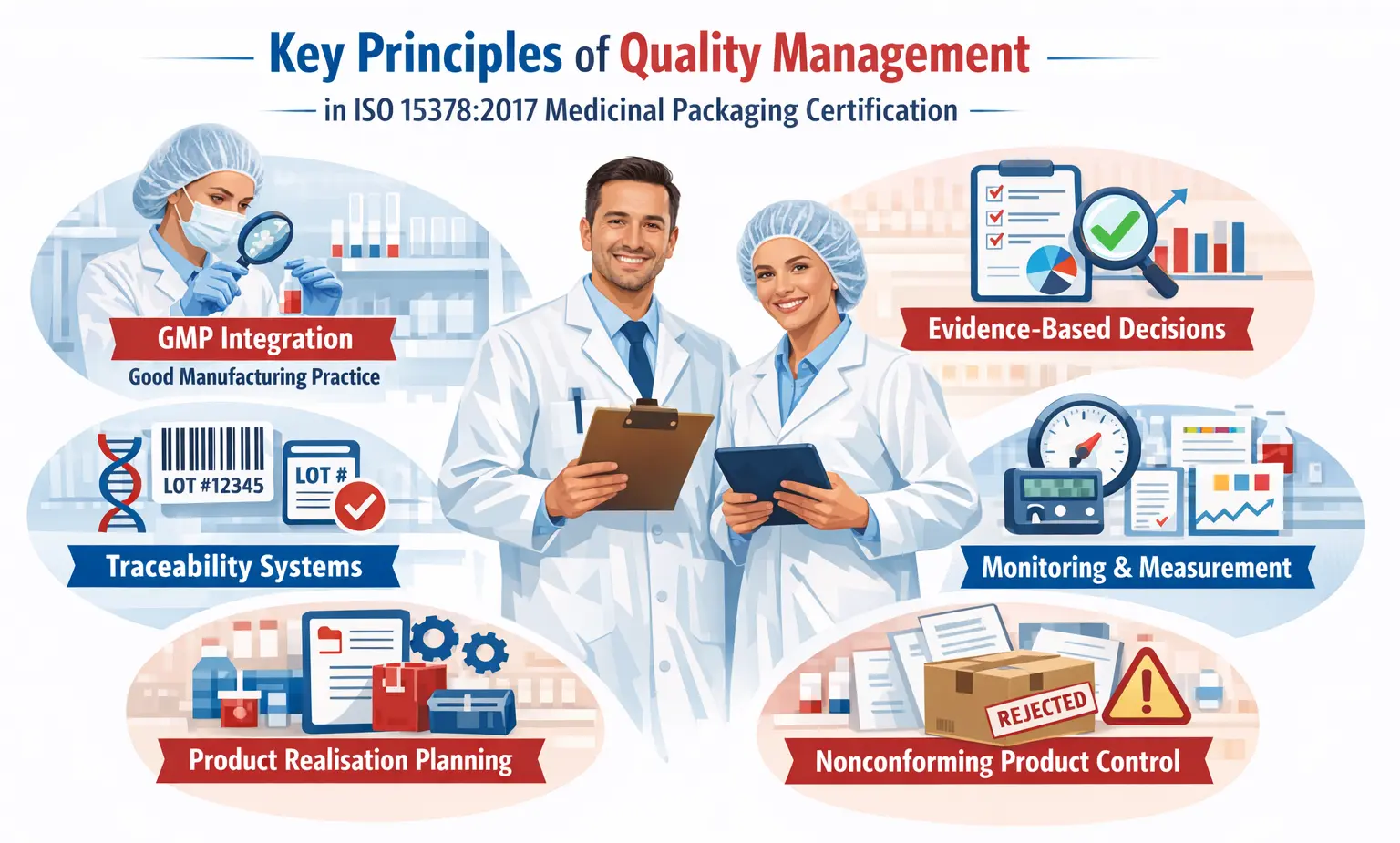
Here are the key principles of quality management in ISO 15378:2017 medicinal packaging certification:
- Good Manufacturing Practice (GMP) Integration: GMP principles are embedded into daily operations to prevent contamination, mix-ups, and deviations and ensure hygienic, controlled manufacturing environments.
- Regulatory Compliance: Organisations ensure full compliance with applicable pharmaceutical regulations, international standards, and customer-specific requirements to maintain certification validity and global market acceptance.
- Change Management: Any changes in materials, processes, suppliers, or equipment are formally evaluated, approved, validated, and documented before implementation.
- Traceability Systems: Complete traceability of raw materials, production batches, and finished goods is maintained to enable effective recall and investigation.
- Contamination Control: Strict controls are implemented to prevent particulate, microbial, or cross-contamination during manufacturing and packaging operations.
- Process Approach: Activities are managed as interconnected processes with defined inputs, outputs, controls, and performance indicators to ensure consistency, traceability, and controlled manufacturing outcomes.
- Risk-Based Thinking: Risks related to contamination, mix-ups, and product defects are identified, evaluated, and mitigated systematically to protect medicinal product quality and patient safety.
- Evidence-Based Decision Making: Decisions are based on documented data, audits, validation results, monitoring records, and measurable performance indicators to enhance reliability and regulatory compliance.
- Product Realisation Planning: Production planning ensures resources, controls, and verification steps are clearly defined before manufacturing begins.
- Monitoring and Measurement: Key quality parameters are monitored using calibrated instruments to maintain consistent manufacturing performance.
- Nonconforming Product Control: Nonconforming materials are identified, segregated, documented, and dispositioned to prevent unintended use.
How is ISO 15378 Different from ISO 13485?
ISO 15378:2017 and ISO 13485:2016 are specialised standards developed for distinct healthcare sectors, focusing respectively on pharmaceutical packaging compliance with GMP principles and comprehensive quality system requirements for medical device lifecycle management and regulatory conformity. Here are the key differences between the two:
|
Basis of Comparison |
ISO 15378:2017 |
ISO 13485:2016 |
|
Industry Focus |
Primary packaging materials for medicinal products |
Medical device design, manufacturing, and distribution |
|
Product Scope |
Glass vials, rubber stoppers, aluminum caps, plastic medicine containers |
Surgical instruments, implants, diagnostic devices, equipment |
|
Risk Management |
Focus on contamination, mix-ups, and packaging integrity |
Focus on patient safety and device performance risks |
|
Certification Objective |
Ensures safe, compliant primary medicinal packaging |
Ensures safe and effective medical devices |
|
Cleanliness Control |
Emphasizes contamination and hygiene controls for packaging |
Emphasizes sterile device manufacturing and validation |
What are the Key Requirements for ISO 15378:2017 Medicinal Packaging Certification?
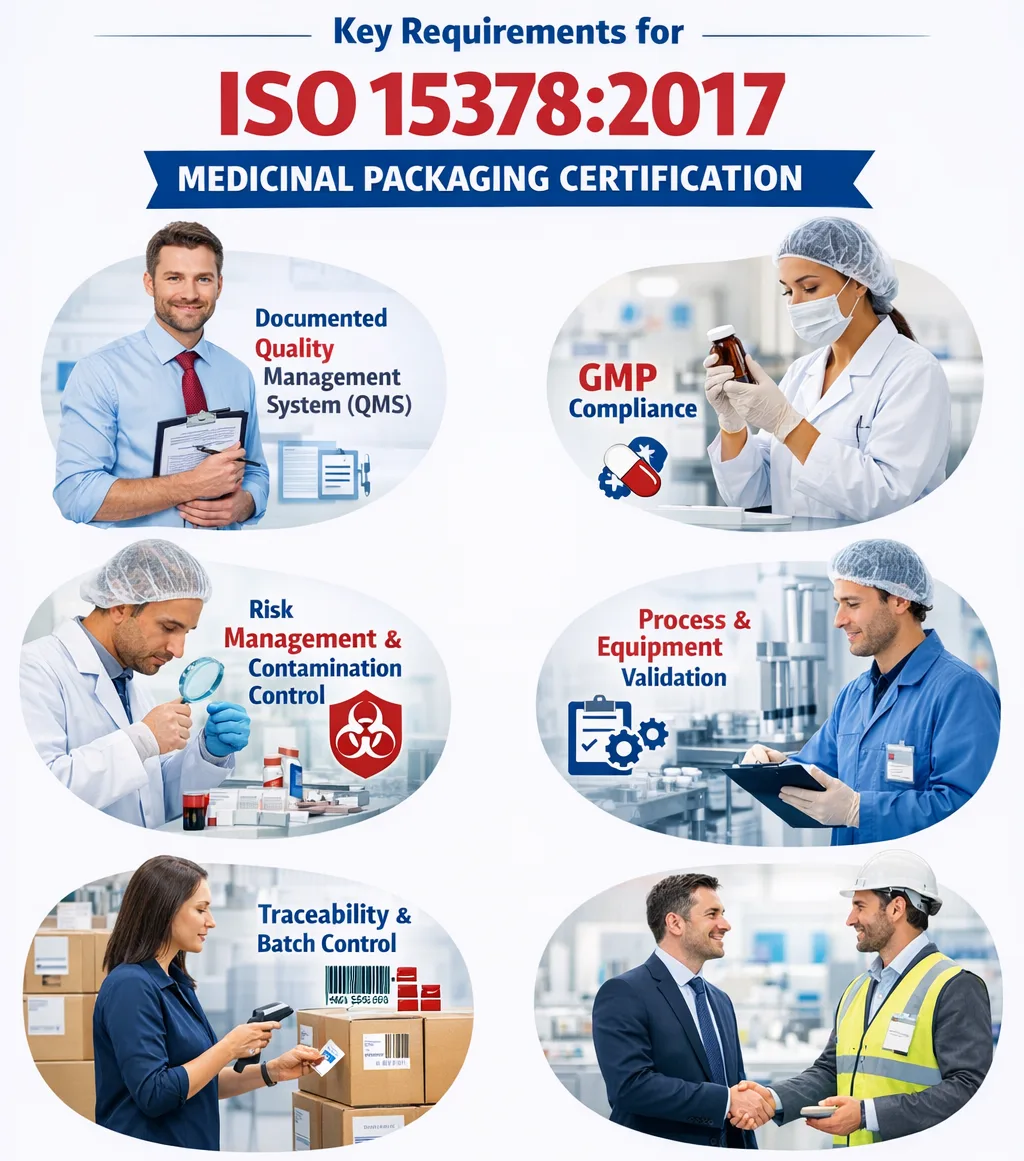
ISO 15378:2017 medicinal packaging certification requires pharmaceutical packaging manufacturers to establish a robust quality management system integrated with GMP principles, ensuring regulatory compliance, contamination control, traceability, validation, and consistent production of safe primary packaging materials. Here are the key requirements for ISO 15378 certification:
1. Documented Quality Management System (QMS): The organisation must implement a fully documented quality management system including a quality manual, procedures, records, policies, defined responsibilities, and relevant documentation.
2. Good Manufacturing Practice (GMP) Compliance: GMP requirements must be embedded into operations to control hygiene, personnel practices, contamination prevention, material handling, and production environments.
3. Risk Management and Contamination Control: A structured risk management system must identify, assess, and mitigate risks such as cross-contamination, mix-ups, particulate matter, and material defects that could compromise medicinal product safety or packaging integrity.
4. Validation of Processes and Equipment: Critical manufacturing processes, utilities, and equipment must be qualified and validated to demonstrate consistent performance and ability to meet predetermined quality specifications under defined operating conditions.
5. Traceability and Batch Control Systems: Complete traceability of raw materials, components, production batches, and finished goods must be maintained to enable effective recall, investigation, and regulatory transparency throughout the product lifecycle.
6. Supplier Qualification and Monitoring: Suppliers of raw materials and components must be evaluated, approved, and periodically monitored through audits and performance reviews to ensure consistent quality and compliance with pharmaceutical requirements.
7. Change Management and CAPA System: Formal change control procedures and corrective and preventive action systems must be implemented to manage modifications, investigate root causes of nonconformities, and prevent recurrence while maintaining regulatory compliance.
How Does ISO 15378:2017 Medicinal Packaging Certification Benefit Your Business?
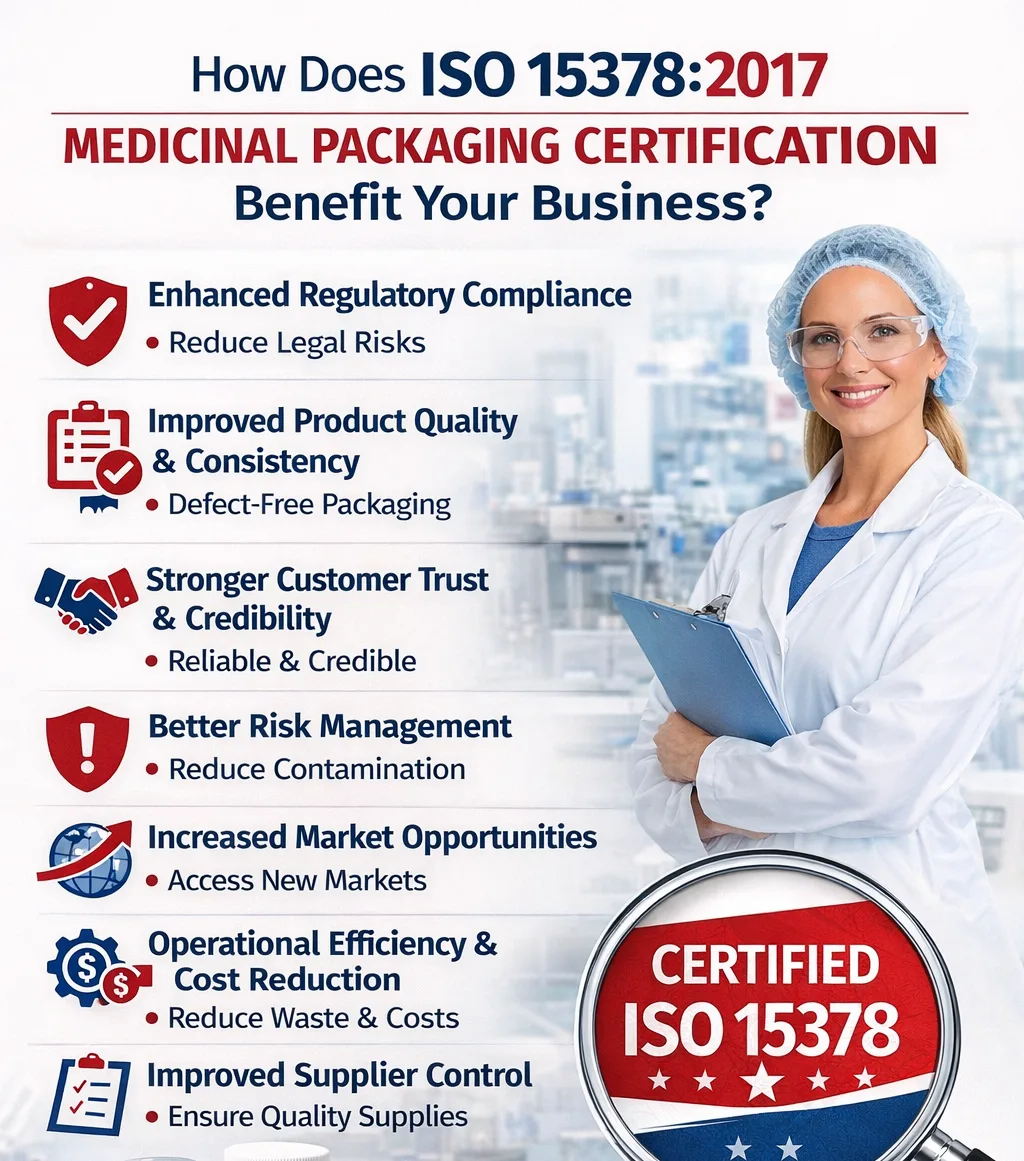
ISO 15378:2017 medicinal packaging certification provides pharmaceutical packaging manufacturers with a globally recognised quality framework helping businesses enhance compliance, operational efficiency, customer confidence, and competitive positioning in regulated healthcare markets. Here are the key benefits of ISO 15378 certification for businesses:
- Enhanced Regulatory Compliance: Ensures alignment with pharmaceutical regulations and GMP guidelines, reducing legal risks, audit failures, and regulatory penalties.
- Improved Product Quality and Consistency: Standardised processes and validated controls ensure consistent manufacturing of safe, defect-free primary packaging materials.
- Stronger Customer Trust and Credibility: Certification demonstrates commitment to quality and compliance, strengthening relationships with pharmaceutical clients and global partners.
- Better Risk Management: Structured risk assessment minimises contamination, mix-ups, recalls, and costly production disruptions.
- Increased Market Opportunities: Globally recognised certification improves eligibility for international tenders and export markets.
- Operational Efficiency and Cost Reduction: Process control, monitoring, and continual improvement reduce waste, rework, and operational inefficiencies.
- Improved Supplier Control: Supplier qualification systems ensure consistent raw material quality and reliable supply chain performance.
What are the Key Documents Required for ISO 15378:2017 Medicinal Packaging Certification?
To obtain ISO 15378 certification, the following documents are specifically required:
- Quality Manual (integrated with GMP requirements)
- GMP Procedures and Hygiene Control SOPs
- Risk Management File
- Process Validation and Qualification Reports
- CAPA (Corrective and Preventive Action) Records
- Internal Audit Reports
- Training and Competency Records
- Supplier Qualification and Approval Records
- Traceability and Batch Manufacturing Records
- Change Control Records
What is the Process for Obtaining ISO 15378:2017 Medicinal Packaging Certification?
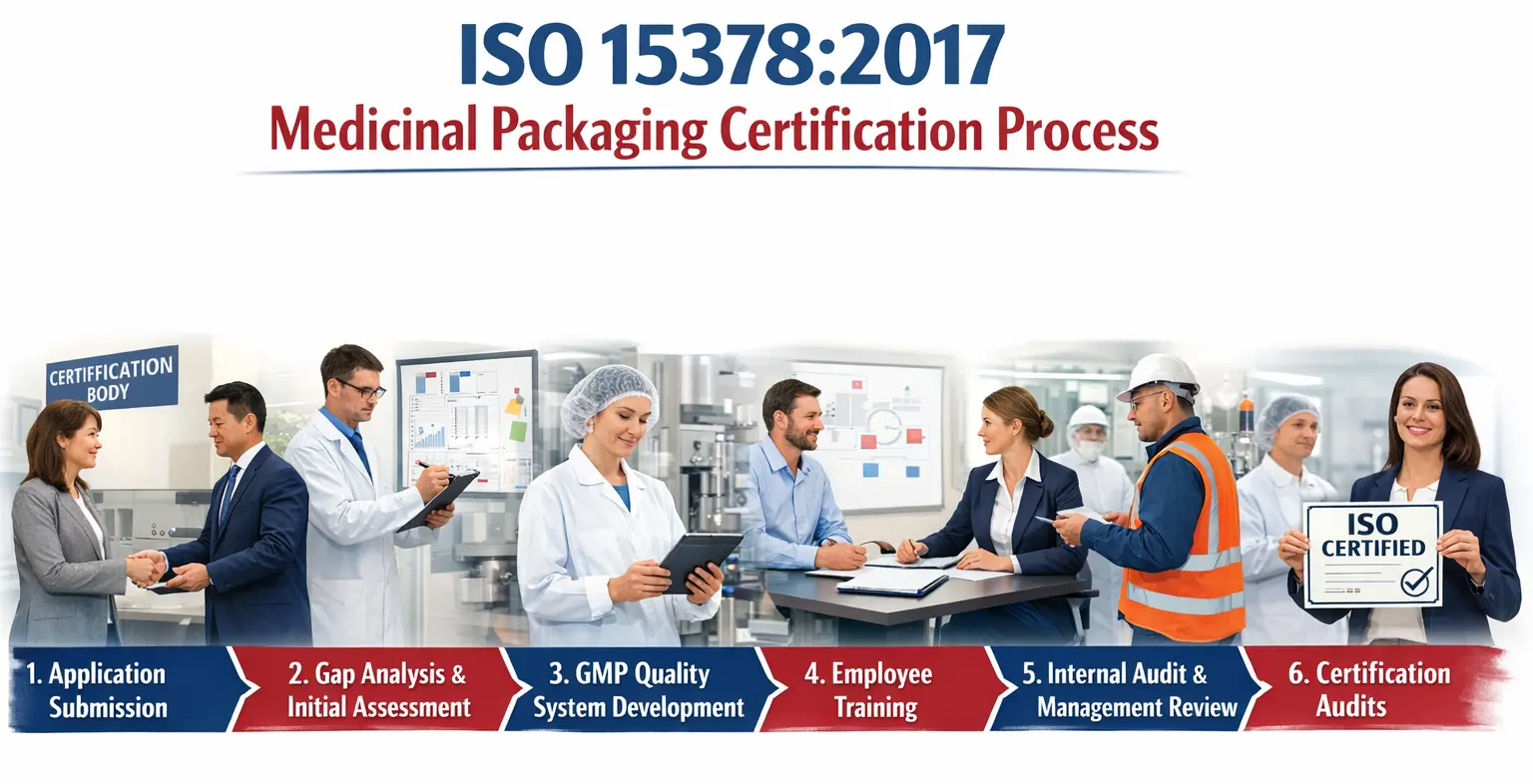
The following is the step-by-step process for obtaining ISO 15378:2017 medical packaging certification:
1. Application Submission to Accredited Certification Body
The organisation formally submits an application to an accredited certification body, defining the scope of certification, manufacturing sites, product categories, employee strength, and regulatory requirements for evaluation planning.
2. Gap Analysis and Initial Assessment
The organisation conducts a detailed gap analysis comparing existing systems with ISO 15378 requirements, identifying deficiencies in documentation, risk controls, validation, contamination prevention and regulatory compliance before initiating corrective implementation actions.
3. Development of a GMP-Based Quality Management System
A documented quality management system is established, incorporating ISO 9001 principles and GMP requirements, including quality policy, procedures, work instructions, batch documentation, traceability controls, and clearly defined responsibilities across operations.
4. Employee Training and Competency Assurance
Personnel receive structured training in GMP, hygiene, quality procedures, risk awareness, and operational controls, ensuring documented competency and clear understanding of compliance responsibilities.
5. Internal Audit and Management Review
Comprehensive internal audits are conducted to verify system effectiveness, followed by formal management review meetings assessing performance metrics, risks, nonconformities, and improvement opportunities before certification audit scheduling.
6. Certification Audits by Accredited Body
An accredited certification body performs a two-stage audit evaluating documentation readiness and on-site implementation effectiveness.
7. Certification Grant and Surveillance Audits
Successful closure of nonconformities leads to ISO 15378 certification issuance. Afterwards, a periodic surveillance audit is conducted annually to verify continued compliance, effectiveness of corrective actions, and sustained adherence to ISO 15378 requirements.
Why Choose Legal Babu?
Choosing Legal Babu ensures a smooth, transparent, and professionally managed certification journey for ISO and regulatory approvals. With experienced consultants and industry-specific expertise, we provide end-to-end assistance, including documentation support, gap analysis, implementation guidance, and audit coordination. Our team focuses on practical compliance solutions tailored to your business operations rather than generic templates.
FAQS
Have some questions about ISO 15378 Certification?
We have got you covered:
-
Is ISO 15378 certification mandatory?
ISO 15378 certification is not legally mandatory, but many pharmaceutical companies require it contractually from primary packaging suppliers to ensure GMP-aligned quality systems.
- Who issues ISO 15378 certification?
- What is the validity period of ISO 15378 certification?
- Can ISO 15378 certification apply to secondary packaging?
- Does ISO 15378 certification include cleanroom requirements?
- Is risk management mandatory under ISO 15378 certification?
- Can a company with ISO 9001 easily upgrade to ISO 15378?
- Does ISO 15378 certification require product testing laboratories?
- Are contract manufacturers eligible for ISO 15378 certification?
- Does ISO 15378 certification address product recalls?
- Is software validation required under ISO 15378 certification?
- Does ISO 15378 certification cover warehousing activities?
- Can ISO 15378 certification support export compliance?
- Are periodic recertification audits required in ISO 15378 certification?
- Does ISO 15378 certification require hygiene programs?
- Can ISO 15378 certification integrate with environmental management systems?
- Does ISO 15378 certification require calibration control?
- Is management responsibility defined in ISO 15378 certification?
- Are risk assessments documented?
- Does ISO 15378 certification apply to export trading companies?


