
Hasslefree IEM Registration in India – Industrial Entrepreneur Memorandum Filing Guide for Large-Scale Industries

India’s industrial policy framework requires eligible large-scale, de-licensed industrial undertakings to file an Industrial Entrepreneur Memorandum (IEM) with the Department for Promotion of Industry and Internal Trade (DPIIT). IEM registration is a mandatory pre-commencement intimation for businesses that meet prescribed financial thresholds and operate in sectors not requiring an industrial licence.
Unlike renewal-based compliance, new IEM registration is the first regulatory step before setting up or expanding a large manufacturing unit. It establishes official recognition of the proposed industrial activity under the Industrial (Development & Regulation) Act, 1951.
At Legal Babu, we assist businesses with end-to-end IEM registration, ensuring accurate filings, proper documentation, and smooth processing through the National Single Window System (NSWS).
What is IEM Registration?
An Industrial Entrepreneur Memorandum (IEM) is a formal declaration filed with DPIIT by eligible industrial undertakings proposing to:
-
Establish a new large-scale industrial unit
-
Expand an existing manufacturing unit
-
Manufacture additional products in a de-licensed sector
IEM is applicable only to industries that do not require an industrial licence but meet prescribed investment or turnover thresholds.
When Is New IEM Registration Required?
A new IEM (Part A) must be filed before commencement of commercial production in the following cases:
-
Setting up a new large manufacturing unit
-
Substantial expansion in plant and machinery
-
Diversification into additional products
-
Crossing prescribed financial thresholds
Financial Thresholds for IEM Applicability
IEM registration is required for industrial undertakings with:
-
Investment in plant and machinery exceeding INR 125 crore, OR
-
Annual turnover exceeding INR 500 crore
If either of these thresholds is met, IEM filing becomes mandatory (subject to sector eligibility).
Accurate disclosure of financial projections and investment estimates is critical, as DPIIT may scrutinise supporting documentation.
IEM Registration Process (Step-by-Step)
1. Filing of IEM Part A
The first step is filing IEM Part A through the National Single Window System (NSWS) portal. This includes:
-
Details of the industrial undertaking
-
Proposed manufacturing activity
-
Location of plant
-
Investment in plant and machinery
-
Expected production capacity
-
Product details (NIC Code classification)
Upon successful submission and fee payment, DPIIT issues an IEM Acknowledgement Number.
2. Commencement of Commercial Production
After the manufacturing unit becomes operational and commercial production begins, the undertaking must proceed to the next step.
3. Filing of IEM Part B
Once production starts, IEM Part B must be filed to formally intimate DPIIT of commencement of commercial production.
Failure to file Part B may create compliance complications in the future.
IEM Filing Platform – Fully Digital Framework
All IEM filings are submitted online through the National Single Window System (NSWS). The process is entirely digital, including:
-
Submission of forms
-
Payment of fees
-
Issuance of acknowledgement
-
Queries and clarifications
-
Amendment filings
Consistency in PAN, MCA records, GST registration, and entity details across government systems is essential to avoid delays.
Applicability Across Ownership Structures
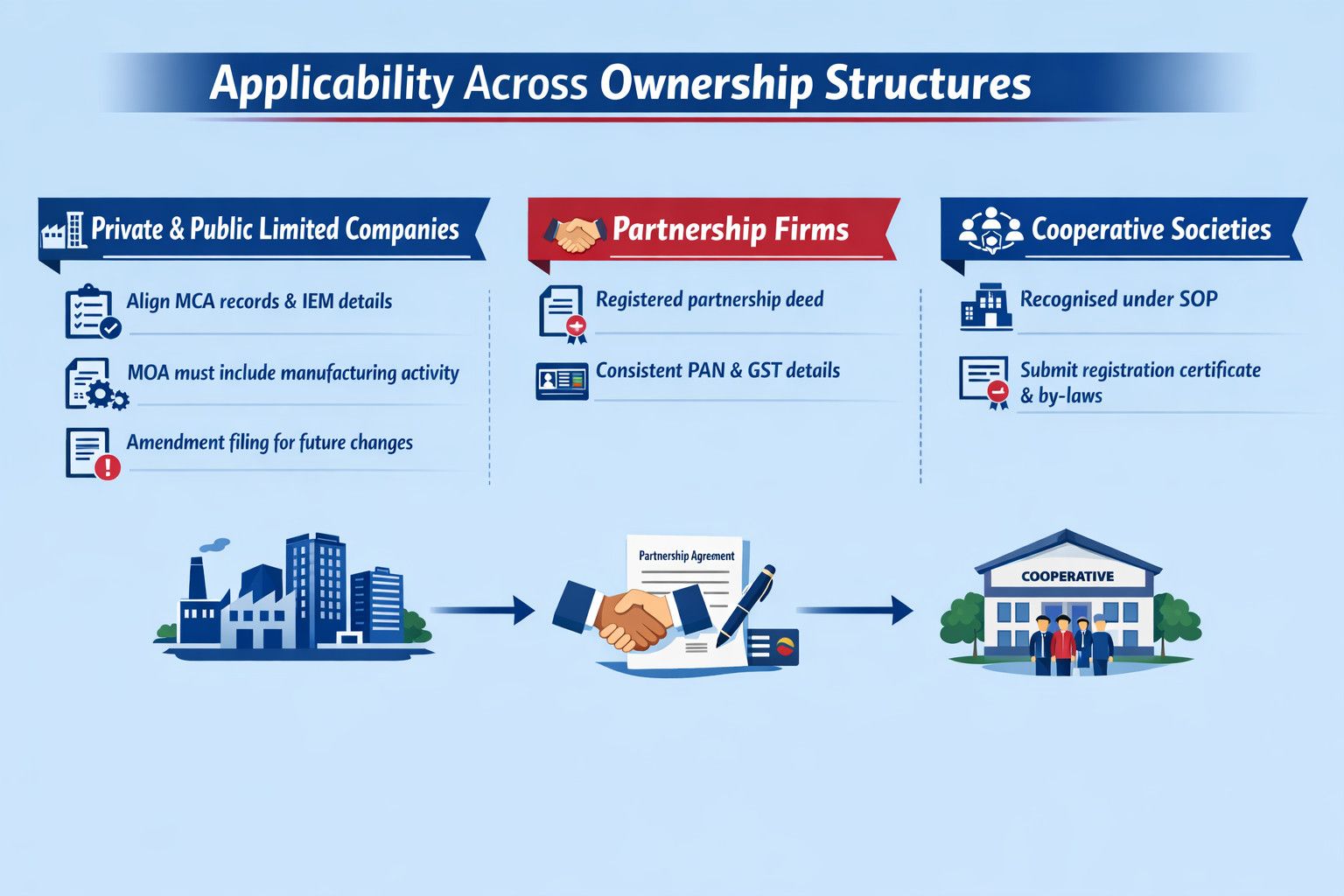
IEM registration applies uniformly across eligible legal entities, including:
Private & Public Limited Companies
-
Must ensure alignment between MCA records and IEM details
-
MOA objects should include manufacturing activity
-
Any future changes require amendment filing
Partnership Firms
-
Registered partnership deed required
-
Consistency in PAN and GST details mandatory
Cooperative Societies
-
Recognised under SOP as eligible undertakings
-
Must submit registration certificate and by-laws
Other Recognised Industrial Undertakings
Any legally recognised entity meeting financial thresholds and operating in de-licensed sectors may be required to file IEM.
DPIIT evaluates compliance based on the legal structure and authenticity of documents submitted.
Documents Required for New IEM Registration
For Companies whether public limited or private limited:
-
PAN Card of the company
-
Certificate of Incorporation
-
MCA Master Data
-
Memorandum of Association (MOA)
-
Articles of Association (AOA)
-
GST Registration Certificate
-
Board Resolution / Authorisation
-
Details of plant location
-
Project report (where applicable)
For Partnership Firms:
-
PAN Card of the firm
-
Registered Partnership Deed
-
GST Registration Certificate
-
Authorisation letter
For Cooperative Societies
-
PAN Card
-
Registration Certificate from Registrar
-
By-laws
-
GST Registration
For All Entities
-
Details of investment in plant & machinery
-
Proposed production capacity
-
Product description and NIC codes
-
Address proof of manufacturing location
DPIIT may request additional clarification documents during scrutiny.
Government Fees for IEM Registration
For IEM registration you need to pay a certain fee depending your requirement:
|
Particulars |
Government Fee (?) |
|
|
IEM Part A Filing (New Registration) |
INR 1,000 |
Mandatory fee for filing new IEM before commencement of production |
|
Additional Products (More than 10 items) |
INR 250 per set of 10 items |
Applicable if multiple NIC product entries are filed |
|
Amendment to IEM (if required later) |
INR 250 per set of 10 items |
Applicable for future modifications in products/capacity |
|
IEM Part B Filing |
No Government Fee |
Filed after commencement of commercial production |
Fees must be paid online through NSWS at the time of filing.
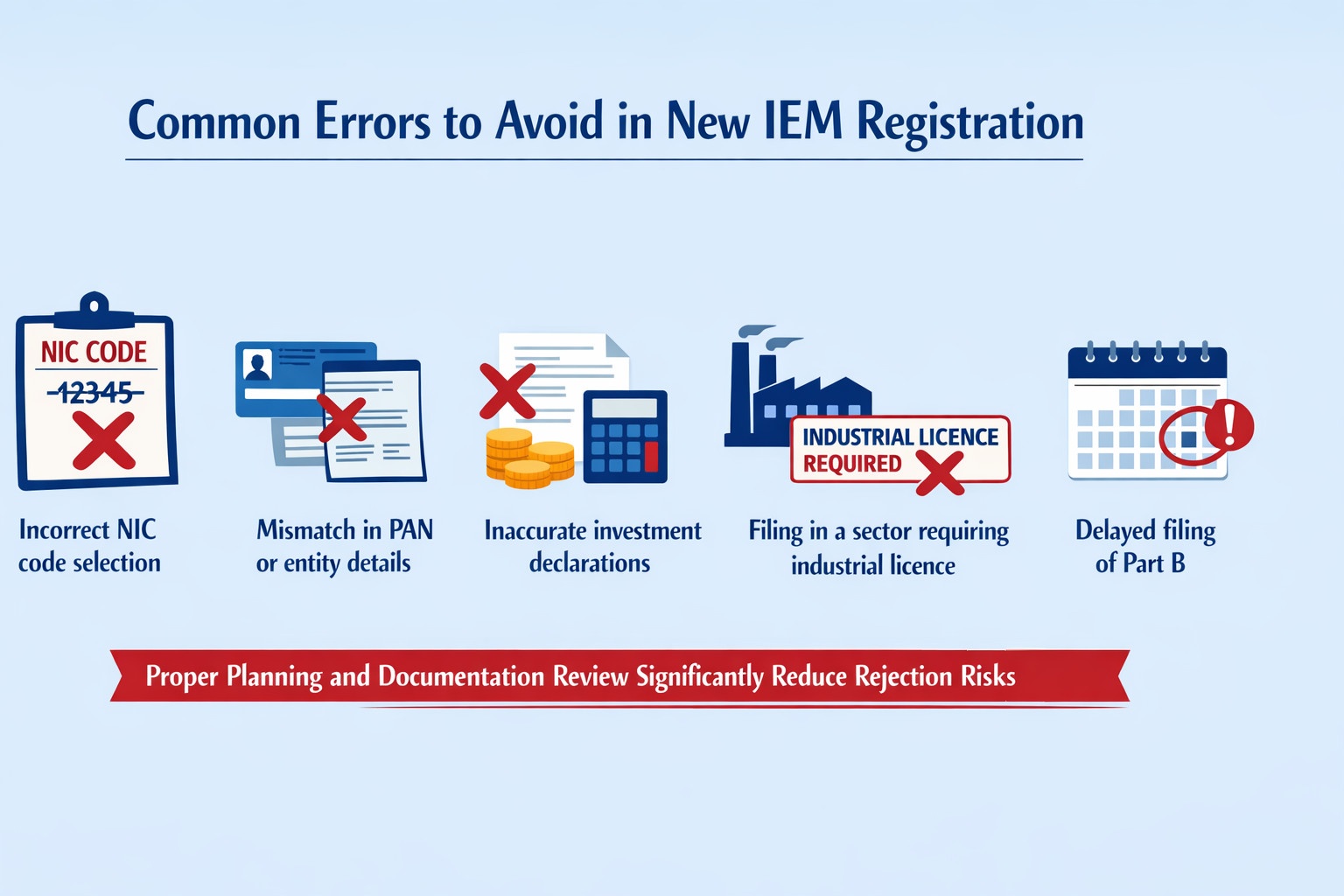
Common Errors to Avoid in New IEM Registration
-
Incorrect NIC code selection
-
Mismatch in PAN or entity details
-
Inaccurate investment declarations
-
Filing in a sector requiring industrial licence
-
Delayed filing of Part B
Proper planning and documentation review significantly reduce rejection risks.
Queries and Scrutiny by DPIIT
DPIIT may raise queries if discrepancies are identified. Applicants must respond within the prescribed time.
If clarifications are not submitted within three months from the last query, the application may be treated as invalid.
Professional handling of responses ensures smooth processing and avoids regulatory setbacks.
How Legal Babu Assists with New IEM Registration
Legal Babu provides end-to-end assistance, including:
-
Eligibility assessment under financial thresholds
-
Sector verification (licensed vs de-licensed)
Documentation review and structuring -
Preparation and filing of IEM Part A
-
Advisory on Part B compliance
-
Handling DPIIT queries and clarifications
-
Post-registration amendment support
Our structured approach ensures accurate filings while management teams focus on operational setup.
IEM registration is a critical compliance requirement for large-scale industrial undertakings operating in de-licensed sectors. It is not merely a formality but a statutory declaration that must be handled with precision.
Timely and accurate IEM registration ensures regulatory clarity, prevents compliance risks, and facilitates smooth industrial operations under India’s industrial policy framework.
Businesses planning large manufacturing investments should prioritise proper IEM filing to avoid future regulatory complications.
FAQS
Frequently Asked Questions on New IEM Registration
-
1. What is IEM Part A?
IEM Part A is the initial declaration filed with DPIIT before setting up or expanding a large industrial undertaking in a de-licensed sector.
- 2. When should I file IEM?
- 3. Is IEM required for MSMEs?
- 4. What is IEM Part B?
- 5. Is IEM required for all manufacturing activities?
- 6. How long does it take to receive IEM acknowledgement?
- 7. Can I amend my IEM after registration?
- 8. Is there any expiry period for IEM?
- 9. What happens if I do not file Part B?
- 10. Can DPIIT reject an IEM application?


