Get Cosmetics License in India Hasslefree with Expert Assistance
The cosmetics industry in India is strictly regulated to ensure consumer safety, product quality, and compliance with statutory standards. Any business involved in manufacturing, importing, or testing cosmetic products must obtain the appropriate cosmetics license under the Drugs and Cosmetics Act, 1940 and the Cosmetics Rules, 2020.
From shampoos and skincare products to perfumes and makeup items, operating without a valid license can result in severe penalties, product seizures, or even criminal prosecution. This makes regulatory compliance not just a legal obligation, but a critical foundation for building a sustainable cosmetics business in India.
At Legal Babu, we help businesses navigate the complex cosmetics licensing framework with complete accuracy, ensuring approvals are obtained smoothly and without compliance risks.
Who Needs a Cosmetics License in India?
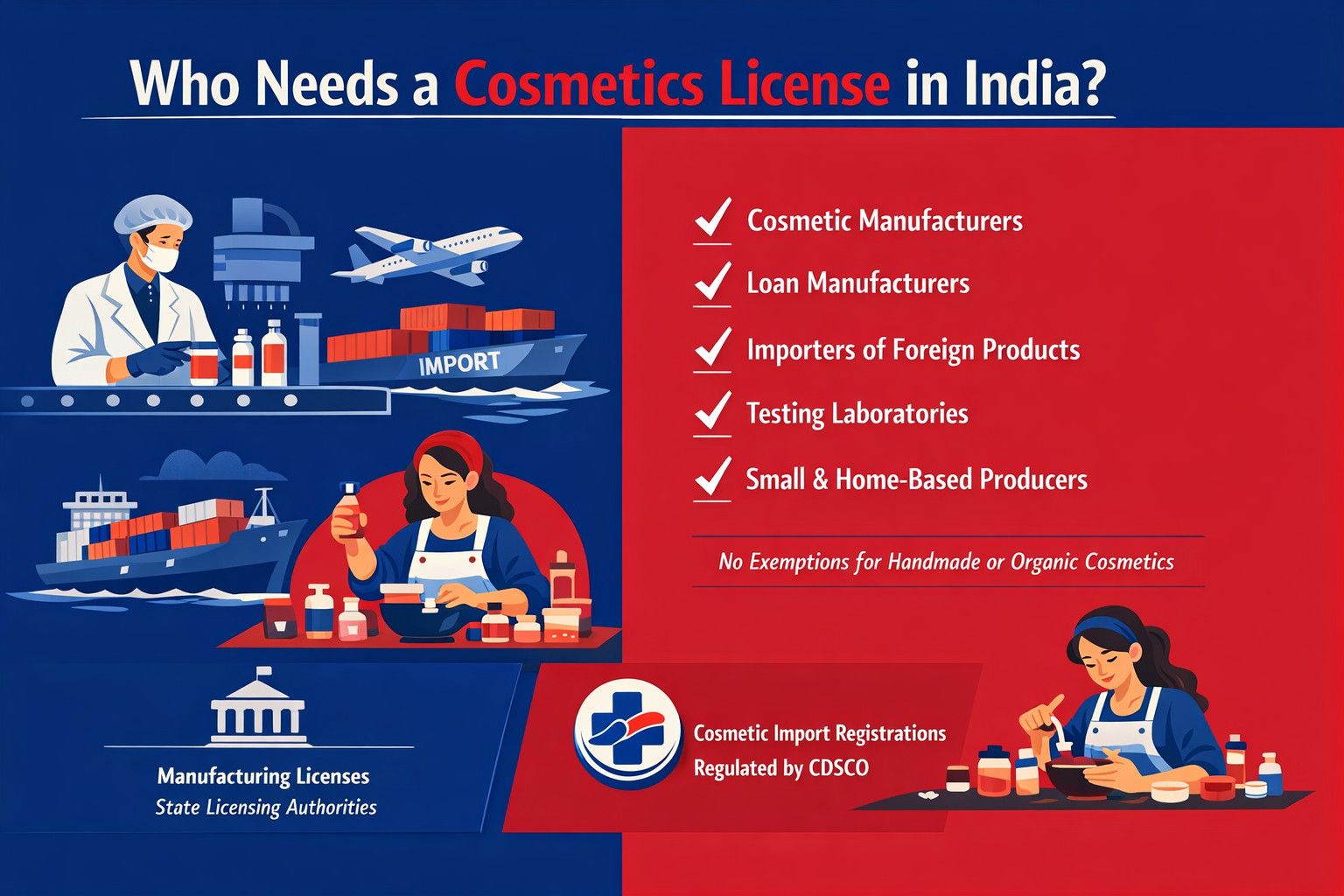
Any entity engaged in the cosmetics supply chain requires a valid license. Cosmetics are broadly defined as products intended for cleansing, beautifying, promoting attractiveness, or altering appearance.
Licensing is mandatory for:
-
Manufacturers producing cosmetics for sale, distribution, or export
-
Loan manufacturers using third-party licensed facilities
-
Importers bringing foreign cosmetic products into India
-
Businesses testing cosmetics or raw materials
-
Small-scale and home-based cosmetic producers
There are no exemptions for handmade, organic, or home-based cosmetic businesses. Even small operations must obtain regulatory approval before selling products.
Manufacturing licenses are issued by State Licensing Authorities, while cosmetic import registrations are regulated centrally by CDSCO.
Types of Cosmetics Licenses in India
India mandates specific licenses by activity, each with validity periods and forms.
Different cosmetic business activities require different regulatory approvals. The applicable license depends on whether the business is manufacturing, outsourcing production, importing products, or conducting testing activities. Each license is issued by a designated authority and carries a defined validity period.
|
License Type |
Purpose |
Issuing Authority |
Validity |
Key Forms & Government Fees |
|
Manufacturing License (For Sale) |
Manufacture and sell cosmetic products (up to 10 items per Schedule M-II category such as soaps, creams, hair dyes) |
State Licensing Authority (SLA) |
5 years |
Application in Form 31, License in Form 32; Government fee: INR 2,500 + INR 1,000 inspection fee |
|
Loan Manufacturing License |
Manufacture cosmetics through a third-party licensed manufacturing facility |
State Licensing Authority (SLA) |
5 years |
Application in Form 31-A, License in Form 32-A; Same government fees as manufacturing license |
|
Cosmetic Import Registration |
Import and market foreign cosmetic products in India |
CDSCO (Central Authority) |
3 years |
Application in Form 42, Registration Certificate in Form 43; USD 250 or equivalent to Indian rupee per brand |
|
Testing Approval |
Testing of cosmetics or cosmetic raw materials |
State Licensing Authority (SLA) |
As specified by authority |
Application in Form 36, Approval in Form 37; Inspection fee: INR 1,500 |
Eligibility Criteria for Cosmetics Licensing
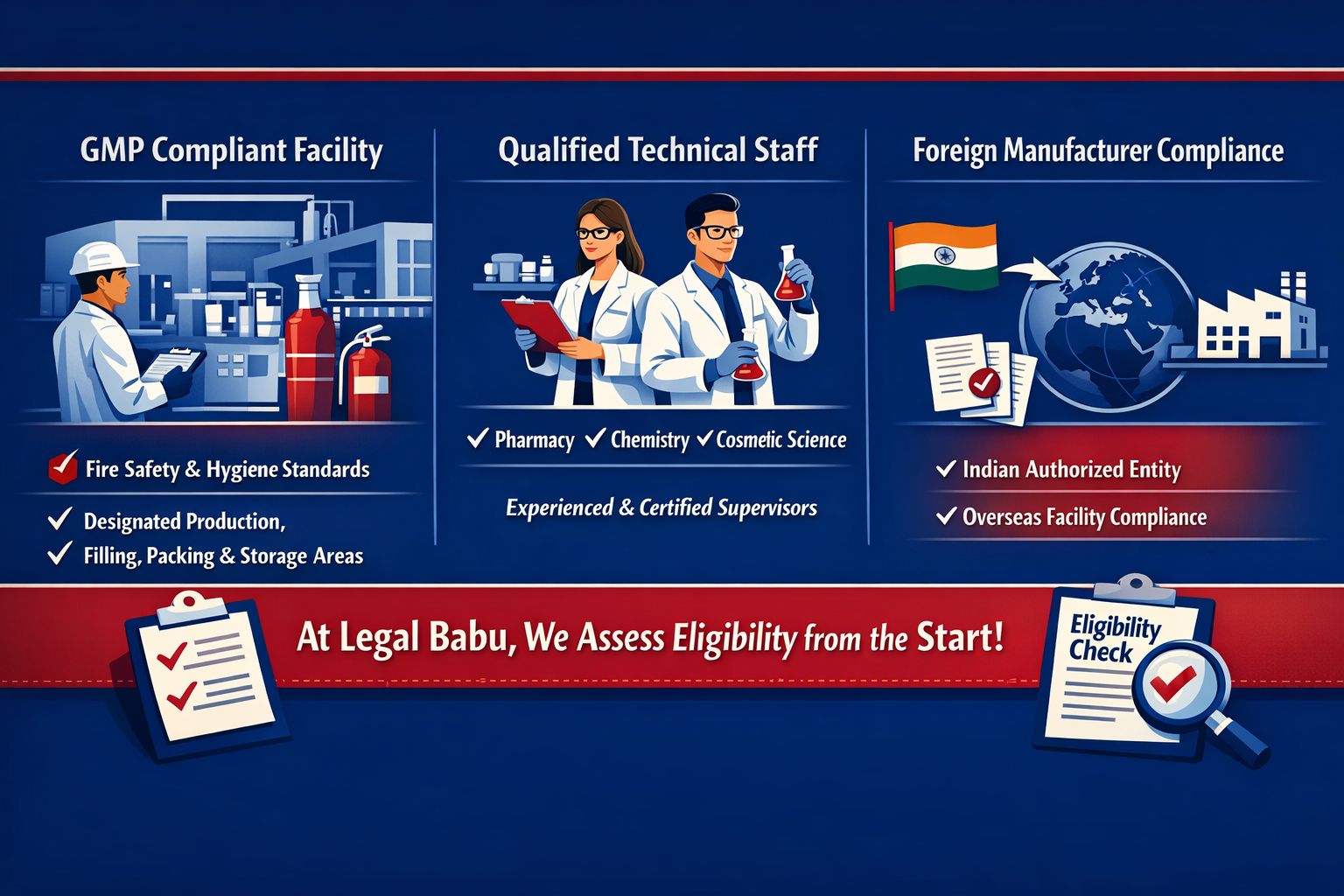
Authorities assess eligibility based on infrastructure, personnel qualifications, and compliance history.
Applicants must demonstrate adequate manufacturing premises that meet Good Manufacturing Practices (GMP) standards, including designated production, filling, packing, and storage areas. Fire safety and hygiene standards are closely scrutinised.
Qualified technical staff is mandatory. Manufacturing activities must be supervised by personnel with prescribed educational qualifications and relevant experience in pharmacy, chemistry, or cosmetic science.
For import registrations, foreign manufacturers must authorise an Indian entity, and all overseas facilities must comply with Indian cosmetic regulations.
At Legal Babu, we evaluate eligibility at the initial stage itself to avoid unnecessary delays or rejections.
Documents Required for Cosmetics License
Cosmetics licensing involves extensive documentation, and even minor inconsistencies can trigger regulatory queries.
Commonly required documents include business registration proofs, premises details, GMP declarations, product formulations, technical staff credentials, and compliance declarations. Import registrations additionally require foreign manufacturing approvals, free sale certificates, and labelling samples.
Our team manages document preparation, verification, and submission, ensuring every detail aligns with regulatory expectations.
GMP, ISO Certifications, and Quality Standards for Cosmetics Businesses
Regulatory compliance for cosmetics in India goes beyond obtaining a license. Authorities closely evaluate manufacturing quality, safety controls, and adherence to prescribed standards to ensure that cosmetic products released into the market are safe for consumer use.
While ISO certifications are not legally mandatory for obtaining or maintaining a cosmetics license in India, compliance with Good Manufacturing Practices (GMP) under Schedule M-II of the Drugs and Cosmetics Rules is compulsory for all licensed cosmetic manufacturers.
Understanding the distinction between mandatory compliance and voluntary certifications is essential to avoid regulatory risks and unnecessary expenditure.
GMP Compliance: A Mandatory Licensing Requirement
Good Manufacturing Practices (GMP) form the backbone of cosmetic regulatory compliance in India. GMP compliance is non-negotiable for the grant and continuation of a cosmetic manufacturing license.
Regulatory authorities assess GMP compliance through inspections and documentation review, focusing on:
-
Manufacturing hygiene and sanitation controls
-
Raw material sourcing and quality testing
-
Equipment calibration and maintenance
-
Trained and qualified production personnel
-
Batch records, quality control, and traceability systems
Applicants are required to submit a self-declaration of GMP compliance at the time of application. However, licensing authorities retain the right to conduct inspections and audits at any stage, even after license approval.
At Legal Babu, we ensure your facility documentation, compliance framework, and declarations align fully with Schedule M-II requirements, significantly reducing inspection risks and objections.
ISO Certifications: Not Mandatory, But Strategically Valuable
ISO certifications are voluntary for cosmetic businesses in India and are not enforced by licensing authorities. However, they are widely recognised as indicators of robust quality management systems and international best practices.
ISO 22716 – Cosmetics Good Manufacturing Practices
ISO 22716 is the internationally accepted GMP standard for cosmetics. While not legally required, it closely aligns with Schedule M-II and demonstrates advanced compliance in:
-
Production and process controls
-
Storage and warehousing practices
-
Distribution and shipment safety
-
Risk management and documentation systems
This certification is particularly valuable for exporters, international brand collaborations, and businesses targeting premium markets.
ISO 9001 – Quality Management System
ISO 9001 focuses on organisational quality management systems. It is optional but helps streamline operations, improve consistency, and enhance customer confidence.
We advise clients on whether ISO certifications are commercially beneficial, depending on business scale, export plans, and brand positioning, without pushing unnecessary compliance costs.
BIS Certification and Other Mandatory Standards
While ISO certifications are optional, certain product-specific standards are mandatory.
Bureau of Indian Standards (BIS) certification, including the ISI mark, is compulsory for select cosmetic categories such as:
-
Hair dyes
-
Skin powders
-
Other products notified under BIS safety standards
Additionally, newly introduced cosmetic products may require safety data review and regulatory scrutiny, especially where formulations or claims attract additional oversight.
Legal Babu evaluates product portfolios to identify mandatory BIS or CDSCO requirements, ensuring that no regulated product enters the market without proper approvals.
How Legal Babu Handles the Cosmetics License Process
Obtaining a cosmetics license is a technically sensitive process involving multiple authorities, inspections, and regulatory checkpoints. Instead of navigating this complexity yourself, Legal Babu offers complete end-to-end assistance.
We handle:
-
Eligibility assessment and license type determination
-
End-to-end documentation and compliance review
-
Online application filing through appropriate portals
-
Coordination with licensing authorities
-
Inspection preparedness and compliance support
-
Regulatory follow-ups until final approval
By managing the entire process on your behalf, we minimize delays, eliminate errors, and ensure approvals are issued without complications.
Validity, Renewal, and Ongoing Compliance
Cosmetics manufacturing licenses are generally valid for five years, while import registrations have a three-year validity. Timely renewal is mandatory to avoid suspension of operations.
Post-licensing, businesses must continue complying with:
-
Schedule M-II manufacturing standards
-
Ingredient restrictions and safety limits
-
Accurate labelling and batch traceability
-
Maintenance of production and quality records
Failure to comply can result in suspension, cancellation, or prosecution under the amended Cosmetics Rules, which have significantly strengthened penalties.
Legal Babu also supports clients with renewals, compliance audits, regulatory updates, and post-approval obligations, ensuring long-term regulatory peace of mind.
Penalties for Non-Compliance
Operating without a valid cosmetics license or violating regulatory conditions can lead to:
-
Heavy monetary penalties
-
Product seizure and recall
-
Suspension or cancellation of licenses
-
Imprisonment under serious violations
With enhanced enforcement under the 2020 Rules, proactive compliance is no longer optional. It is essential.
Why Choose Legal Babu for Cosmetics Licensing?
Cosmetics licensing is not just about filing forms. It requires regulatory insight, technical accuracy, and continuous follow-up with authorities.
With Legal Babu, you get:
-
Expert handling of complex licensing requirements
-
Error-free applications aligned with current regulations
-
Dedicated support throughout inspections and approvals
-
End-to-end compliance management under one roof
Whether you are launching a new cosmetic brand, expanding manufacturing, or importing international products into India, we ensure your business remains fully compliant from day one.
Contact Legal Babu today to get your cosmetics license processed seamlessly and focus on growing your brand, while we take care of the compliance.
FAQS
Frequently Asked Questions on Cosmetics License in India
-
1. Is a cosmetics license mandatory to start a cosmetic business in India?
Yes, a cosmetics license is mandatory for any business involved in manufacturing, importing, loan manufacturing, or testing cosmetic products in India. Selling cosmetics without a valid license is a punishable offence under the Drugs and Cosmetics Act, 1940.
- 2. Do handmade or home-based cosmetic businesses require a license?
- 3. Which authority issues cosmetics manufacturing licenses in India?
- 4. What is the validity period of a cosmetics license?
- 5. Is GMP compliance compulsory for cosmetics licensing?
- 6. Are ISO certifications mandatory for cosmetics businesses in India?
- 7. Can a cosmetics license application be rejected?
- 8. How long does it take to obtain a cosmetics license in India?
- 9. Is BIS certification required for all cosmetic products?
- 10. Can Legal Babu manage the entire cosmetics licensing process?


