
Table of Content
- What is CE Marking Certification?
- Products for which CE Marking is Mandatory
- Key Principles of Quality Management in CE Marking Certification
- Key Requirements for Obtaining CE Marking Certification
- Why Choose CE Marking Certification?
- Process for Obtaining CE Marking Certification
- Why Choose Legal Babu for CE Marking Certification?
What is CE Marking Certification?
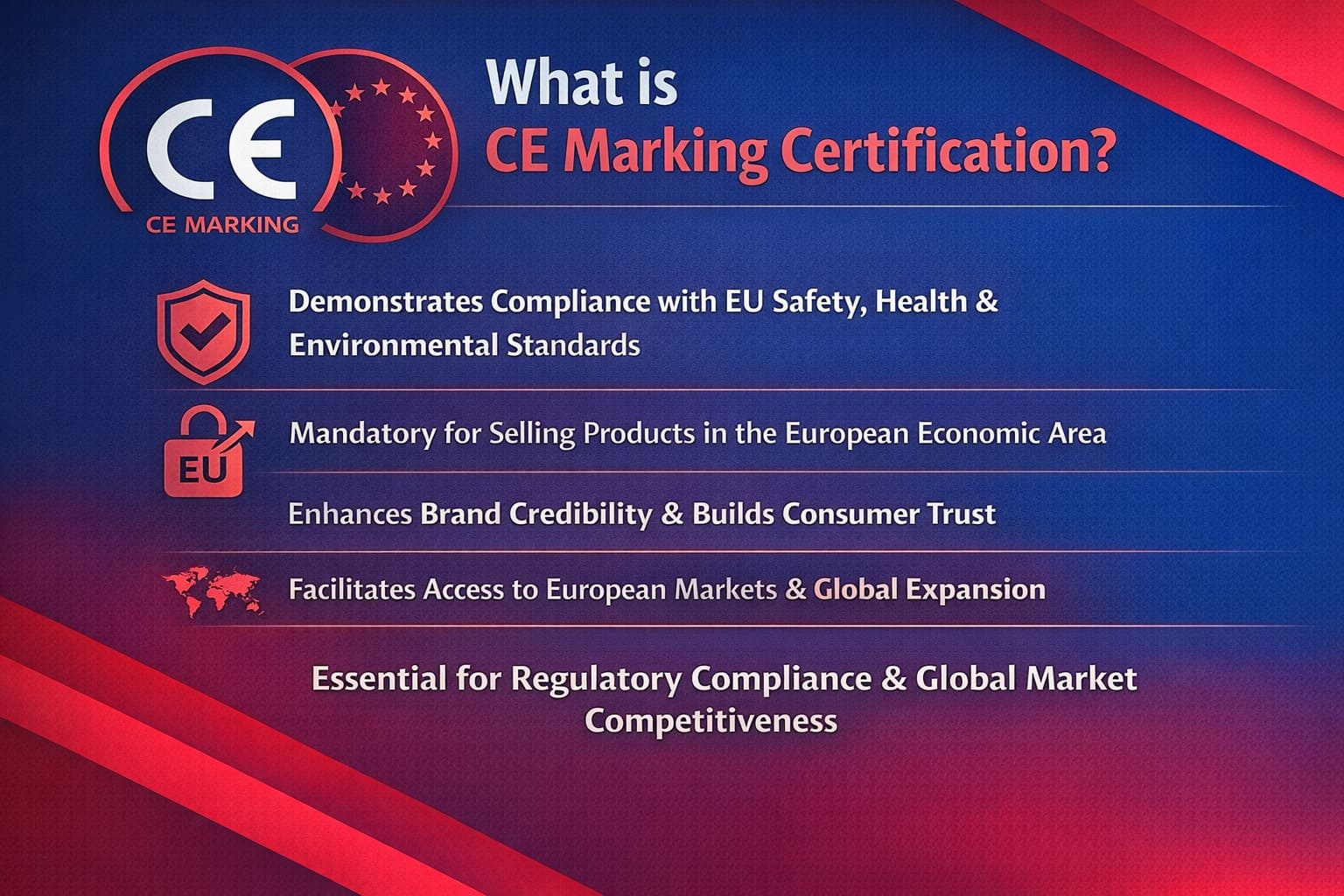
CE marking certification is a standard that reflects that the product complies with the safety, health, and environmental requirements of the European Union. CE marking is mandatory for organisations to sell their product in the European Economic Area. This standard shows that the manufacturer has assessed the product and confirmed it meets all applicable EU directives and regulations.
CE Marking certification enhances the brand’s credibility, builds trust, and facilitates access to the European markets. It demonstrates commitment towards product safety and regulatory compliance. Obtaining CE marking certification is essential for organisations planning to expand internationally and compete in the global market.
Products for which CE Marking is Mandatory
CE marking becomes mandatory when a product falls under applicable European directives or regulations and is intended to be sold within the European Union. It confirms compliance with safety, health, and environmental requirements.
Here are the products for which CE marking is mandatory:
| Product Category | Examples of Products |
| Electrical & Electronic Equipment | Mobile phones, laptops, televisions, LED lights, power adapters, washing machines, refrigerators, microwave ovens, industrial control panels, cables, circuit breakers |
| Machinery & Industrial Equipment | CNC machines, packaging machines, printing machines, hydraulic presses, conveyor systems, agricultural machinery, construction machinery, compressors |
| Medical & Healthcare Devices | Surgical instruments, diagnostic kits, thermometers, blood pressure monitors, X-ray machines, implants, syringes, ventilators, in-vitro diagnostic kits |
| Personal Protective & Safety Equipment (PPE) | Safety helmets, gloves, safety shoes, protective goggles, respiratory masks (including N95), fire-resistant clothing, fall protection harnesses |
| Construction & Pressure Equipment | Cement, doors, windows, fire alarms, smoke detectors, boilers, pressure vessels, gas cylinders, pipelines, water heaters |
| Consumer & Children’s Products | Toys (electronic & non-electronic), bicycles, childcare articles, playground equipment, household gas appliances, heaters |
Key Principles of Quality Management in CE Marking Certification?
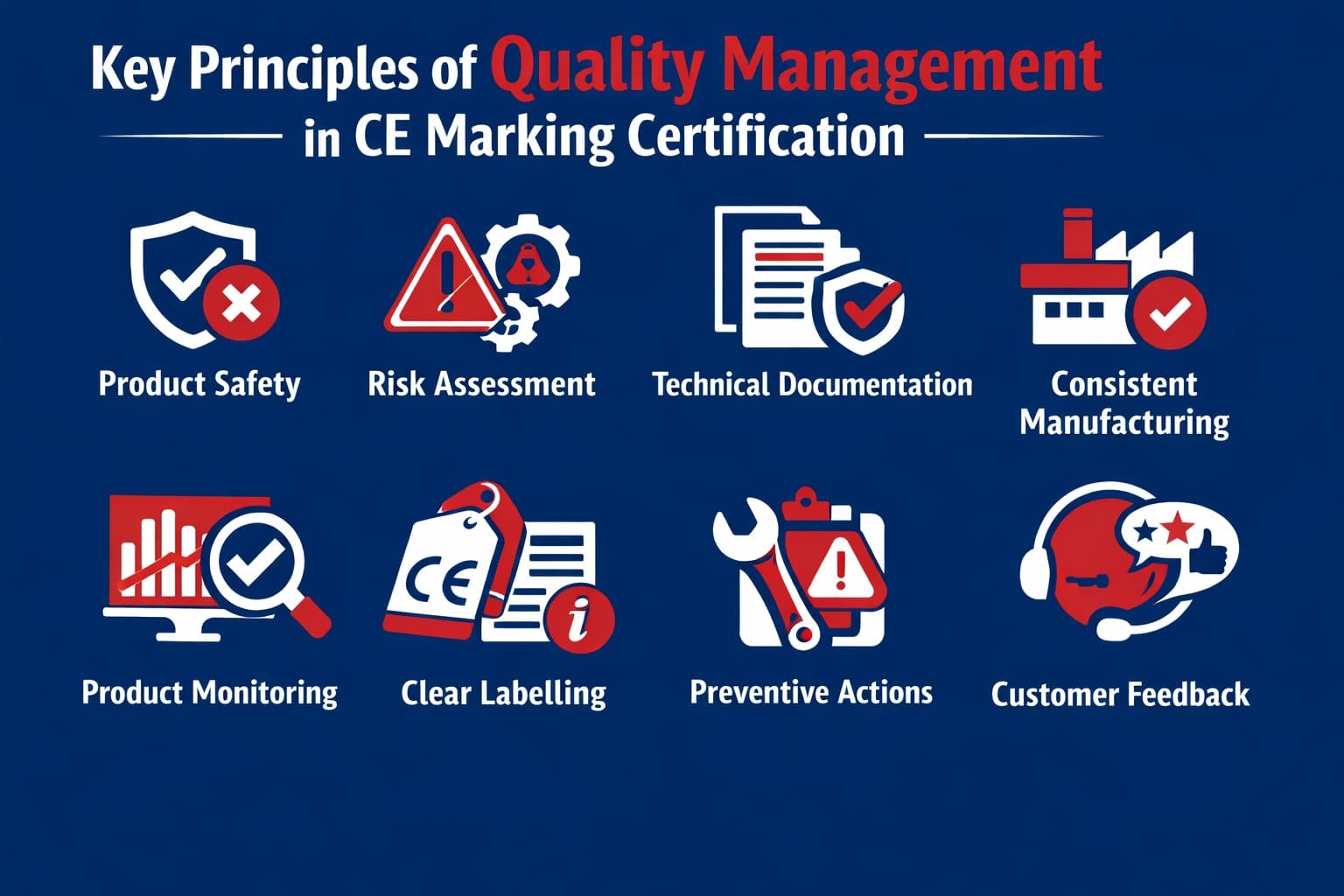
The following are the key principles of quality management in CE marking certification:
- Product Safety: Ensuring that the product complies with the applicable EU safety, health, and environmental protection requirements.
- Risk Assessment: Identifying potential product risks and implementing measures to eliminate or minimise hazards for safe usage.
- Technical Documentation: Ensuring complete technical documentation to demonstrate product conformity and enabling regulatory authorities to verify compliance.
- Consistent Manufacturing Quality: Ensuring consistency in the production process and conformity with the SU quality requirements.
- Product Monitoring and Compliance: Continuously monitoring product performance and updating compliance measures in case of regulatory changes.
- Product Information and Labelling: Providing clear instructions, warnings, and labelling to ensure safe usage and legal compliance.
- Preventive Management: The organisation must establish procedures to correct non-compliant products and take preventive actions in case of default.
- Product Feedback Handling: Monitoring product performance and addressing customers’ feedback and grievances effectively.
Key Requirements for Obtaining CE Marking Certification?
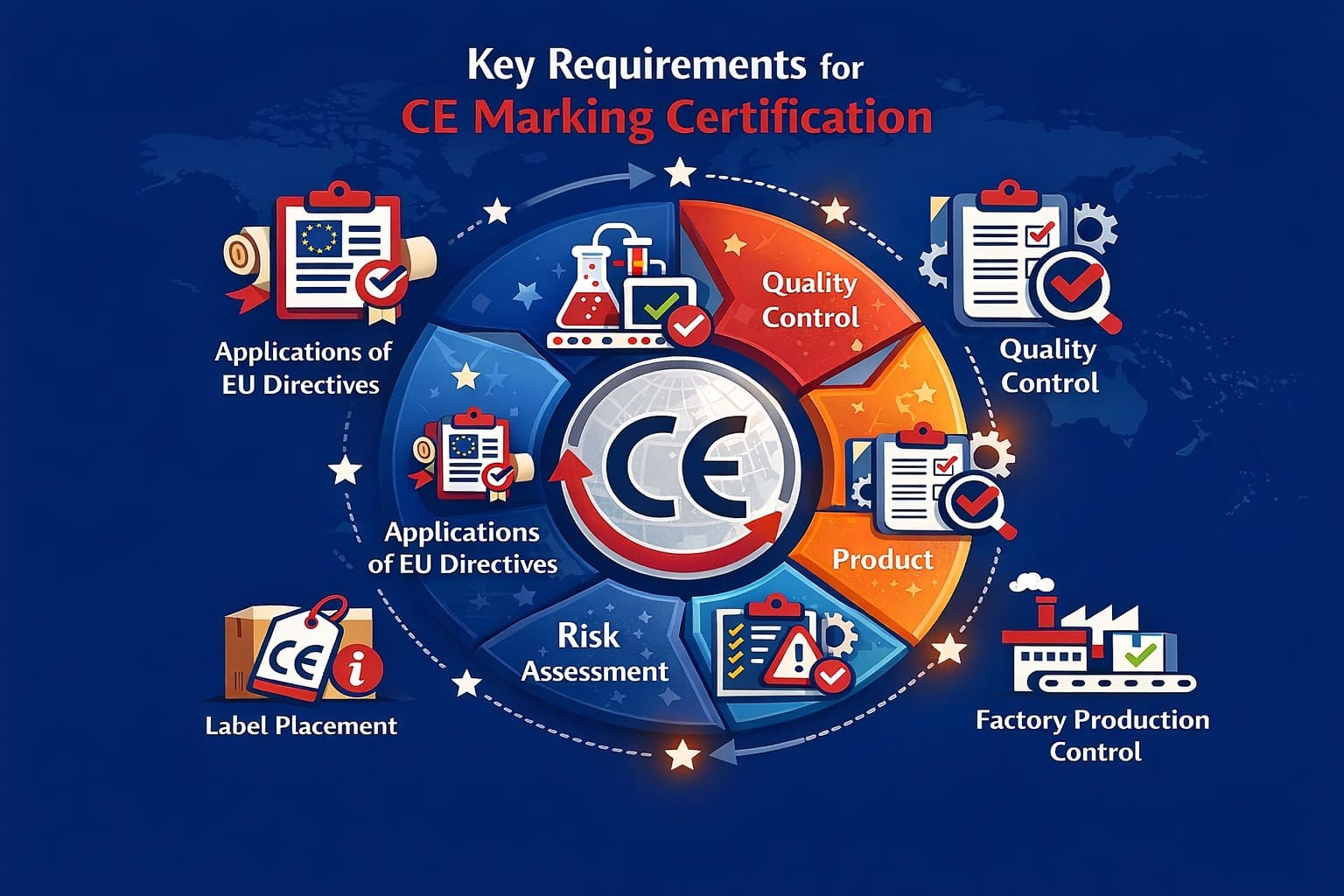
Obtaining CE marking certification allows organisations to compete in the European Union market and establish their brand image. Here are the key requirements for obtaining CE marking certification to ensure product safety, environmental regulation compliance, and enhnacing brand image in the global market:
1. Applications of EU Directives and Regulations: The organisation must identify all the rules, regulations, and legal obligations of the EU applicable to their products and must implement or follow them. Before applying for the certification, it is quite necessary to ensure conformity with the EU requirements.
2. Product Testing and Conformity Assessment: The organisation must undergo product testing and conformity assessment to verify that the product complies with all requirements and EU safety standards.
3. Quality Control Procedure: The organisation must implement enhanced quality control procedures to ensure products consistently comply with approved technical specifications. Consistent quality control ensures product reliability, trustworthiness and reduces the risk of product failures.
4. Label Placement: The organisation is required to place the CE marking label on its products or packaging. The label helps customers to identify that the product is standardised, high-quality, and safe to use.
5. Risk Assessment and Evaluation: The organisation is required to conduct a detailed risk assessment to identify potential threats, hazards, and other issues associated with product use. Risk assessment ensures that the product entering the European Union is safe and reliable.
6. Factory Production Control System: The organisation must establish a well-structured factory production control system to analyse and maintain product quality throughout the production process. It includes production monitoring, inspection, evaluation, and product safety to ensure products consistently meet the required standards.
Why Choose CE Marking Certification?
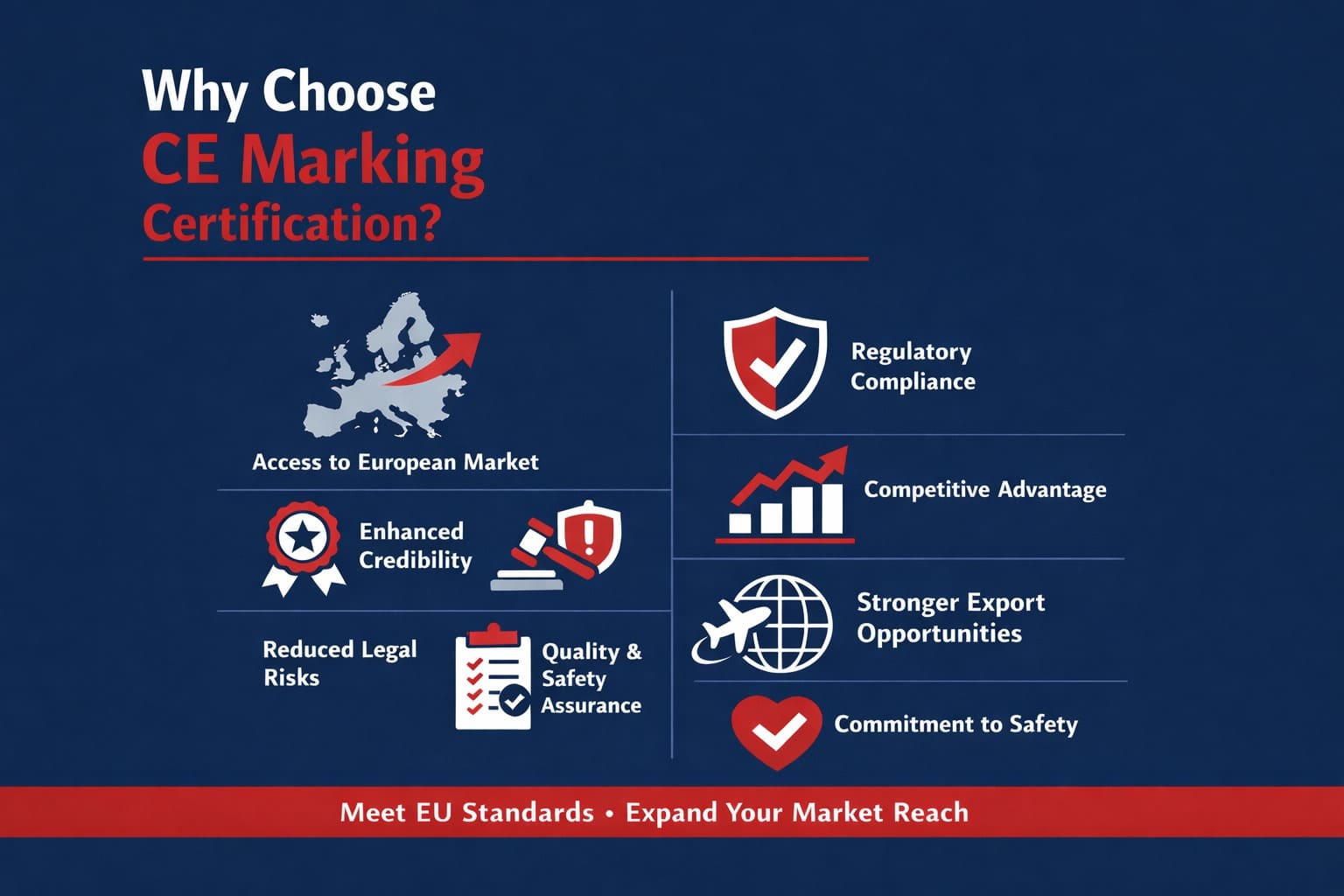
Choosing CE marking certification allows organisations to legally sell products in European Economic Areas and ensures compliance with EU standards. This certificate demonstrates product credibility, builds customer trust, and allows the organisation to establish itself in the international market. CE marking reduces trade barriers and enables smooth cross-border product distributions. Apart from this, it serves several other benefits.
Here are the key benefits of choosing CE marking certification:
- Access to the European Market: CE marking certification allows manufacturers to legally sell products across the European Economic Area without trade barriers.
- Regulatory Compliance Assurance: It confirms that products comply with EU safety, health, and environmental protection requirements.
- Improved Market Credibility: CE marking enhances brand trust and increases customer confidence in product quality and safety.
- Competitive Business Advantage: Certified products gain easier acceptance in international markets, improving business expansion opportunities.
- Reduced Legal and Compliance Risks: CE marking helps businesses avoid penalties, product bans, or legal complications due to non-compliance.
- Enhanced Product Quality Control: The certification process encourages consistent quality and safety checks throughout manufacturing operations.
Additional Benefits:
- Simplified Trade Across Europe: CE marking removes technical trade barriers, allowing smooth movement of products within European markets.
- Increased Customer Confidence: Products with CE marking are perceived as safe and reliable, encouraging customer preference and repeat purchases.
- Stronger Export Opportunities: CE certification opens opportunities for businesses to expand exports into regulated international markets.
- Commitment to Product Safety: Certification demonstrates the organisation’s responsibility toward the environment, delivering safe and compliant products to consumers.
Process for Obtaining CE Marking Certification?
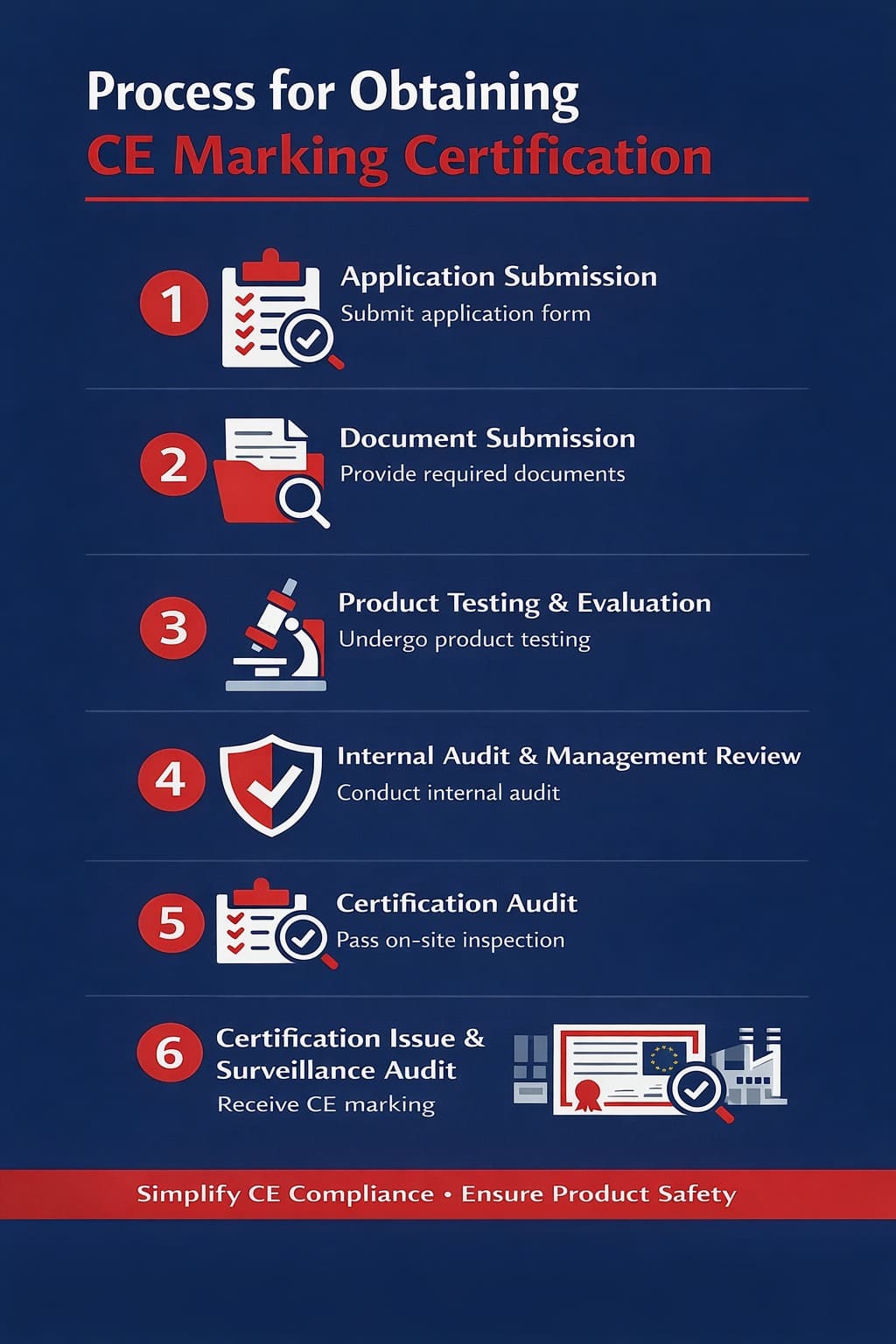
The process for obtaining CE marking certification is quite easy and simple. You just need to follow the following procedure step-by-step:
1. Application Submission
The organisation needs to submit the application form, including all the details of the organisation and products. The organisation should provide objectives, scope, product specifications, and product assessment details in the application.
2. Document Submission
The organisation needs to submit all the required documents, including product specifications, test reports, risk assessments, and compliance information. The organisation needs to submit accurate and updated documents for certification approval.
3. Product Testing and Compliance Evaluation
The organisation needs to undergo product testing and compliance evaluation to ensure that there are no gaps in the process and all the EU requirements are fulfilled. If any non-conformity or irregularities are found during the process, appropriate measures should be taken to correct them.
4. Internal Audit and Management Review
The organisation needs to conduct an internal audit to verify the information, document authenticity, and whether the compliance system aligns with the organisation’s objective or not. Management review the audit report and make corrections or specifications in the product accordingly.
5. Certification Audit
The authorised certification body conducts an audit and on-site inspection to verify compliance with EU directives and manufacturing controls. The certification body examines all the documents, processes, technical documentation, and production processes.
6. Certification Issue and Surveillance Audit
After verifying all the details, the accredited body grants CE marking certification to the organisation. The organisation needs to conduct an annual or surveillance audit to ensure certification renewal and continuous compliance with EU standards.
Why Choose Legal Babu for CE Marking Certification?
Obtaining CE marking certification can be a long process if you don’t have proper documentation, legal guidance, and knowledge of the EU legal requirements. However, you can simplify this journey with Legal Babu’s expert assistance, accurate documentation, and dependable compliance support. Here is why you should choose Legal Babu:
- Expert consultation on CE marking requirements and applicable EU directives.
- Complete documentation preparation and compliance support.
- Assistance with product testing and conformity assessment procedures.
- End-to-end certification process management with minimal delays.
- Experienced professionals ensuring accurate and timely compliance.
- Transparent pricing with no hidden charges.
- Dedicated support team for quick query resolution.
- Assistance in preparing the EU Declaration of Conformity.
- Support in establishing factory production control systems.
- Post-certification guidance to maintain compliance standards.
FAQS
Have some questions about CE Marking Certification?
We have got you covered:
-
Why is CE marking important for manufacturers?
CE marking allows manufacturers to legally sell products in European markets while demonstrating compliance with essential EU regulatory requirements.
- Which products require CE marking certification?
- Is CE marking mandatory in all European countries?
- Does CE marking guarantee product quality?
- How long does CE marking certification take?
- What happens if products lack CE marking?
- Does CE marking apply outside Europe?
- How often is CE marking compliance reviewed?
- Can CE marking certification be withdrawn?
- Does CE marking cover environmental protection requirements?
- What industries benefit most from CE marking certification?
- Can CE marking improve international business opportunities?
- Is product testing mandatory for CE marking?
- How can companies prepare for CE marking certification?
- Does CE marking apply to imported products?
- What are the main EU directives related to CE marking?
- Does CE marking cover packaging compliance?
- Can small businesses obtain CE marking certification easily?
- What role does risk assessment play in CE marking certification?
- Is user instruction documentation required for CE marking?


