
Table of Content
- What is BIS Certification?
- Products that come under BIS Certification
- Different Types of BIS Certification in India
- Key Principles of Quality Management in BIS Certification
- Key Requirements for BIS Certification
- Documents Required for BIS Certification
- Why Choose BIS Certification?
- Process for Obtaining BIS Certification
- Why Choose Legal Babu?
What is BIS Certification?
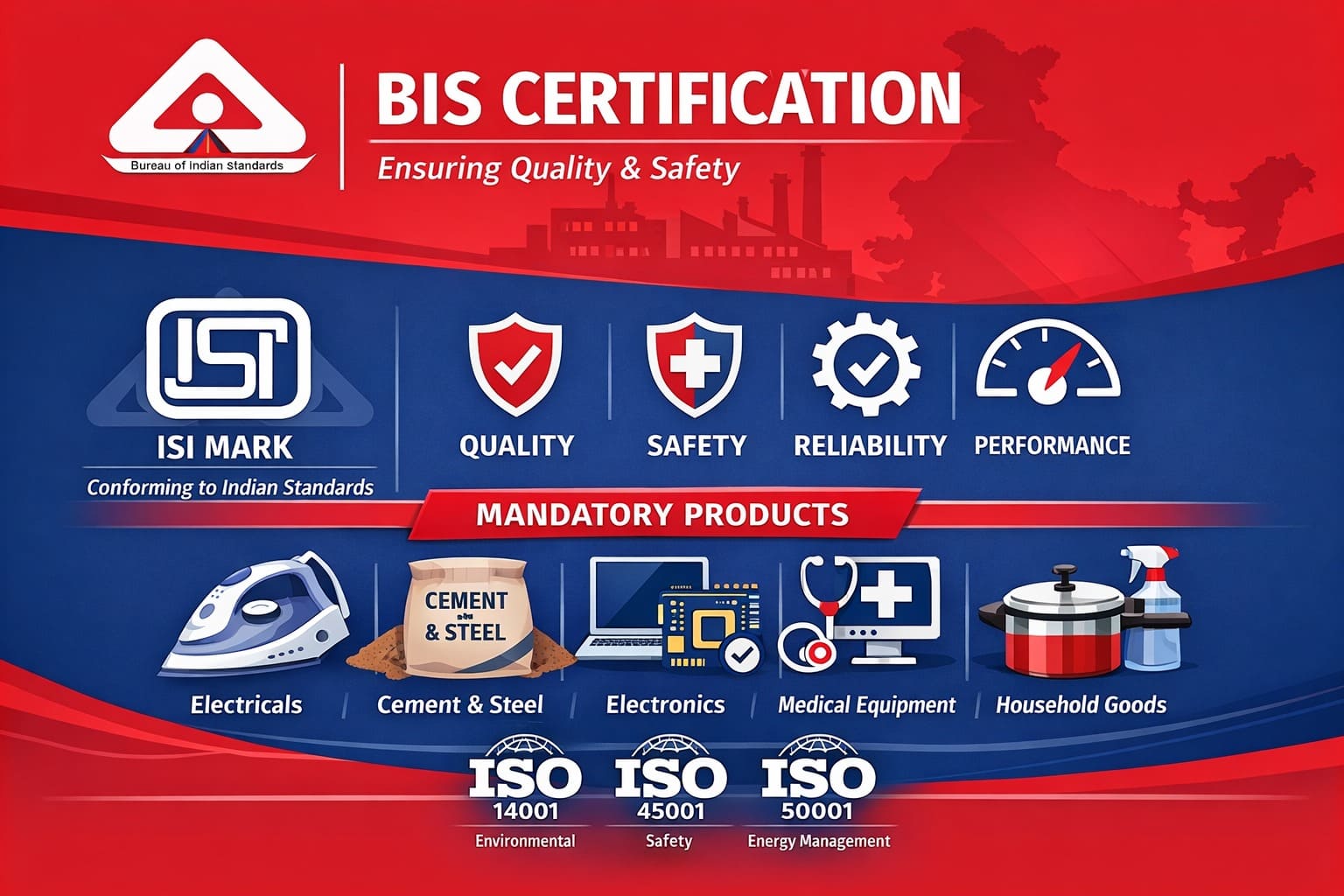
BIS certification, issued by the Bureau of Indian Standard (BIS), under the BIS Act 2016, is a national standard that ensures that the product meets the standard for quality, safety, performance, and reliability. It reflects that the product conforms to Indian Standards and allows manufacturers to use the ISI Mark on their product.
BIS certification is mandatory for products like electrical appliances, cement, steel, electronics, medical equipment, and household goods. This certification ensures consumer safety and protects them against unsafe and hazardous products. BIS certification integrated with ISO 14001, ISO 45001, and ISO 50001 ensures product quality, consumer confidence, and legal compliance, supporting India’s regulatory and quality infrastructure.
Products that come under BIS Certification
There are different types of products that come under BIS certification, including electrical appliances, electronics, steel and cement products, cables, chemicals, automotive components, LPG equipment, toys, helmets, pressure cookers, medical devices, and packaged drinking water equipment. The list of products is quite exhaustive and divided into the following categories:
- Products that fall under Compulsory Registration Scheme-1 (ISI Mark Scheme)
- Products that fall under Compulsory Registration Scheme-2 (Registration Scheme)
- High-quality electronics and information technology products
Different Types of BIS Certification in India
Here are the different types of registration schemes under BIS certification in India which a manufacturer can choose from according to product types and suitability:
| Certification / Scheme | Who Requires It? | Purpose |
| BIS Compulsory Registration Scheme (CRS) | Manufacturers (Indian & Foreign) of notified electronic & IT products | Mandatory registration before selling products like mobile phones, LED lights, laptops, etc. in India |
| ISI Mark Certification | Manufacturers of products under mandatory BIS certification | Ensures products such as cement, electrical appliances, LPG cylinders, steel, packaged drinking water, etc. meet Indian Standards |
| Foreign Manufacturers Certification Scheme (FMCS) | Foreign manufacturers exporting products to India | Allows foreign manufacturers to obtain ISI Mark certification for products sold in India |
| Recognition of Assaying & Hallmarking Centre | Assaying and Hallmarking Centres (testing laboratories for jewellery) | Authorizes centres to test and certify purity of gold/silver jewellery |
| Hallmark Registration | Jewellers and gold jewellery sellers in India | Mandatory certification for selling hallmarked gold jewellery |
| ECO Mark Certification | Manufacturers of environmentally friendly products | Certifies eco-friendly products such as paints, paper, detergents, etc. |
| BIS Laboratory Recognition Scheme | Testing laboratories (Government & Private) | Recognition for labs to test products as per Indian Standards |
| Management System Certification | Organizations seeking ISO certification | Certification for management systems such as ISO 9001, ISO 14001, etc., issued by BIS |
What are the Key Principles of Quality Management in BIS Certification?
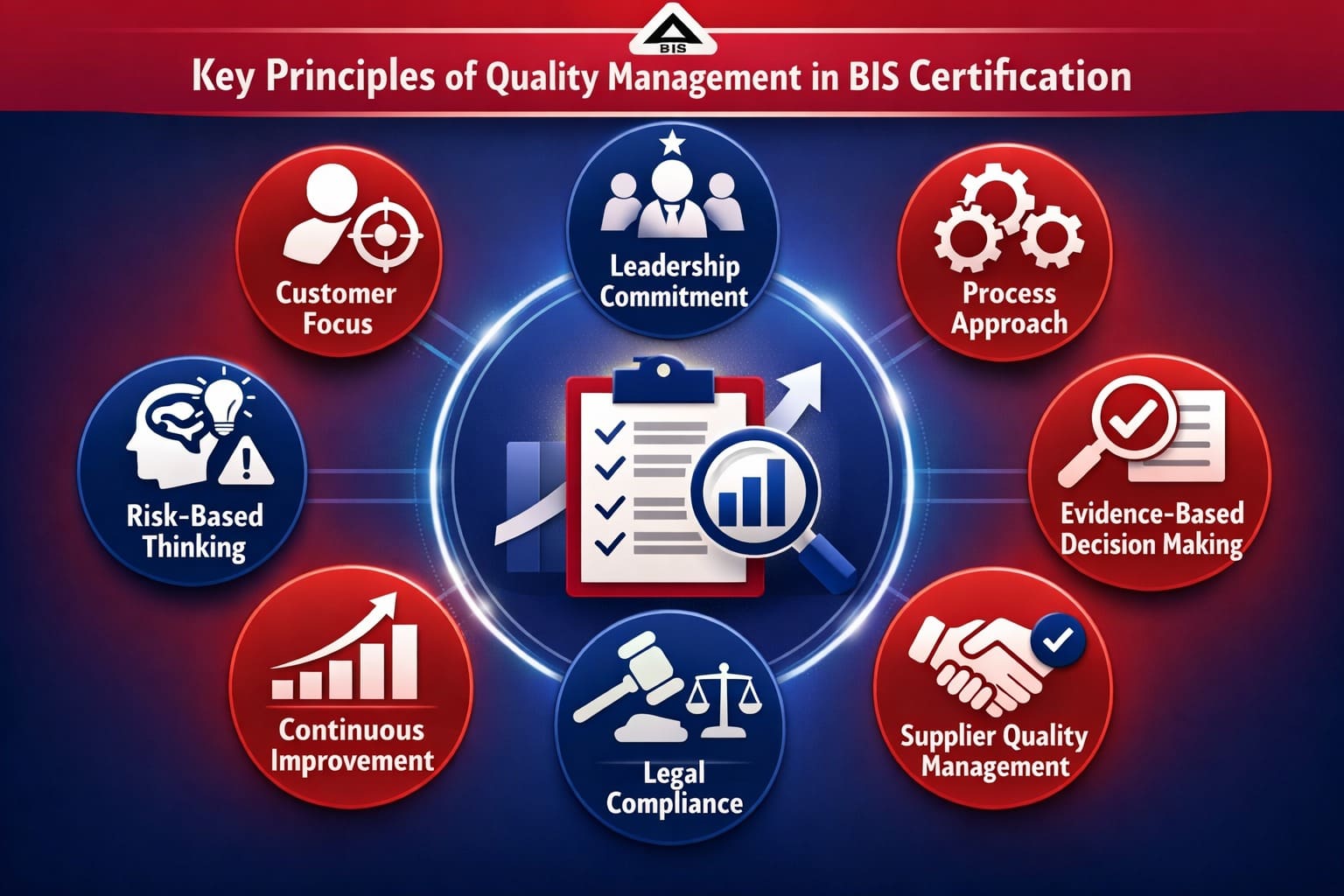
The following are the key principles of quality management in BIS certification:
- Customer Focus: The organisation must ensure that the product meets customers’ expectations, regulatory requirements, and safety standards.
- Leadership Commitment: Management should establish clear leadership goals defining roles, responsibilities, objectives, policies, and allocation of resources.
- Process Approach: The processes and activities of the organisation should be systematic and effectively managed. From procurement of raw material to final product testing, management should ensure compliance with applicable Indian Standards.
- Risk-Based Thinking: The organisation must identify potential risks that may affect the product quality and safety and take appropriate steps to mitigate them.
- Evidence-Based Decision Making: All the decisions of the organisation should be made based on the documents, accurate data, and management report.
- Continuous Improvement: The organisation must strive to maintain a quality system, address non-conformities, and frequently implement preventive actions for continuous improvement of the product.
- Legal Compliance: Ensuring adherence to applicable laws, regulations, and Indian Standards. It requires organisation to monitor and update regulatory changes, product performance, and labelling requirements.
- Supplier Quality Management: The organisation must evaluate the quality of the raw material and monitor suppliers to ensure consistent input quality.
What are the Key Requirements for BIS Certification?
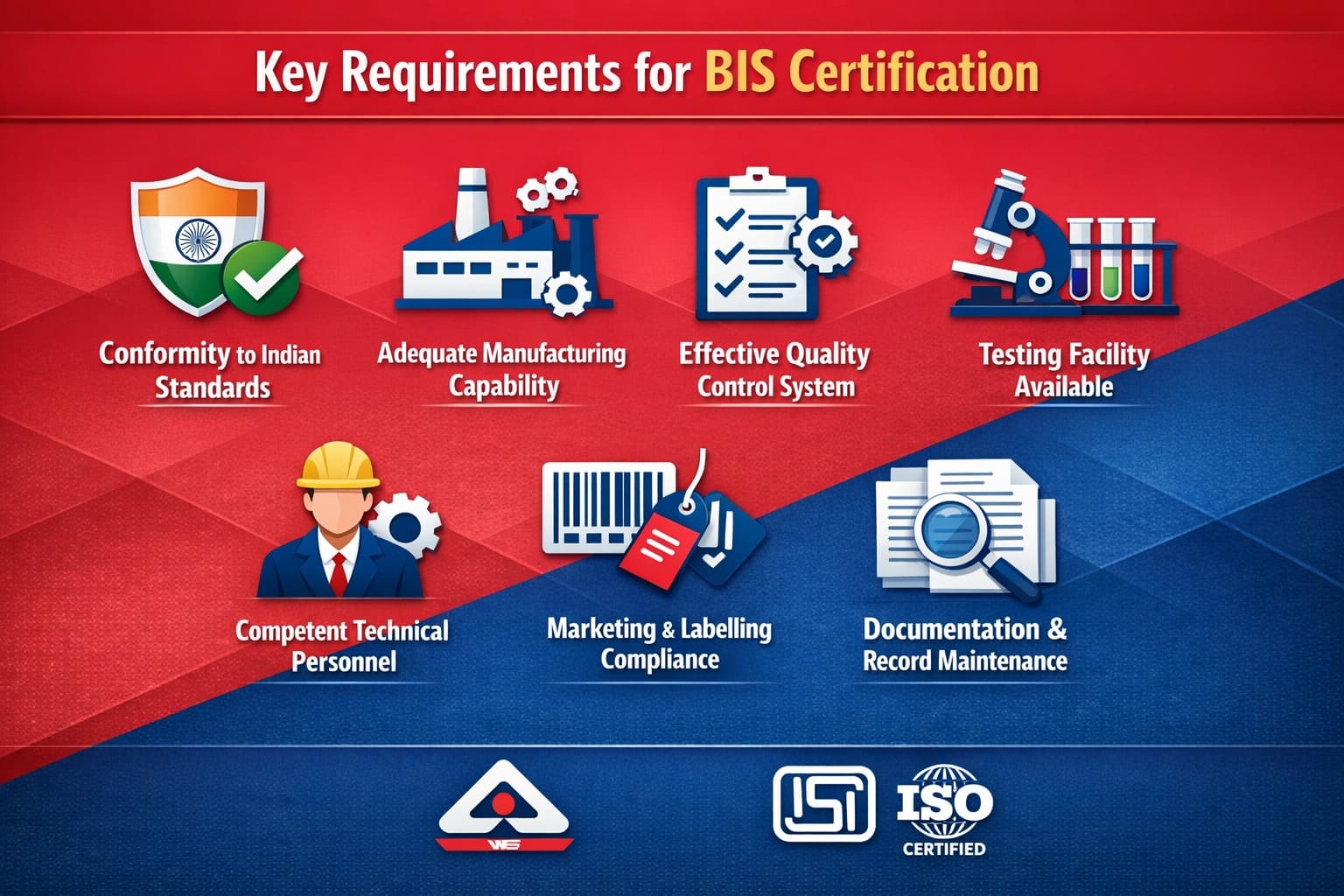
BIS certification is a mandatory requirement to ensure product safety, environmental safety and to prevent unfair trade practices. To obtain BIS certification, the organisations need to fulfil the following requirements:
1. Conformity to Applicable Indian Standards: The product must conform to the relevant Indian Standards. It includes qualifying the technical requirements, safety parameters, quality benchmark, and performance requirements. The organisation must ensure that the product qualifies for all the applicable testing and consistently meets these requirements.
2. Adequate Manufacturing Capability: The organisation or manufacturer applying for the BSI certification should have an adequate production infrastructure, including machinery and technical capabilities. The facility should be well organised, controlled, monitored, and capable of maintaining product quality and safety requirements.
3. Effective Quality Control System: To obtain BIS certification, an effective and well-developed quality control system is a must. The organisation should monitor and record the procedures for raw material inspection, supplier inspection, in-process checks, and final product testing.
4. Availability of Testing Facility: The organisation must have access to a testing facility to test and monitor the performance and quality of the product. It ensures accuracy, product safety, and good maintenance of the product. This requirement ensures that the products are verified and safe for consumption before sale.
5. Competent Technical Personnel: The organisation must employ qualified and well-trained staff to handle, supervise, and monitor the production processes. It’s a ley requirement that the personeel working in the production house should understand the relevant Indian Standards and possess necessary technical and managerial skills.
6. Product Marketing and Labelling Compliance: The product must comply with the BSI marking and labelling requirements. It includes correct use of the ISI mark, licence number, and other mandatory declarations. Proper labelling ensures traceability, authenticity, and boosts customers’ confidence.
7. Documentation and Record Maintenance: The organisation must prepare and maintain accurate documents of the production process, testing results, and inspection reports. Proper documentation ensures traceability of product and accountability in case of defects or regulatory reviews.
Documents Required for BIS Certification
The document requirements for BIS certification vary depending on the types of products and registration scheme. However, the following are the general documents required for obtaining BIS certification:
1. Name and address proof of office and factory
2. Documents showing the establishment of the manufacturing unit, such as an incorporation certificate, registration certificate, memorandum of Association, etc.
3. MSME/SSI certificate, if applicable
4. Details of outsourcing of manufacturing operation, if applicable
5. Third-party laboratory test report as per Indian Standards, if applicable
6. Manufacturing process flow covering all processes of manufacture (from raw material to finished product stage)
7. Manufacturing machinery list along with the machinery details
8. Layout plan of the factory premises and location plan of the factory
9. A detailed list of testing facilities and testing equipment list
10. Copies of valid calibration certificates of testing equipment
11. In-house or independent test report, if applicable
12. In case the application is signed by the authorised signatory, the authorisation letter from CEO in the authorised signatory's name
13. In case of a foreign manufacturer or overseas applicant, nomination details of Indian agent and nomination form
Why Choose BIS Certification?
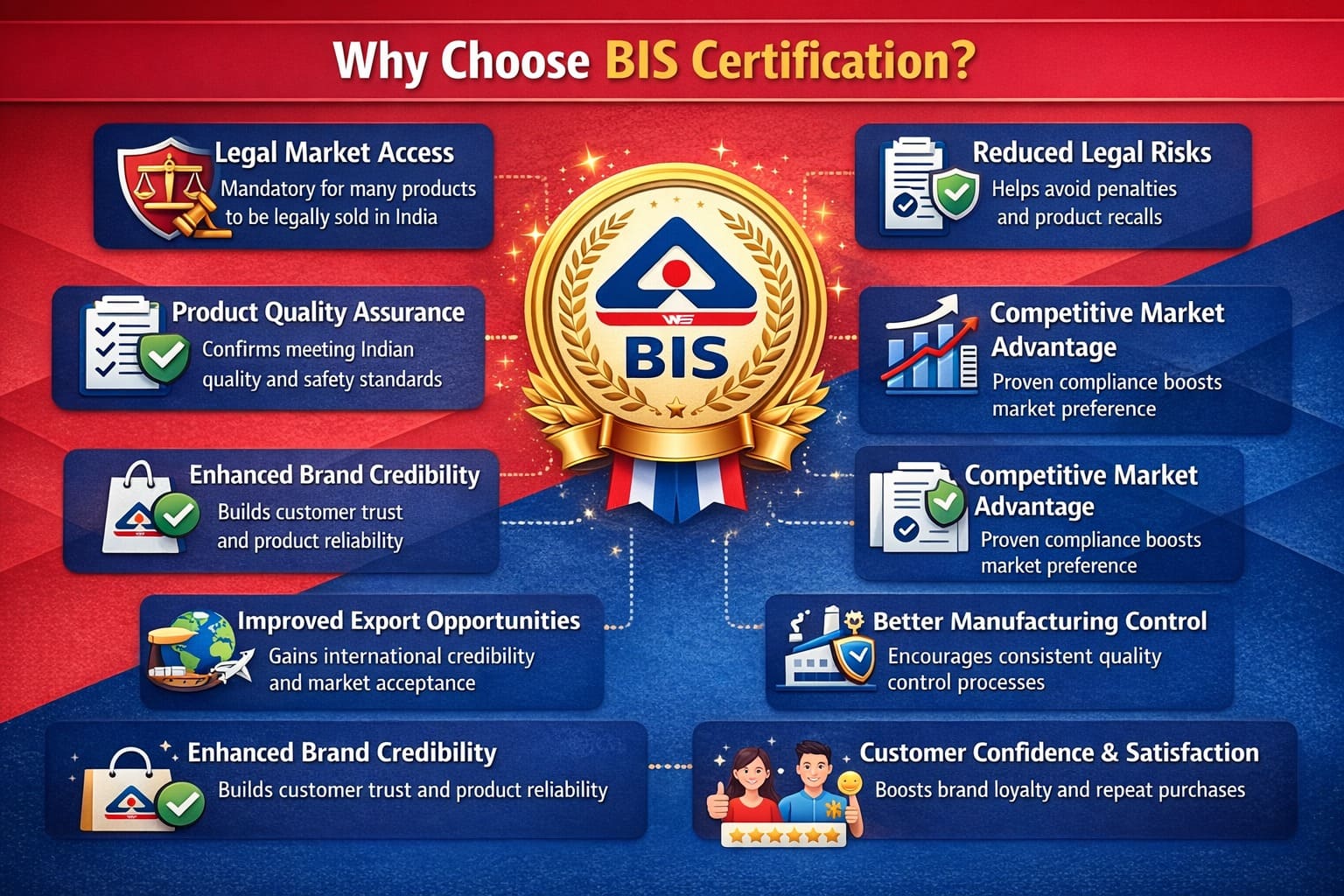
BIS certification is important for organisations, manufacturers, and production companies seeking to ensure product safety, reliability, and regulatory compliance. It demonstrates that the product conforms to the Indian Standard and helps in building customers' trust and brand credibility. Additionally, it reduces legal risks, helps businesses expand their reach, and improves market acceptance of the product.
Here are the key reasons why you should choose BIS certification:
- Legal Market Access: BIS certification is mandatory for many products to be legally sold in the Indian market.
- Product Quality Assurance: Certification confirms that products meet Indian quality and safety standards for consumer protection.
- Enhanced Brand Credibility: BIS mark builds customer trust by demonstrating product reliability and compliance with national standards.
- Consumer Safety Compliance: Certification ensures products are tested and verified for safe use by consumers.
- Competitive Market Advantage: BIS-certified products gain preference in markets due to proven compliance and quality assurance.
- Reduced Legal Risks: Compliance with BIS regulations helps businesses avoid penalties, product recalls, or legal issues.
- Improved Export Opportunities: Certified products gain credibility in international markets, recognising Indian quality standards.
- Better Manufacturing Control: Certification encourages consistent quality control and standardised production processes.
- Government Tender Eligibility: Many government procurement contracts require BIS certification for supplier eligibility.
- Customer Confidence and Satisfaction: BIS-certified products improve customer confidence, resulting in better brand loyalty and repeat purchases.
What is the Process for Obtaining BIS Certification?
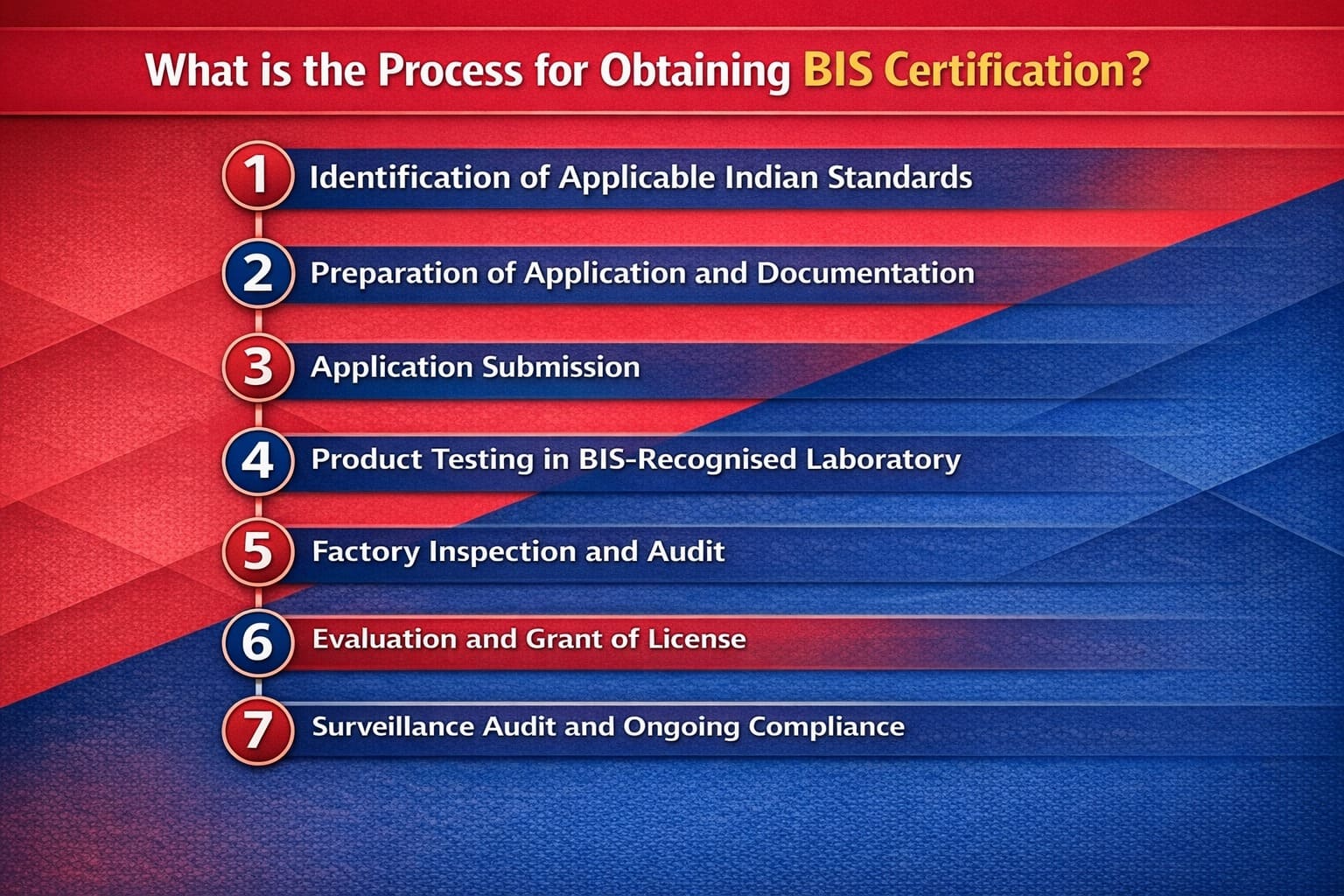
Here is the step-by-step process for obtaining BIS Certification:
1. Identification of Applicable Indian Standards
The first and foremost step in the BSI certification process is to identify the relevant Indian Standard Code applicable to the product. Each product category is governed by a specific quality, performance, and safety requirement. The organisation needs to carefully analyse the standard to understand technical requirements and develop a production plan accordingly.
2. Preparation of Application and Documentation
The organisation must prepare and submit an online application form through the BSI portal and submit all the relevant and required documentation. It includes registration proof, organisation details, product details, factory license, quality control measures, equipment lists, test reports, and manufacturing process details.
3. Application Submission
After compiling all the documents, the organisation needs to submit the application along with the applicable fees. The BSI goes through the application for its authentication and correctness. If any discrepancies are found, the BSI may request clarification or additional documentation.
4. Product Testing in BIS-Recognised Laboratory
After reviewing the application and all the documents, the sample of the products is tested in a BIS-recognised laboratory to ensure it conforms to the required quality and safety standards.
5. Factory Inspection and Audit
After verifying the product’s testing reports and on the satisfaction that the product conforms to all the applicable standards, the BIS conducts an on-site visit to verify production capability, audit reports, effectiveness of the testing facility, and record maintenance. The inspection ensures that the manufacturer can consistently produce reliable and quality products.
6. Evaluation and Grant of License
After successful evaluation, inspection, and product testing, the BIS evaluates all the reports and findings and grants the BIS certification. If any non-conformity is found during this stage, BIS asks the organisation to take corrective action for it before granting the certificate.
7. Surveillance Audit and Ongoing Compliance
After certification, BIS conducts surveillance or a periodic audit to ensure continued compliance. The manufacturer must maintain consistent product quality, and adherence to standards. Any failure to comply with the requirements can lead to cancellation or suspension of the license.
Why Choose Legal Babu?
Legal Babu is a trusted compliance and certification consultancy helping businesses obtain certifications smoothly and efficiently across India and international markets. With experienced professionals, end-to-end documentation support, and transparent processes, Legal Babu ensures quick certification while maintaining full regulatory compliance.
From application preparation to final approval, Legal Babu simplifies complex regulatory requirements so businesses can focus on growth. Their commitment to customer satisfaction, affordable pricing, and reliable post-certification support makes them a preferred partner for certification services.
FAQS
Have some questions about BIS certification?
We have got you covered:
-
Is BIS certification mandatory in India?
BIS certification becomes mandatory for products listed under government quality control orders to protect consumers across India.
- Do foreign manufacturers need BIS certification?
- How long is BIS certification valid?
- What documents are required for BIS certification?
- Is product testing mandatory for certification?
- How much does BIS certification cost?
- How can BIS certification be renewed?
- What happens if products lack mandatory BIS certification?
- Is BIS certification required for imported products?
- Can BIS-certified products be sold online?
- Does BIS conduct product surveillance?
- Can small manufacturers obtain BIS certification?
- How long does BIS certification approval take?
- What is the Compulsory Registration Scheme under BIS?
- Can BIS certification be suspended?
- How can businesses apply for BIS certification?
- Is factory inspection compulsory for BIS certification?
- Can certification be transferred to another manufacturer?
- Do startups need BIS certification before product launch?
- Are periodic product tests required after certification?


