
How to Obtain APEDA Registration?

Want to Start a food export business in India? If yes then you should know about APEDA registration. It is mandatory for businesses involved in exporting scheduled agricultural and processed food products from India. Also remember it is not only a legal mandate but a getaway to essential government support that helps exporters compete in International markets with big brands.
Without APEDA Registration-cum-Membership Certificate (RCMC), exporters cannot legally ship scheduled products overseas. Beyond compliance, APEDA registration provides access to valuable financial assistance and subsidy schemes, supports global brand promotion initiatives such as and enables participation in international trade fairs and exhibitions.
But to avail these benefits you have to complete the APEDA registration successfully and carefully as even a single mistake can lead to rejection. But worry not. We at Legal Babu will help you complete the process and make sure that you get the registration hassle free. Let’s understand the whole process and how we can help you.
Product Coverage under APEDA Registration
Before proceeding to the registration process it would be wise to know which food products are qualified for registration. As per the latest APEDA registration is required for exporters dealing in scheduled agricultural and processed food products, which includes:
|
S.No |
Category |
Sub-Category / Products |
|
1 |
Floriculture & Seeds |
01 Floriculture 02 Vegetables Seeds 03 Herbal & Medicinal Plants |
|
2 |
Fruits & Vegetables |
01 Fresh Onions 02 Other Fresh Vegetables 03 Walnut 04 Fresh Mangoes 05 Fresh Grapes 06 Other Fresh Fruits 07 Miscellaneous Preparations |
|
3 |
Processed Fruits & Vegetables |
01 Dried & Preserved Vegetables 02 Mango Pulp 03 Pickle & Chutney 04 Other Processed Fruits & Vegetables |
|
4 |
Animal Products |
01 Buffalo Meat 02 Sheep/Goat Meat 03 Poultry Products 04 Dairy Products 05 Animal Casings 06 Processed Meat 07 Honey 08 Meat of Other Animals |
|
5 |
Other Processed Foods |
01 Groundnuts 02 Guargum 03 Jaggery & Confectionery 04 Cocoa Products 05 Cereal Preparations 06 Alcoholic & Non-Alcoholic Beverages 07 Miscellaneous Preparations |
|
6 |
Cereals |
01 Non-Basmati Rice 02 Basmati Rice 03 Wheat 04 Other Coarse Grains |
Who are Eligible for APEDA Registration
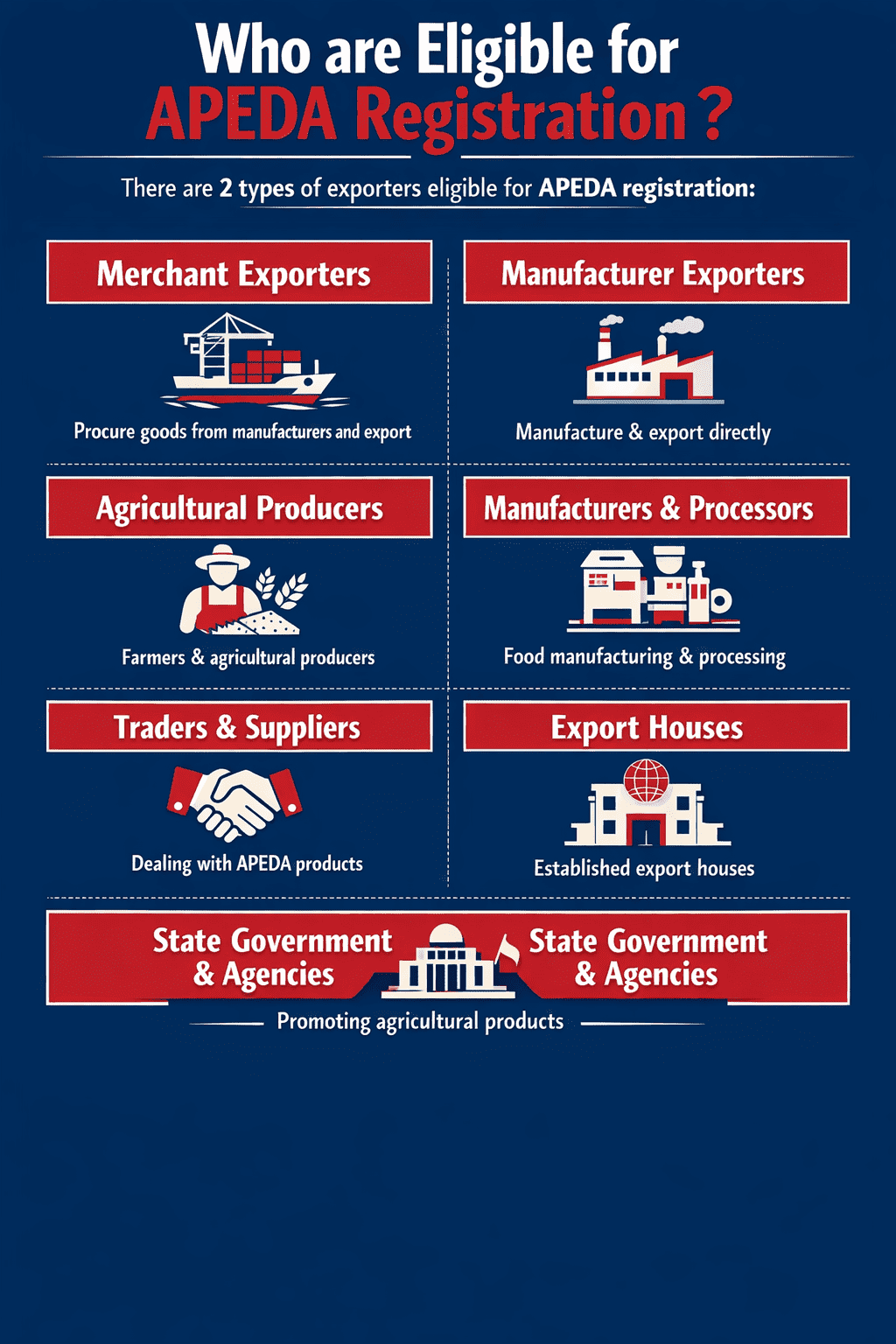
There are 2 types of exporters i.e merchant and manufacturers who are eligible to get an APEDA registration. These can be classified into these categories:
-
Agricultural Producers - Farmers and agricultural producers who want to export their produce.
-
Manufacturers and Processors - Entities who are involved in manufacturing and processing food products.
-
Traders and Suppliers - Traders and suppliers who are dealing with scheduled APEDA products for export purposes.
-
Export Houses - Established and recognized export houses who are focusing on export of agricultural and processed food products.
-
State Government and Agencies - State Governments and agencies who are working to promote agricultural products.
Benefits of APEDA Registration
The APEDA registration is mandatory to export agricultural produce but it also offer exporters with multifaceted benefits which includes:
-
Legal Export of APEDA-Scheduled Products - APEDA registration allows exporters to legally ship scheduled agricultural and processed food products from India. Without a valid Registration-cum-Membership Certificate (RCMC), shipments cannot clear customs, and businesses may face penalties or delays. Legal recognition ensures exporters operate in full compliance with Indian export regulations, providing a secure foundation for international trade.
-
Access to Financial Assistance and Subsidy Schemes - Registered exporters can access APEDA’s financial assistance and subsidy programs, which support growth and competitiveness. These benefits include funding for packaging improvements, quality testing, infrastructure development, branding, and participation in trade promotion activities. Such support reduces operational costs and helps businesses establish a strong presence in global markets.
-
Participation in International Trade Fairs and Exhibitions - APEDA registration enables exporters to participate in international trade fairs, exhibitions, and buyer–seller meets organized or supported by APEDA. These platforms allow exporters to meet global buyers directly, understand international demand trends, and explore new markets. Exposure at such events also helps businesses expand networks and strengthen international partnerships.
-
Guidance on Export Quality Standards - Exporters with APEDA registration receive guidance on quality standards and international compliance requirements. APEDA provides technical support on packaging, labelling, food safety, and quality control. This ensures products meet global norms, minimizing the risk of rejection in foreign markets and enhancing overall product reliability.
-
Improved Credibility with Overseas Buyers - APEDA registration enhances credibility with international buyers and importers. It signals that the exporter adheres to Indian regulatory, safety, and quality standards. This builds trust, facilitates long-term business relationships, and increases the likelihood of repeat orders and contracts in competitive international markets.
-
Benefits from Market Development and Promotion Initiatives - Registered exporters also gain access to APEDA’s market development and promotional initiatives. These include market intelligence reports, training programs, and support under various initiatives. Such initiatives help exporters position their products effectively, understand global trends, and compete successfully in international markets.
Complete APEDA Registration Process
Applying for an APEDA Registration (RCMC) may appear straightforward, but in practice, the process can be technically complex. The application is scrutinised closely by APEDA authorities, and even a single error in documentation, product selection, or declaration can lead to delays, queries, or outright rejection.
From choosing the correct exporter category to uploading accurate certificates and aligning details with DGFT records, each step requires careful attention. This is where professional expertise becomes important.
As APEDA registration consultants, our objective is to ensure that the application is complete, accurate, and compliant with the latest DGFT and APEDA guidelines. Here is the step by step process:
-
Document Preparation - We will ask you to provide us with all mandatory documents, including IEC, PAN, bank certificate, FSSAI licence, business registration proof, and address details. We will carefully review them as any mismatch between documents and DGFT records can trigger objections.
-
Application Filing - Once document verification is complete, we will file an application for APEDA registration. We will make sure that exporter type and product category is classified correctly, and business details are up to date to avoid rejection of application by DGFT.
-
Verification and Clarifications - Once submitted, the application is examined by APEDA officials. If any inconsistencies or missing details are identified, we will provide clarification or additional documentation as soon as possible because timely and accurate responses are essential to avoid rejection.
-
RCMC Issuance - After successful verification, the APEDA Registration-Cum-Membership Certificate (RCMC) will be issued digitally. We will download it from the portal and send it to you. No physical certificate is issued.
At Legal Babu, we are always available to guide you through the process to answer your every query regarding APEDA registration. Contact us now to know how we can help you.
Documents Required for APEDA Registration
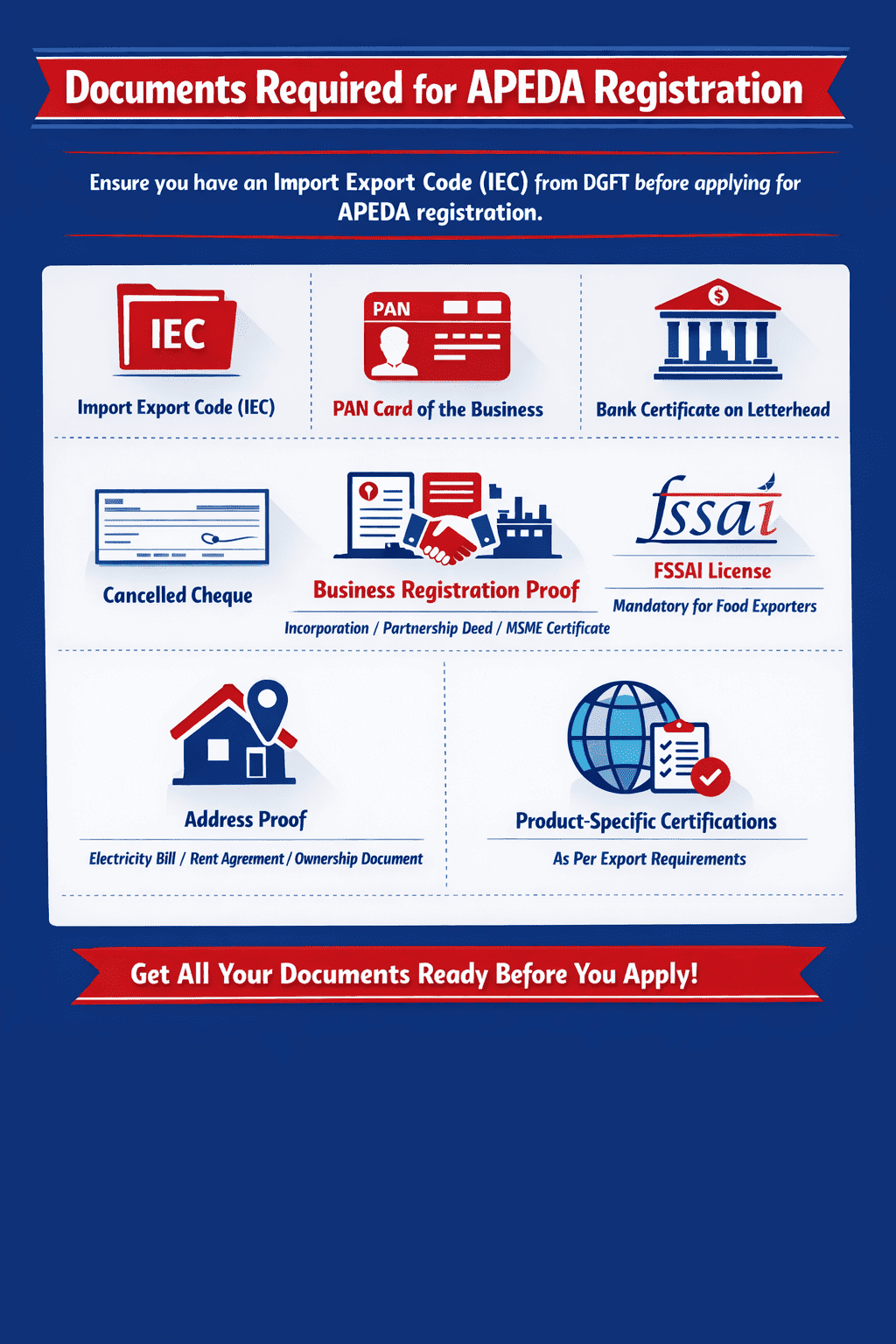
Before we proceed ahead, you should know that for APEDA registration you must have import Export Code registration which is issued by Directorate General of Foreign Trade (DGFT). Having an IEC is mandatory and if you don’t have one, we will help you get one.
To complete the registration process successfully, applicants must have possession of these documents in PDF, JPEG, or PNG format for registration:
-
Self-certified copy of Import Export Code (IEC)
-
PAN card of the business entity
-
Bank certificate on bank letterhead confirming account details
-
Cancelled cheque of the business bank account
-
Business registration proof, such as:
- Certificate of Incorporation
- Partnership Deed
- MSME (Udyam) Certificate
-
FSSAI license (mandatory for food exporters and processors)
-
Address proof of business premise like electricity bill, rent agreement, or ownership documents
Additional product-specific certifications may be required depending on the nature of exports.
Government Fee For APEDA Registration
For APEDA registration you have to pay a fee of INR 5,000 and additional GST of 18% to the government which is around INR 900. In total APEDA registration will cost you INR 5900.
Validity of APEDA Registration
Once you get the registration, it is valid for 5 years from the date of registration. After this period, renewal fee will be charged. Also exports must notify the APEDA about any changes in-
-
Business address
-
Directors or partners
-
Business constitution
-
Product category
Also registration can be cancelled if any Director/Partner/Proprietor resorts to any unlawful practise or the activity of the firm comes to the adverse notice of APEDA or concerned Govt. Authorities including, Ministry of Commerce & Industry, DGFT, Ministry of Finance , Central Board of Excise & Customs etc regularly overview the activities of registration holders.
Post- APEDA Registration Compliance
After obtaining APEDA registration, exporters are required to:
-
Comply with product-specific export standards
-
Submit periodic returns, where applicable
-
Inform APEDA of any changes in business profile
-
Follow APEDA and DGFT export regulations
Non-compliance may lead to suspension or cancellation of registration.
FAQS
Frequently Asked Questions on APEDA Registration
-
1. What is APEDA registration and why is it required?
APEDA registration, also known as Registration-Cum-Membership Certificate (RCMC), is mandatory for exporters dealing in scheduled agricultural and processed food products. It allows businesses to legally export these products from India and ensures compliance with export regulations under the APEDA Act, 1985.
- 2. Is there any fee for APEDA Registration?
- 3. Is APEDA registration mandatory for all exporters in India?
- 4. What is the validity period of APEDA registration?
- 5. Is Import Export Code (IEC) compulsory for APEDA registration?
- 6. How long does it take to obtain APEDA registration?
- 7. What documents are required for APEDA registration?
- 8. Can APEDA registration be rejected?
- 9. Is FSSAI licence mandatory for APEDA registration?
- 10. What are the benefits of APEDA registration?
- 11. Can APEDA registration be cancelled after approval?


