
FSSC 22000 Certificate for Food Businesses: A Complete Guide
- by admin
- Updated Jan 16, 2026
- 8 mins read
What is the FSSC 22000 Certificate?
Food Safety System Certification 22000, or FSSC 22000 Certificate, is a globally recognised certification scheme that ensures food safety and combines ISO 22000 (Food Safety Management System) with sector-specific prerequisite programmes (PRPs). It is a comprehensive framework that manages food safety and eliminates potential risks. It is benchmarked by the Global Food Safety Initiative (GFSI) and mandates food retailers and manufacturers to meet robust food safety standards.
What are the key principles of quality management outlined in the FSSC 22000 certificate?
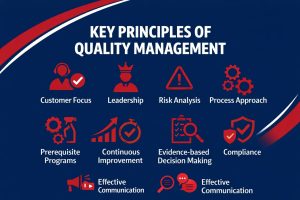
1. Customer Focus: Ensuring customer satisfaction and providing high-quality products that meet customers’ expectations.
2. Leadership: Establishing high commitment goals towards food safety and quality and defining roles, responsibilities, and accountability.
3. Risk Analysis: Identification of food safety risks and adoption of effective measures to minimise them.
4. Process Approach: Managing interconnected processes effectively to ensure control over inputs, outputs, and daily operations.
5. Prerequisite Programs: Implementing hygiene and operational controls like cleaning, pest control, equipment management, and supplier management.
6. Continuous Improvement: Looking for continuous improvement of the organisation through management reviews, performance monitoring, and internal audits.
7. Evidence-based Decision Making: Monitoring records and documents to make an informed decision.
8. Compliance: Adhering to national food safety laws and standards to ensure legal and regulatory compliance.
9. Effective Communication: Establishing clear and transparent communication to ensure updates, information, and complaints are effectively handled.
By following these principles, organisations can ensure a flawless and effective Food Safety Management System and mitigate risks before they become a major problem. Adhering to these principles also ensures customer satisfaction and boosts the brand’s identity globally.
What are the key requirements for obtaining the FSSC 22000 Certificate?
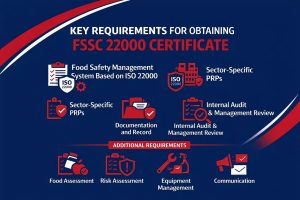
Here is an overview of the key requirement for obtaining the FSSC 22000 certificate:
Food Safety Management System Based on ISO 22000: The organisation must implement a well-structured and clearly defined food safety management system that includes management’s objectives, roles, responsibilities, risk analysis and management, HACCP principles, corrective actions, and documentation.
Sector-Specific Prerequisite Program (PRPs): The organisation must implement PRPs tailored to its specific operations, including pest control, cleaning and sanitisation, personal hygiene, equipment maintenance, and allergen control.
Documentation and Records: The organisation must maintain essential documents such as a food safety policy, HACCP plans, operational records, internal audit reports, and management review outputs.
Internal Audit and Management Review: Before obtaining a certificate, the organisation should conduct an internal audit and management review to check the compliance , effectiveness, and performance of the organisation. This ensures your system is fully functioning and the organisation is ready for certification.
Additional Requirements
Food Assessment: Conducting an overall assessment of food quality, including raw materials, ingredients, supplies, and packaging.
Risk Assessment: Identifying vulnerabilities related to facility layout, storage, security, and contamination risks.
Equipment Management: Ensuring all equipment is clean, sanitised, and suitable for its intended purpose.
Communication: Maintaining effective communication with the certification body regarding changes, records, and incidents.
What are the benefits of the FSSC 22000 certificate?
A globally recognised FSSC 22000 certificate offers numerous advantages to the organisation. Some of them are:
1. Global Recognition: Enhances organisational reputation and credibility worldwide.
2. Improved Operational Efficiency: Helps reduce operational costs through structured processes and management.
3. Increased Market Access: Enables entry into international markets and global trade.
4. Build Customer’s Trust: Assures customers of food safety and quality.
5. Legal Compliance: Demonstrates compliance with FSSAI Act, FSS Rules, and Food Safety Standards.
6. Risk Reduction: Minimises contamination and food safety incidents.
7. Better Supply Management: Improves control and utilisation of raw materials.
8. Continuous Improvement: Encourages ongoing improvement through audits and monitoring.
9. Competitive Advantage: Differentiates certified organisations from non-certified competitors.
Why Choose the FSSC 22000 Certificate?
The FSSC 22000 certificate is a globally recognised benchmark demonstrating commitment to food safety, hygiene, and quality. It is widely accepted by international buyers, retailers, and regulatory authorities.
The certification enhances brand credibility, builds customer confidence, and integrates ISO 22000, PRPs, and food fraud prevention measures to ensure product safety and reliability. Choosing FSSC 22000 supports regulatory compliance, operational efficiency, and long-term business sustainability.
What are the stages involved in the FSSC 22000 certification process?
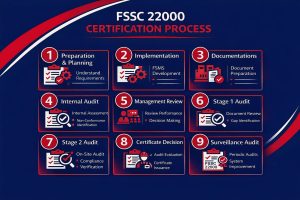
Here is a detailed step-by-step process involved in the FSSC 22000 certification process:
1. Preparation and Planning:
1.1 Understanding Requirements: Analyse the FSSC 22000 certificate requirements like HACCP requirements, PRPs, and other requirements.
1.2 Resource Planning: Make a detailed plan of the roles, responsibilities, infrastructure, and resources needed for the implementation.
2. Implementation:
2.1 FSMS Development: Develop a Food Safety Management System and outline the food safety policies, objectives, risk management plan, and control measures.
2.2 Implementation: Implement the plan across all departments of the organisation, ensuring procedures are strictly followed by the employees.
3. Documentation:
3.1 Document Preparation: Prepare all the necessary documents, such as the food safety manual, procedures, records, and SOPs.
3.2 Document Management: Update the documents regularly and include all the new policies and regulatory changes.
4. Internal Audit:
4.1 Internal Assessment: Conduct an internal audit to verify the authenticity of the documents and compliance with FSSC 22000 requirements.
4.2 Non-Conformance Identification: Identify the gaps and non-conformities in the process and take corrective actions.
5. Management Review:
5.1 Review Performance: Conduct a review meeting with a specialist to analyse FSMS performance, audit results, and overall management of the organisation.
5.2 Decision Making: Take corrective measures and effective decisions for overall improvement.
6. Stage 1 Audit (Document Review):
6.1 Evaluation: The certification body will deeply review and analyse the documented information and assess readiness for certification.
6.2 Gap Identification: Any gaps in the documentation are identified, and corrective measures are taken before the final audit.
7. Stage 2 Audit (Certification Audit):
7.1 On-Site Audit: The auditor visits the organisation for effectively analysing the implementation of the food safety management system.
7.2 Compliance Verification: The auditor ensures that the organisation complied with ISO 22000, PRPs, and FSSC mandatory requirements.
8. Certificate Decision:
8.1 Audit Evaluation: The certification body reviews and analyses the audit report to evaluate whether to grant the certificate or not.
8.2 Certificate Issuance: After successful evaluation, the FSSC 22000 certificate is issued to the organisation.
9. Surveillance Audit:
9.1 Periodic Audits: The regulatory body conducts annual audits to ensure continuous compliance.
9.2 System Improvement: The regulatory body monitors the continuous FSMS improvement.
Frequently Asked Questions
1. Is FSSC 22000 certification costly for small businesses?
No, the FSSC 22000 certification process is not costly for small businesses. It is quite reasonable and within the budget limit of small businesses.
2. How long does the FSSC 22000 certification process take?
The FSSC 22000 certification process usually takes 45–120 days depending on the planning, documentation, and internal audit process.
3. Does the FSSC 22000 process reduce operational costs?
Yes, the FSSC 22000 certification process helps organisations reduce operational costs through minimising wastage, effective resource allocation, improved hygiene, and cost management.
4. Who can apply for an FSSC 22000 certificate?
Any business operating in the food supply chain or food business, whether small, medium, or large, can apply for the FSSC 22000 certificate.
5. Is the FSSC 22000 certificate mandatory in India?
No, obtaining an FSSC 22000 certificate is not mandatory in India, but it is required by businesses engaged in export and import activities globally.
6. What is the validity of the FSSC 22000 certificate?
An FSSC 22000 certificate is valid for a period of three years, subject to successful surveillance audits.
7. Is HACCP mandatory for the FSSC 22000 certificate?
Yes, adherence to HACCP principles is mandatory for obtaining the FSSC 22000 certificate.
8. Does FSSC 22000 apply to food packaging companies?
Yes, FSSC 22000 applies to food packaging companies, including plastic, paper, metal, and glass packaging manufacturers.
9. What happens if non-conformities are found during the FSSC 22000 certification audit?
The non-conformities identified during the audit must be corrected within the specified timeframe, supported by appropriate corrective actions, before certification is granted.
10. How much does FSSC 22000 certification cost?
The cost varies based on company size, scope, location, and audit duration. It generally includes consultancy fees, audit charges, and certification body fees.
11. What is the difference between ISO 22000 and FSSC 22000?
ISO 22000 provides a basic food safety management system framework, while FSSC 22000 builds upon ISO 22000 by adding sector-specific prerequisite programmes and additional requirements, making it GFSI-recognised.
12. Is FSSC 22000 recognised by GFSI?
Yes, FSSC 22000 is fully recognised by the Global Food Safety Initiative (GFSI).
13. Who issues FSSC 22000 certificates?
FSSC 22000 certificates are issued by accredited certification bodies approved by FSSC and accredited by recognised accreditation bodies such as NABCB.
14. Is employee training mandatory for FSSC 22000?
Yes, regular training and competency assessment of employees is mandatory under FSSC 22000.
15. Can FSSC 22000 certification be suspended?
Yes, the certification can be suspended or withdrawn due to major non-conformities or failure to comply with surveillance audit requirements.
16. Can consultants help in obtaining FSSC 22000 certification?
Yes, experienced consultants like Legal Babu assist organisations with gap analysis, documentation, employee training, and audit support.
17. Is internal audit mandatory under FSSC 22000?
Yes, organisations must conduct periodic internal audits to verify the effectiveness and compliance of the food safety management system.
18. Does FSSC 22000 cover food defence and food fraud?
Yes, FSSC 22000 requires food defence plans and food fraud vulnerability assessments.
19. Can startups apply for FSSC 22000 certification?
Yes, startups can apply for FSSC 22000 certification once operations are functional and documented food safety systems are implemented.
20. Does FSSC 22000 certification cover outsourced processes?
Yes, outsourced processes that impact food safety must be controlled, documented, and monitored under the Food Safety Management System (FSMS).
You may also like
MTO Insurance Essentials: Cargo Liability Coverage for 2026
As global supply chains grow more complex, Multimodal Transport Operators (MT


